Friday Night Crash Shut Two Lanes of I-65 Northbound Near Cottage Hill in Mobile
A Friday-night crash closed two northbound I-65 lanes near Cottage Hill Road in Mobile, with police and fire crews on scene.
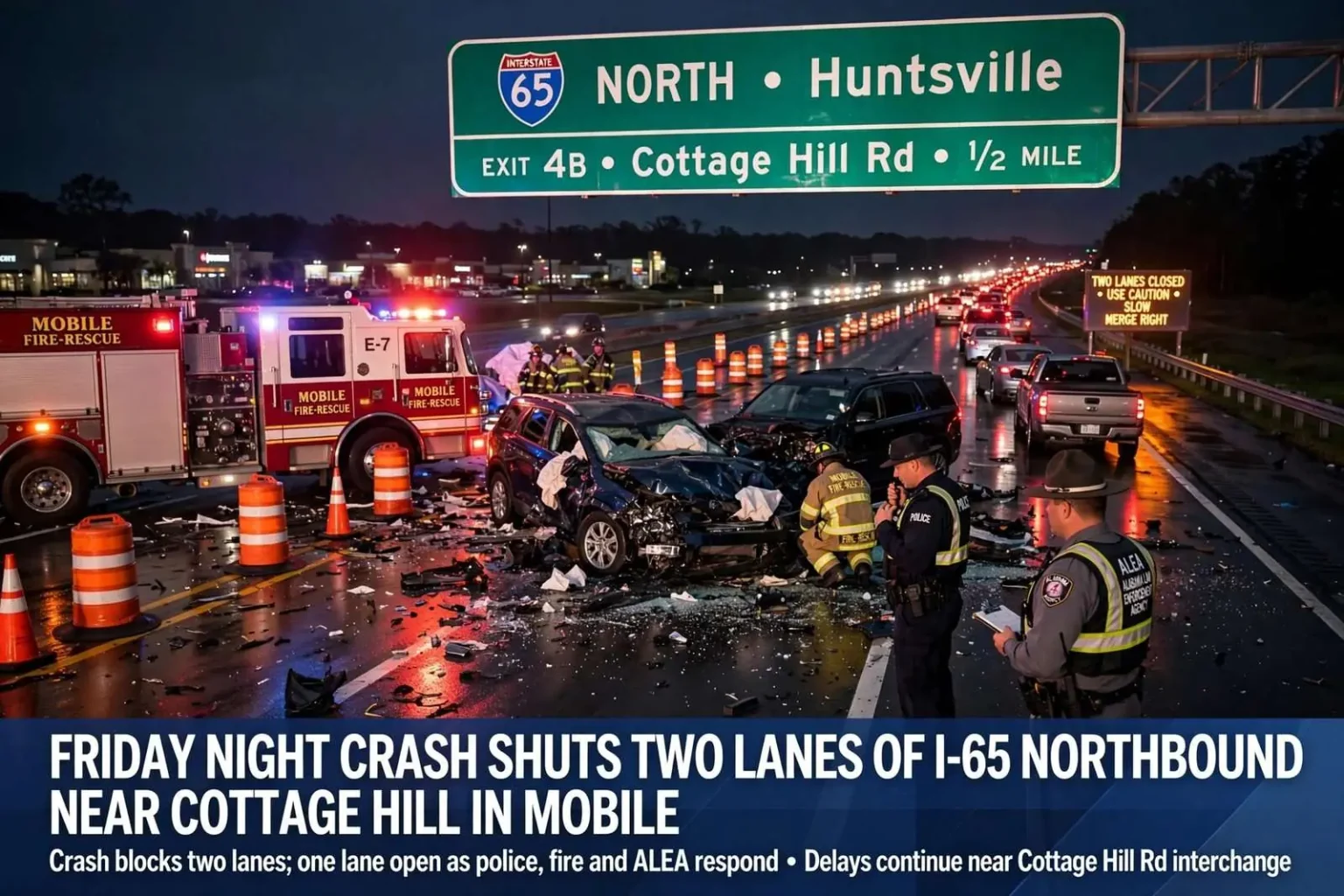
A crash on northbound Interstate 65 near Cottage Hill Road shut down two lanes and slowed Friday night traffic through west Mobile. Police and fire units were on the scene working the wreck, which blocked the middle of the roadway on one of Mobile’s busiest north-south routes. Drivers were squeezed past the scene in a single lane while crews cleared the vehicles.
The Cottage Hill Road interchange carries heavy evening traffic between west Mobile neighborhoods and the interstate, so lane closures there produce immediate backups in both directions on surface streets as drivers reroute. The crash came at the end of a weekday evening commute, compounding delays. Authorities had not released information about injuries or how many vehicles were involved.
Officials said they would provide more details once investigators from the Alabama Law Enforcement Agency completed their initial review of the scene.
Friday night on Interstate 65 is among the most demanding stretches of highway time Mobile County sees each week. The north-south interstate carries commuters home from work, weekend travelers and freight traffic moving between Mobile’s port and the rest of the region, and by evening the pavement between the Airport Boulevard and Cottage Hill Road interchanges is often running at capacity. A wreck that blocks the middle of the roadway there doesn’t just slow the interstate — it pushes hundreds of vehicles onto parallel arterials like University Boulevard, Schillinger and Cottage Hill itself, where signals and turn lanes were never designed for diverted interstate volume.
Responders to a Friday night crash face a scene assembled from all of that. Police and fire units arriving on the interstate must protect a work zone in live traffic, often with cars passing just feet from the wreck, while paramedics reach victims and investigators begin their work. Positioning fire apparatus and patrol vehicles to shield the scene is standard practice, and the sight of two lanes closed with traffic funneled past in a single lane is what that protection looks like from a driver’s seat.
Why the Cottage Hill interchange matters so much
The Cottage Hill Road interchange serves some of the most heavily populated residential areas in west Mobile. Neighborhoods stretching west from the interstate toward Schillinger Road use Cottage Hill as their primary east-west spine, and the interchange is where thousands of those daily trips connect to I-65 for commutes downtown, to the airport area, or north toward Huntsville. When a crash blocks lanes at that interchange, the effect is immediate and geometric: on-ramps back up, off-ramps spill onto surface streets, and drivers who abandon the interstate find the same congestion waiting for them at the next traffic light.
The timing of Friday’s crash made the disruption worse. A weekday evening wreck catches the transition between the end of rush hour and the start of weekend travel, when the road is already near capacity and there is no spare room to absorb blocked lanes. Every minute a lane stays closed on a full highway is a minute the queue grows by hundreds of feet, which is why responders move quickly to open at least one passable lane whenever the wreckage allows it.
Mobile’s stretch of I-65 is one of the busiest corridors in Alabama, carrying not just local traffic but the regional flow between I-10 and the cities to the north. The highway passes hospitals, schools, shopping centers and some of the county’s largest employment zones, and its interchanges define the geography of daily life for west Mobile residents. That is why even a two-lane closure on a Friday night registers far beyond the drivers stuck in it — it reshapes where the evening’s traffic goes.
Who investigates a crash on the interstate
Crash investigations on Alabama’s interchanges and interstates typically fall to the Alabama Law Enforcement Agency, whose highway patrol troopers handle wreck investigation and reconstruction on state and federal routes. Local police and fire departments handle the initial response — scene safety, medical care and traffic control — while ALEA investigators document the scene, interview drivers and witnesses, and determine what charges, if any, may apply. Until that initial review is complete, agencies generally release little information about injuries, vehicle counts or fault.
That division of labor can frustrate the public, which wants answers quickly, but it reflects how crash investigations actually work. Scenes are evidence: skid marks, final resting positions, roadway debris and vehicle damage all tell the story of what happened, and that story has legal consequences for the people involved. Investigators photograph and measure before lanes can be reopened, and complex scenes — multi-vehicle wrecks, serious injuries, fatalities — keep lanes closed longer than fender-benders do. The two-lane closure near Cottage Hill suggests a scene substantial enough to demand that full documentation.
Fire department involvement at a crash scene signals more than traffic control. Mobile County fire units respond to interstate wrecks to handle extrication, fire suppression and medical care, and their apparatus is the physical barrier that protects responders from passing traffic. If occupants had to be freed from damaged vehicles, hydraulic rescue tools and multiple crews would have been required, extending the scene’s footprint and the time needed to clear it.
The wider cost of interstate crashes
Secondary crashes are the hidden danger of any interstate backup. Drivers approaching a suddenly slowed queue — sometimes at highway speed, sometimes at night, sometimes distracted — run into the back of the line, and the crashes that result often occur upstream of the original wreck. That risk is why responders place warning signs, flare patterns and matrix boards well before the scene, and why Alabama’s move-over law requires drivers to shift lanes or slow down when passing emergency vehicles on the shoulder. Every additional vehicle that plows into the backup prolongs the closure and multiplies the danger to everyone standing on the pavement.
The economic cost of a Friday night lane closure adds up quietly. Freight moving through Mobile’s port corridor, service vehicles finishing their routes, and families heading to weekend destinations all lose time, and the businesses near the Cottage Hill interchange see the effect in customers who reroute around the area. Transportation planners have long treated interstate reliability as an economic asset for the region, and nights like this one show how quickly it can be withdrawn.
For drivers who came through the scene Friday night, the experience was the familiar crawl past a wreck — single lane, emergency lights, the slow squeeze where a highway becomes a parking lot. For the responders, it was a scene to be worked methodically: protect the area, care for anyone hurt, document the evidence, clear the vehicles, and turn the road back over to the traffic waiting behind the cones.
By the time the night was over, the details that matter most — whether anyone was seriously injured, how many vehicles were involved, and what caused the crash — remained with the investigators, as they do in most serious interstate wrecks. Authorities said more information would be released once ALEA’s initial review was complete. Until then, the incident stands as one more entry in the long record of Friday night surprises on a highway that Mobile depends on: two lanes shut near Cottage Hill, one lane of space between the wrecker and the warning triangles, and a region rerouting around it.
Motorists traveling the corridor in similar conditions are reminded of the basics that this crash scene illustrated in real time: check conditions before driving during peak hours, leave following room that accounts for sudden stops, and when approaching emergency scenes on the interstate, move over or slow down — the space created by the two closed lanes was, in the end, the workspace that allowed police and fire crews to do their jobs safely.
Until that initial review is complete, agencies generally release little about injuries, vehicle counts or fault — the situation officials described Friday night as they pointed to the pending ALEA review. The agency’s troopers work crashes across southwest Alabama, and Mobile’s interstates generate a steady share of that workload, from minor fender-benders to serious multi-vehicle wrecks that close the highway for hours.
The first hours after a crash are when the investigative work is done. Troopers walk the scene, photograph the vehicles in their final positions, measure marks on the pavement and begin interviews while memories are fresh. Evidence that seems obvious at the scene — which lane a car was in, whether brakes were applied, the direction debris scattered — becomes far harder to reconstruct later, which is why investigators hold lanes closed until the documentation is finished, even as the backup grows behind the cones.
Once the initial review is complete, the picture usually becomes clearer for the public: how many vehicles were involved, whether anyone was hospitalized, and whether citations or charges followed. In the meantime, officials said, the details would wait for the investigators rather than be filled in by speculation.