
Frontier Airlines launches new service from Mobile’s Downtown Airport at Brookley Field
Frontier Airlines will begin nonstop service from Mobile's Downtown Airport at Brookley Field to Chicago and Denver starting May 1.
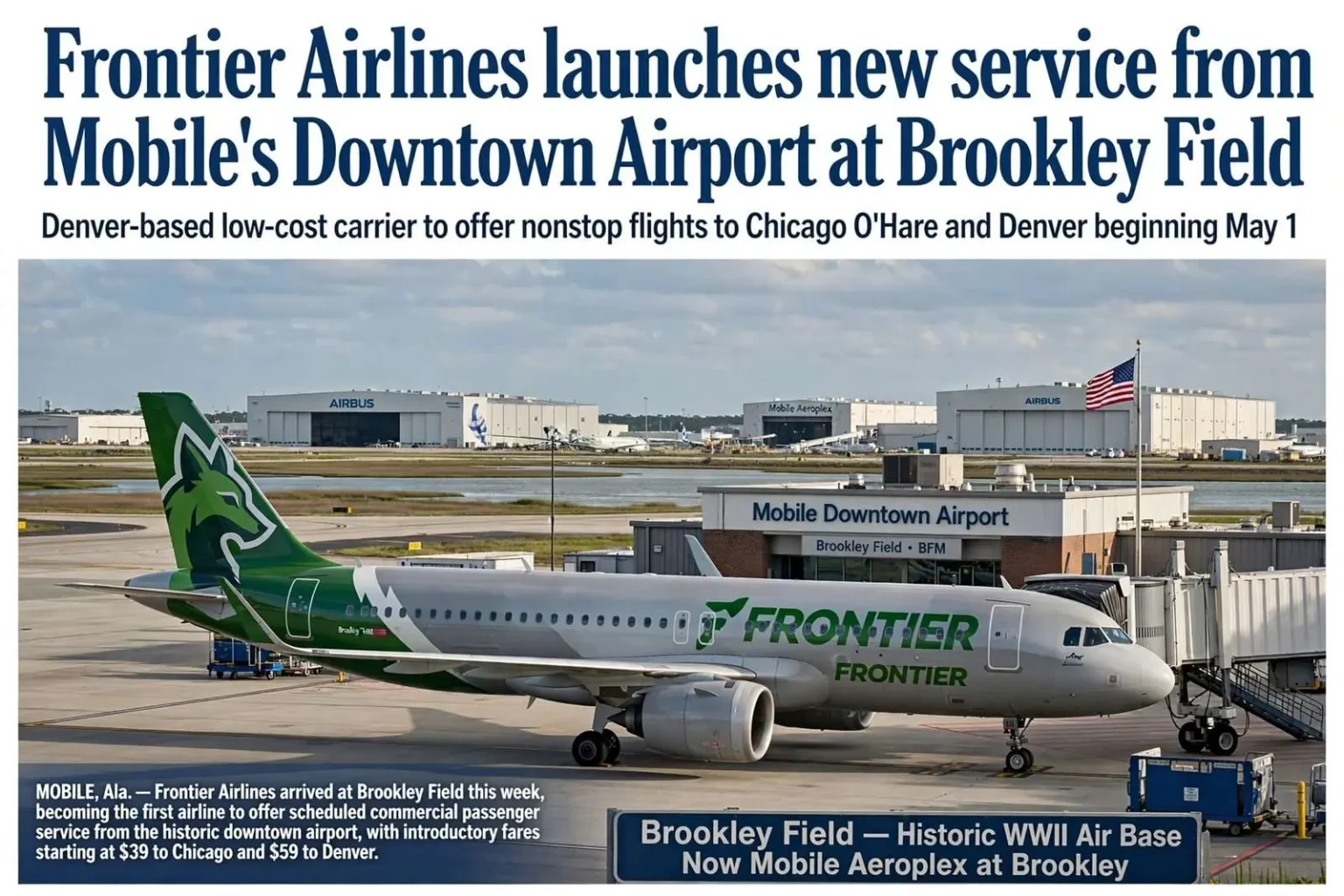
MOBILE, Ala. — Frontier Airlines is coming to Mobile, and to the Downtown Airport at Brookley Field rather than the Mobile Regional Airport. The Denver-based low-cost carrier will offer nonstop service to Chicago’s O’Hare Airport and to Denver beginning May 1.
Frontier becomes the first airline to offer service from Brookley Field, marking the first time scheduled commercial passenger flights will operate from the airport that sits on the site of a storied World War II air base. Via Airlines has discussed providing service at Brookley but currently operates out of the Mobile Regional Airport, where United, Delta and American also fly.
The announcement gives Mobile a two-airport passenger map, a setup few cities its size can claim. Travelers in the metro area will be able to choose between the established service at Mobile Regional, out west near Tillman’s Corner, and the new low-cost routes landing just across the causeway from downtown — a five-minute drive from the central business district.
A Milestone for Brookley Field
Brookley Field carries one of the richer aviation histories on the Gulf Coast. The installation served as a major Army Air Corps depot during World War II, employing tens of thousands of workers at its wartime peak before the military closed the base in the 1960s. The city converted the property into the Mobile Aeroplex at Brookley, an industrial aviation complex that has since grown into one of the region’s most important economic assets.
The Aeroplex’s profile rose dramatically when Airbus selected the site for its first U.S. final assembly line, which now builds A320-family aircraft on the same field where Frontier’s passengers will board. Commercial airline service adds a passenger dimension to a property previously defined by manufacturing, maintenance and cargo — a combination local officials have chased for years as part of a broader vision for the waterfront airport.
Frontier’s decision also reflects the airport’s geography. The Downtown Airport sits closer to Mobile’s population core than Mobile Regional does, putting it within easy reach of downtown hotels, the convention center and the eastern shore communities of Baldwin County via the nearby tunnels and bridges. For low-cost carriers, whose fares only work when operating costs stay lean, a compact terminal and short taxi times are part of the appeal.
The Route Schedule
Flights to and from Denver will operate Mondays, Wednesdays and Saturdays. Flights to and from Chicago will operate Wednesdays and Saturdays.
Flights from Mobile to Denver leave Brookley at 7:10 p.m. and arrive at 9:15 p.m. Flights from Mobile to Chicago leave at 1:45 p.m. and arrive at 4:19 p.m.
Both destinations anchor Frontier’s route network. Denver serves as the carrier’s home base and a major connecting hub, giving Mobile travelers one-stop access through the Mountain West and beyond, while Chicago O’Hare ranks among the busiest airports in the world and opens connections across the upper Midwest and the Northeast.
The schedule structure is built for weekend travelers and long weekends alike. The Wednesday-and-Saturday Chicago pair covers both midweek getaways and traditional weekend trips, while the Denver schedule’s Monday-Wednesday-Saturday pattern gives business travelers a midweek rotation and leisure flyers the Saturday option. Evening departures to Denver let Mobile passengers work a full day before flying; the afternoon Chicago departures put travelers in the Windy City by early evening.
What It Means for Local Travelers
Mobile Airport Authority President Chris Curry hopes it is only the beginning. “I think the expectation is that we start with those two cities, we develop more frequency to those two cities, and then work with Frontier to develop more destinations out of the Mobile Downtown Airport,” Curry said.
That growth path follows a pattern familiar from other mid-sized markets. Low-cost carriers typically enter a city with two or three routes, measure load factors for a season, and add frequency or destinations where demand proves out. Orlando, Las Vegas and the carrier’s Denver hub are frequent second-phase additions in markets of Mobile’s size, and airport leaders here have made clear they intend to make that case.
For consumers, the arrival of an ultra-low-cost carrier changes the price conversation entirely. Frontier’s introductory fares — $39 one way to Chicago and $59 one way to Denver — undercut the legacy carriers at Mobile Regional by a wide margin, and low-cost competition has historically pressured incumbents to respond with fare sales of their own even on routes the newcomer does not fly.
Travelers new to the low-cost model should read the fare rules carefully. Frontier’s base fares cover the seat, with fees for checked bags, carry-ons, seat selection and other extras — a structure that rewards packing light and comparing total costs. Even with add-ons, the introductory fares represent a steep discount over full-service alternatives for the same nonstop routes.
Frontier is offering limited introductory fares of $39 one way to Chicago and $59 one way to Denver. More information is available at FlyFrontier.com.
The Larger Airport Story
The announcement caps years of discussion about Mobile’s air service future. The Mobile Airport Authority has studied ways to grow passenger traffic for both of its airports, and bringing commercial service back to Brookley — where officials have long pointed out the infrastructure, the highway access and the proximity to downtown — gives the authority two distinct products to market: full-service flying at Mobile Regional and low-cost nonstops at the Downtown Airport.
Via Airlines’ earlier discussions about Brookley showed there was local appetite for a second passenger option, and Frontier’s commitment finally delivers it. Via continues to operate from Mobile Regional, joining United, Delta and American, which connect Mobile to their hub networks in Atlanta, Dallas, Houston and Charlotte.
The contrast between the two airports will be visible to travelers immediately. Mobile Regional offers the jet bridges, rental car center and amenities of a classic regional airport; Brookley offers a compact, streamlined terminal experience a short drive from downtown — the kind of quick in-and-out access that frequent flyers on low-cost routes tend to prize.
How the market splits between the two will be one of the region’s aviation storylines of the year. Some travelers will stay loyal to the legacy carriers and their hub connections out west; others will trade frills for fares and make the drive to Brookley. If history in comparable markets is a guide, the low-cost option will grow the overall market — pulling in flyers who previously drove to Pensacola or New Orleans for cheaper nonstops — rather than merely dividing the existing one.
Economic Ripples Beyond the Terminal
New air service is one of the metrics economic developers watch most closely, and the timing could hardly be better for Mobile. The Airbus assembly line has drawn a growing cluster of aviation suppliers to the Aeroplex, and passenger service on the same field adds a quality-of-life amenity that recruiters can pitch to executives, engineers and skilled workers considering a move to the area.
Nonstop routes to Denver and Chicago also tie Mobile directly to two economies with Gulf Coast connections. Chicago is a leading source of convention visitors and second-home buyers along the Alabama and Florida beaches, while Denver anchors a growing energy and aerospace corridor — industries with hiring needs that intersect with Mobile’s own shipbuilding and aviation base.
The airport authority’s long-term bet is that passenger service strengthens the case for further investment at Brookley, from terminal improvements to additional airline recruitment. Every load factor report Frontier files becomes evidence in that pitch, which is why local leaders consistently urge residents to use the new service early and often.
Getting Ready for May 1
The May 1 start date gives travelers time to plan. Introductory fares are typically offered on a limited number of seats and dates, so early bookings secure the best prices; the $39 Chicago and $59 Denver fares will appear on FlyFrontier.com as the schedule opens for sale.
Practical details favor the new airport. Brookley’s location means shorter drives for much of the metro population, simpler parking and faster security lines in the early months of operation — advantages that shrink as the routes mature. Travelers driving from Baldwin County will find the approach across the causeway among the easiest airport trips on the Gulf Coast.
For a city that watched its passenger service concentrate at a single westside airport for decades, the return of commercial flights to Brookley Field restores a piece of the site’s aviation identity — a place built by wartime air crews, remade by industry, and now sending paying passengers to Chicago and Denver on the first commercial wings it has ever hosted.
Schedules, fares and booking information are available at FlyFrontier.com, with service to both cities beginning May 1 from the Mobile Downtown Airport at Brookley Field.


