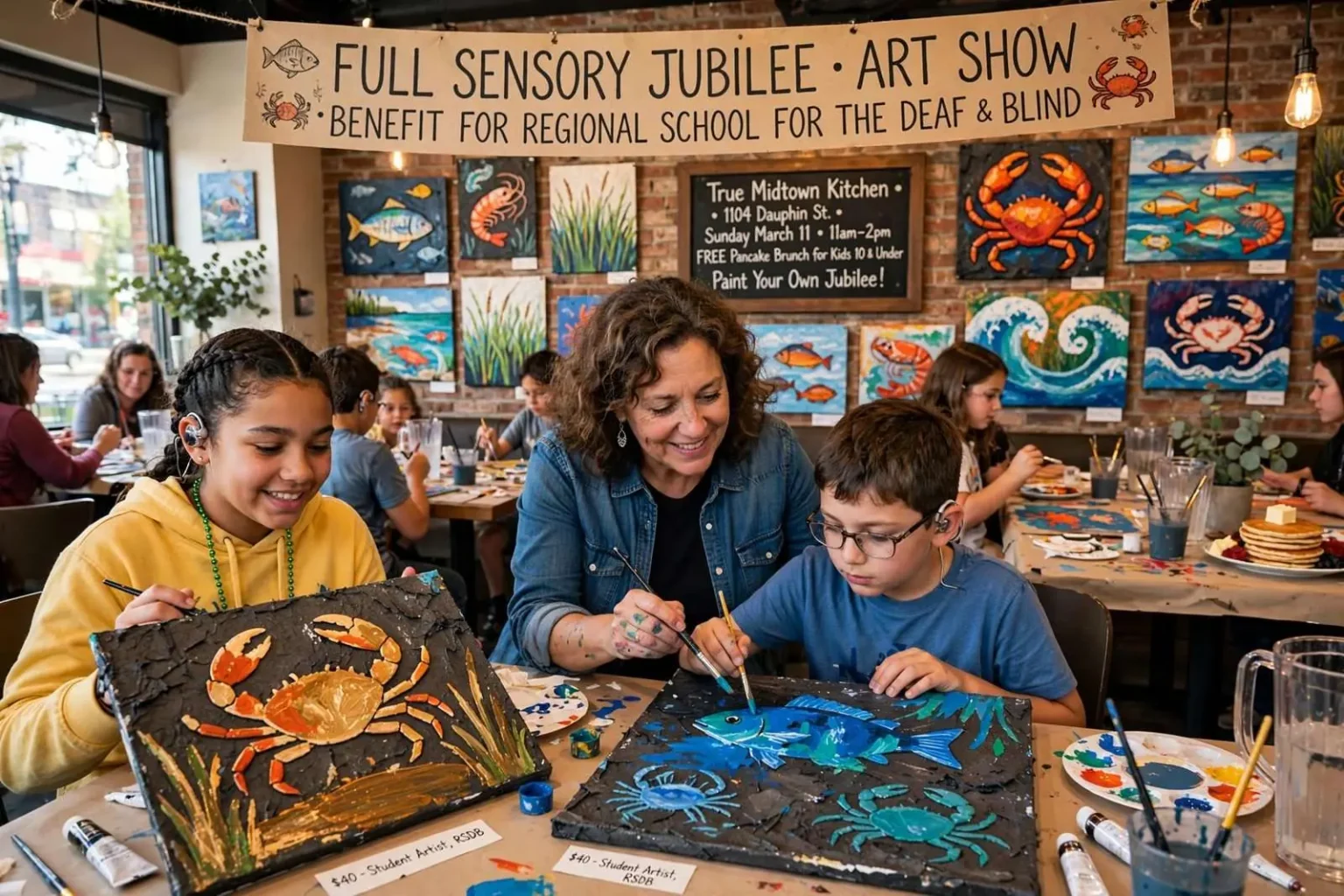
Students at the Regional School for the Deaf and Blind in Mobile have spent weeks turning tarpaper into colorful scenes of local sea life, and their work goes on display this Sunday at True Midtown Kitchen. The “Full Sensory Jubilee” art show is hanging at the restaurant, 1104 Dauphin St., with a special public viewing Sunday, March 11, from 11 a.m. to 2 p.m. The event turns a neighborhood restaurant into a gallery for a Sunday brunch window, giving Midtown diners and families a chance to see student artwork up close and, if they choose, take a piece home for a cause.
Artist Nancy Raia of the Eastern Shore Art Center will join sensory-impaired students on site to paint additional tarpaper “jubilees,” and guests, especially young children, will get the chance to create their own masterpieces. Raia’s presence turns the viewing into something closer to a working studio than a quiet gallery hang, with new pieces taking shape in front of the crowd. Visitors can watch the students work, ask questions, and then try the medium themselves, painting their own scenes on the same textured roofing paper the students have used.
A free pancake brunch will be offered to children 10 and under, a family-friendly touch aimed at drawing young visitors into the room. Children who may never have met a classmate who is blind or deaf will get to stand beside these young artists, watch them paint, and make art of their own, an encounter organizers hope does quiet work in building understanding across what can otherwise be a wide divide between the school’s students and the broader community.
Why Tarpaper, and Why Jubilees
The tarpaper artworks depict local sea life, echoing the Gulf Coast “jubilee” phenomenon in which fish and crabs surge toward shore. A jubilee is one of Mobile Bay’s most famous natural events, a rare occurrence when dissolved oxygen in the bay water drops and thousands of sea creatures, flounder, crabs, shrimp, and more, swim and crawl toward the shoreline in search of oxygenated water. Locals who witness one talk about it for years, and the phenomenon has become part of the cultural identity of the bay’s communities.
The subject matter is a natural fit for the medium. Tarpaper’s rough, tar-coated surface holds thick paint in a way that ordinary canvas does not, giving colors a bold, saturated quality, and its texture provides strong tactile feedback. That matters for sensory-impaired artists: a student with limited vision can feel where the strokes have gone, and the high-contrast surface makes the finished images easier to perceive. What began as an accessible medium has produced work that stands on its own merits, vivid marine scenes of fish, crabs, and coastal marsh life rendered in the same colors as the bay itself.
The pieces are on display and available for purchase at the restaurant, and every tax-deductible purchase or donation goes to a good cause. Buying a painting or simply leaving a donation supports programs for the students who made them, and the tax-deductible structure means supporters can give with the usual benefits of contributing to a school-serving effort.
The Regional School for the Deaf and Blind has served Alabama’s sensory-impaired children for generations, operating as a state-supported school on Government Street in Mobile. Its students come from across the region, and its programs span the academic years from early childhood through high school, paired with the specialized instruction, communication services, and therapies that sensory-impaired students need. For many families, the school is the difference between a child who struggles in a general classroom and a child who learns, socializes, and builds independence in an environment designed around their needs.
The Multi-Sensory Room and the Matching Fund Challenge
The Regional School was awarded a $15,230 grant for a new multi-sensory room, with the catch that the school must raise matching funds. Multi-sensory rooms, sometimes called sensory rooms, are controlled spaces equipped with lighting, sound, textures, and interactive fixtures designed to stimulate and calm students with visual or hearing impairments, and often with additional disabilities. For a school like the Regional School, such a room is not a luxury amenity; it is a therapeutic and instructional space where students can work on sensory processing, communication, and relaxation in ways a standard classroom cannot support.
The matching requirement means the grant only becomes real when the school raises an equal amount on its own, which is where Sunday’s art sale enters the picture. Proceeds from the art sale are intended to help enrich the lives of special-needs children through that space. Every painting sold moves the school closer to unlocking the grant money, and every donation, whether or not the donor takes home a tarpaper jubilee, counts toward the match.
The structure of the challenge also gives the community a clear sense of what its money does. A purchaser at Sunday’s show is not just buying a decorative piece of coastal art; they are buying a share of a sensory room that will serve students for years, and they are doing it with a piece made by the very children the room will serve. That loop, from student artist to community buyer back to student benefit, is what organizers mean by a “full sensory” jubilee.
A Restaurant as a Community Gallery
True Midtown Kitchen’s role as host reflects a wider pattern on Dauphin Street and throughout Midtown Mobile, where restaurants and small businesses increasingly serve as venues for local art and community causes. Hanging student work in a dining room puts it in front of people who might never attend a school fundraiser, and the Sunday brunch window catches families at their most leisurely. The restaurant’s Midtown location, minutes from the school’s neighborhood, makes it easy for families, alumni, and neighbors to drop in between other weekend plans.
For the students, the showing is itself part of the curriculum. Presenting their work to the public, fielding questions about it, and watching strangers respond to something they made builds confidence and communication skills that transfer well beyond art class. Several of the painters have worked with visiting artists through school programs before, but a public exhibition with buyers, press, and a brunch crowd is a different kind of milestone.
The Eastern Shore Art Center’s involvement adds an established arts institution to the effort. The center, based in Fairhope, has long run outreach programs that bring working artists into schools and community settings across the Bay area, and Nancy Raia’s work with sensory-impaired and special-needs artists has been a hallmark of that outreach. Her approach emphasizes what students can do rather than what they cannot, adapting techniques and materials so that a painter who is blind, deaf, or both can make deliberate, expressive choices on the paper in front of them.
That philosophy is visible in the jubilee paintings themselves. Rather than producing tracings or templates, the students compose scenes, fish, crabs, shorelines, boats, in their own palettes and arrangements. The results have been striking enough that the school and its partners have made the tarpaper program a recurring feature of the school’s arts calendar, and Sunday’s show gathers the most recent batch of student work into one room for the first time.
What Visitors Should Know Before Sunday
The viewing runs from 11 a.m. to 2 p.m., which conveniently overlaps with the restaurant’s normal brunch hours, so visitors can order a meal and browse the artwork in the same visit. The pancake brunch for children 10 and under is free, and painting stations will be set up so guests can participate alongside the students and Raia. Visitors who want to purchase a piece or make a donation can do so on site, with purchases and contributions treated as tax-deductible gifts supporting the school’s programs.
Organizers are encouraging anyone who cannot attend Sunday but wants to help to reach out to the school about the multi-sensory room match, since the fundraising need does not end when the art show closes. The paintings will remain available at the restaurant after the special viewing window, giving diners through the following weeks additional chances to buy.
The jubilee theme also ties the show to one of Mobile Bay’s best-known natural wonders, giving the event a conversation starter built right into the title. Many diners will have heard their grandparents describe a jubilee morning on the eastern shore, and seeing that shared local memory reinterpreted by student painters gives the artwork a story that visitors can retell. That kind of built-in narrative is a quiet advantage for a fundraiser, turning each painting into something more than a picture on a wall.
For more information, contact the Regional School for the Deaf and Blind at 221-5454. The school’s staff can answer questions about the art sale, the multi-sensory room project, and other ways to support the school’s students, and the school welcomes inquiries from families, donors, and volunteers year-round, not just during fundraiser season.