GAO Ruling on Air Force Tanker Award Expected This Week, With Mobile Already Planning a Parade
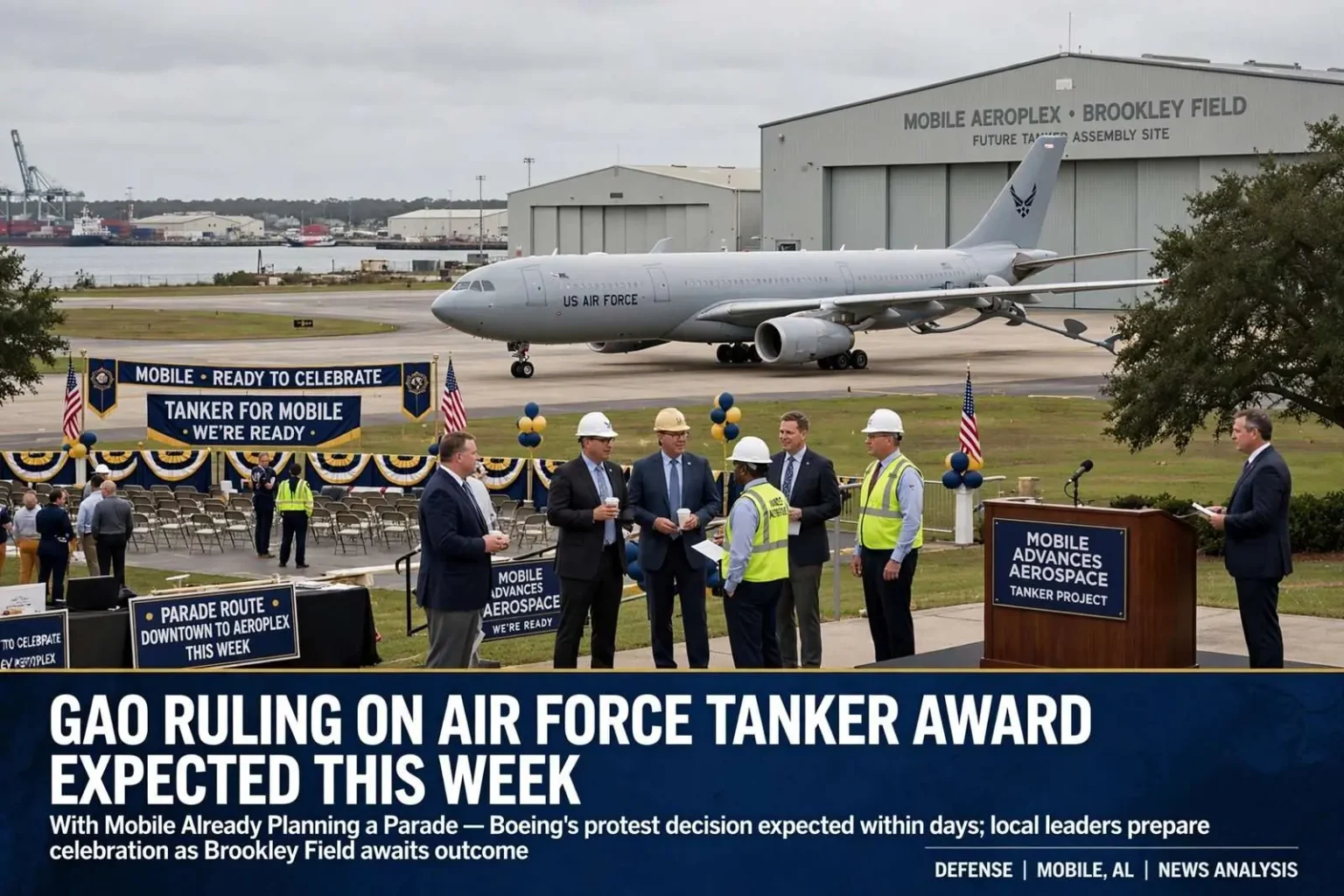
The GAO was expected to rule by Thursday on Boeing's protest of the Air Force tanker award, a decision with major stakes for a planned Northrop Grumman/EADS assembly line in Mobile, where organizers were already planning a celebration parade.
The U.S. Government Accountability Office was expected to issue its judgment within days on Boeing’s formal protest of the Air Force’s decision to award the multibillion-dollar aerial refueling tanker contract to the Northrop Grumman and EADS team, according to reporting by CNBC correspondent Jane Wells, with the ruling expected by that Thursday. The decision was one of the most closely watched procurement rulings in years, and no single market outside Washington had more riding on it than Mobile, where the winning team planned to build its new tankers.
Wells reported that although the Air Force is not technically bound by the GAO’s findings, the current political climate would make it difficult for the service to disregard the watchdog agency’s conclusions, whichever way they fall. The GAO, Congress’s investigative arm, adjudicates bid protests brought by companies that lose federal competitions, and its Office of General Counsel is required to rule on most protests within 100 days of filing. Because the agency answers to Congress, and because tanker decisions in particular had become entangled in congressional politics for years, Air Force officials had long treated GAO findings on this contract as effectively decisive.
The GAO review followed Boeing’s formal protest, which rested on two central arguments: first, that the Air Force effectively favored the larger Northrop Grumman/EADS aircraft without adequately communicating that size was a priority in the competition, and second, that European government subsidies to EADS gave the company an unfair cost advantage that made it harder for Boeing to compete on a level playing field. The subsidy argument carried particular political charge, because it framed the competition not just as a contest between two aircraft but as a question of American jobs versus European-supported industry.
The two arguments aimed at different parts of the Air Force’s evaluation. The size argument attacked the technical scoring, contending that the service’s requirements were written and weighted in a way that rewarded a larger airframe like the one Northrop Grumman and EADS proposed, based on the wide-body commercial airliner EADS built in Europe. The subsidy argument attacked the cost scoring, asserting that launch aid and other supports from European governments allowed EADS to price its aircraft in ways Boeing claimed it could not match. The GAO’s job was to decide whether the Air Force’s evaluation had followed the rules of its own solicitation, not to re-run the competition from scratch.
What the ruling meant for Mobile
The outcome carries direct consequences for Mobile. If the GAO sides with Boeing, the Air Force would likely be pushed to reopen bidding on the contract, which could put the planned Northrop Grumman/EADS assembly line at Brookley Field in jeopardy. If the GAO instead rules in favor of the existing award, it would clear another procedural hurdle for the Mobile-linked project, though the fight would not necessarily be over. Even a favorable GAO ruling would still leave Northrop Grumman and EADS facing pushback in Congress from lawmakers aligned with Boeing, including Washington Rep. Norm Dicks and Kansas Rep. Todd Tiahrt, both of whom represent regions with a direct stake in seeing the contract steered back toward Boeing.
Brookley Field, the site of the proposed assembly operation, occupies a distinctive place in Mobile’s economic history. The former Air Force base on Mobile Bay closed in the base realignment rounds of the 1960s, and the property, now operated as the Mobile Aeroplex, has spent decades awaiting a large industrial anchor of the kind the tanker program promised. Local officials had spent years marketing the airfield’s runway access, deepwater port proximity and open land to aerospace companies, and the tanker contract represented by far the largest potential prize of that effort.
For the region, the stakes extended beyond the assembly line itself. Aerospace work tends to cluster: an aircraft assembly operation draws suppliers, maintenance firms and engineering offices to the surrounding area, and it gives a region a credential that helps recruit the next employer. Mobile’s economic development leadership had assembled incentives and site preparations on the assumption that the tanker award would anchor a new Gulf Coast aerospace corridor, linking existing shipbuilding and aviation suppliers along the central Gulf from New Orleans to Pensacola.
Despite the uncertainty still hanging over the final outcome, word had already spread in Mobile that local organizers were planning a parade to celebrate the tanker win, regardless of how the GAO ultimately ruled. The willingness to celebrate ahead of a final resolution reflects how significant the stakes of the tanker decision had become for the region, where officials and residents alike viewed the prospective assembly line as a marquee win in a broader run of economic development successes along the central Gulf Coast. Planning a party before the paperwork was final also said something about the confidence that had built up in Mobile since the Air Force announced its selection.
A competition years in the making
The tanker competition, which could be worth up to $40 billion over its full run, has drawn sustained national attention because of the jobs and industrial capacity at stake for whichever region ultimately hosts the winning manufacturer’s assembly operations. For Mobile, landing the Northrop Grumman/EADS assembly line was seen as a potential catalyst for thousands of aerospace jobs and a validation of the region’s yearslong push to rebuild its industrial and manufacturing base.
The contest’s history explains the intensity. The Air Force has flown Boeing-built refueling tankers, derived from the 707 airframe, for generations, and the fleet’s advancing age made replacement an urgent priority. An earlier attempt to lease and then buy converted Boeing 767s collapsed in scandal several years before this competition, prompting the Air Force to rewrite the program and open it to full competition. Northrop Grumman, pairing with EADS as its airframe provider, chose to enter, and the two-candidate contest quickly became a proxy fight between Boeing’s Puget Sound and Kansas workforces and a prospective Gulf Coast assembly operation.
Geography made the politics personal. The Air Force’s tanker units are spread across the country, and members of Congress in every region have constituents whose jobs depend on the existing tanker fleet and its maintenance. A new production line, wherever it lands, concentrates decades’ worth of work in one place, which is why the competition drew statements from governors, senators and representatives far beyond Washington State and Kansas. The involvement of EADS, the European parent of Airbus, added a trade dimension that kept the protest in the national news long after the Air Force’s technical evaluation ended.
How a GAO protest works
The protest process that produced this week’s deadline follows a well-worn path. A losing bidder files with the GAO, the agency under review answers with a legal briefing report, the protester replies, and attorneys for both sides appear for oral argument before a panel of GAO attorneys. The office then issues a written decision, typically with a public summary, explaining whether it sustained or denied the protest grounds. Sustained findings can direct the agency to re-evaluate proposals, reopen discussions or amend the solicitation; denied findings allow the award to stand, though the losing company retains the option of taking its case to the U.S. Court of Federal Claims.
That remaining avenue matters for interpreting whatever the GAO announced. Even a denial would not necessarily end Boeing’s challenge, and even a sustaining would not automatically hand the contract back to Boeing; the most likely outcome of a sustained protest would be a re-competition or a corrected award process, reopening months of uncertainty for Mobile. Local officials understood that the parade being planned might mark a milestone rather than a finish line, but after years of stops and starts they were prepared to take the win however it arrived.
The political pressure described by Wells cuts in both directions. Lawmakers aligned with Boeing could press the Air Force to act on any adverse GAO findings, while Mobile’s supporters in the Alabama delegation, along with Gulf Coast business and labor groups, argued that overturning a fair competition would chill future bidders and delay a fleet replacement the Air Force itself had called urgent. Between those forces sat the Air Force, which had already lived through one collapsed tanker program and was reluctant to preside over another.
Why Mobile kept planning the parade
The parade talk, however premature it looked from Washington, captured the way Mobile experienced the competition. The city had been promised a tanker plant once before in an earlier round of the program, only to see the award reversed after a successful Boeing protest of that earlier competition, so residents knew both the euphoria of an award and the deflation of its reversal. Local coverage treated the GAO’s imminent decision as a civic event, and talk radio, barbershops and editorial pages all weighed in on whether the watchdog would bless the region’s biggest industrial prize.
Mobile’s civic establishment had reason to treat the moment as a celebration of momentum even before any ruling. The region had spent the decade landing major industrial projects, from shipbuilding expansions to steel and paper investments, and the tanker bid symbolized the biggest possible step up into aerospace. Whatever the GAO said that Thursday, the argument went, Mobile had already demonstrated to national employers that it could compete for billion-dollar projects, and the parade would be as much about that claim as about any single contract.
Still, the assembly line itself, with its thousands of jobs and its decades-long runway, existed only in plans and drawings until the protest was resolved. The GAO’s decision, expected within days, would determine whether those plans advanced toward construction at Brookley Field or headed back into another round of competition and litigation. Mobile had bet its aerospace ambitions on the answer, and the city was not going to wait for Washington’s paperwork to start celebrating.