Gardening and Life Skills: Mobile Partners Launch Youth Program at Taylor Park
Mobile partners launched Crime Prevention Through Environmental Design, teaching youth gardening and conflict resolution at Taylor Park.
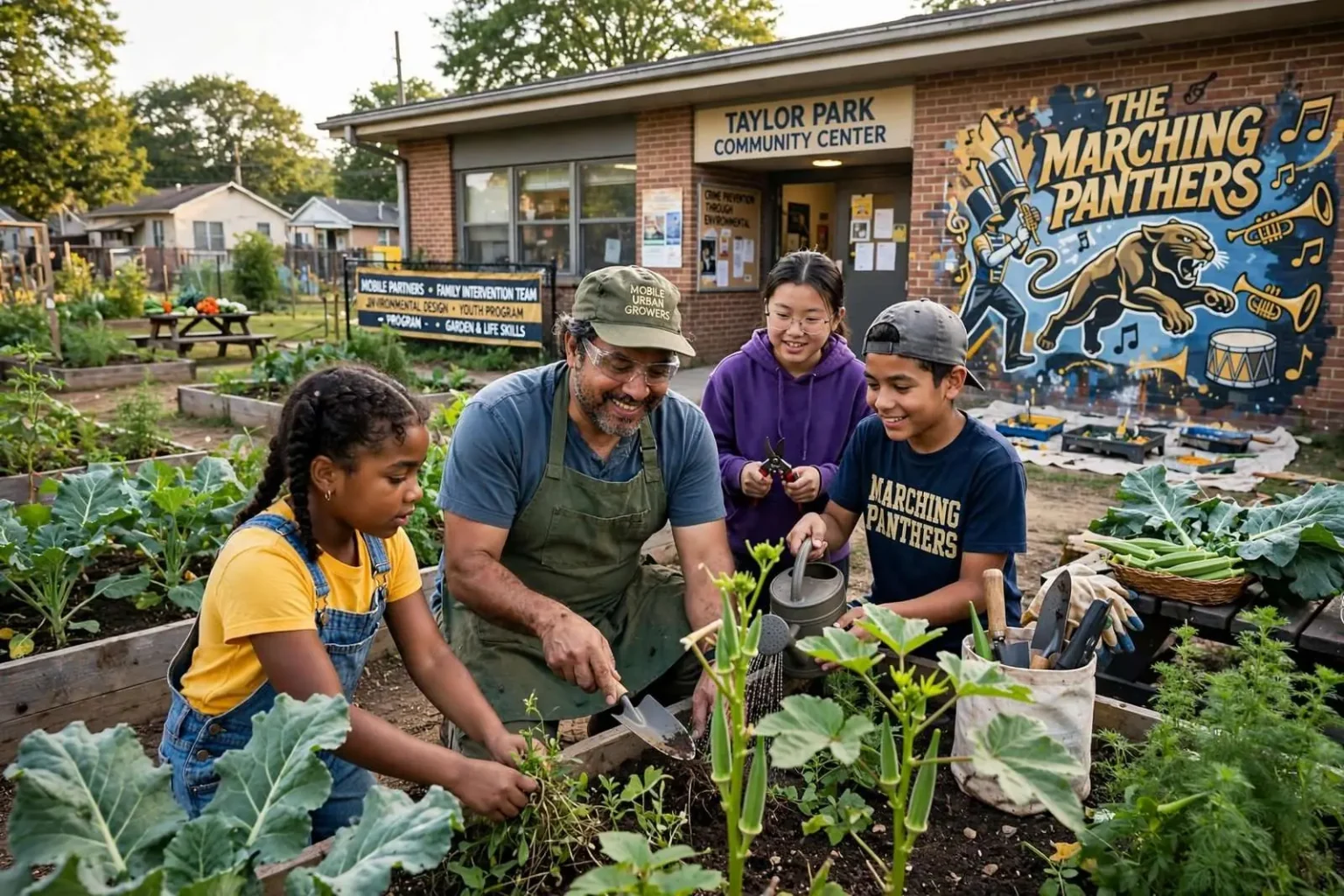
A coalition of Mobile agencies is betting that a garden can grow more than vegetables — it might keep young people on a better path. Crime Prevention Through Environmental Design, a new program at Taylor Park Community Center, blends gardening with life-skills lessons for the city’s youth.
The program brings together an unusual mix of partners for a single purpose: giving young people in the Taylor Park neighborhood something constructive to do, someone to learn from, and a reason to see their own community differently. Participants spend time in raised beds and garden rows, but the stated ambition reaches well past the harvest. Organizers want the garden to function as a classroom for conflict resolution, teamwork, and pride of place — skills that crime prevention advocates say are as important as any police strategy in steering children away from trouble.
A curriculum grown in the garden
Gardener Leo Denton of Mobile Urban Growers, who works directly with participants, said the curriculum goes beyond tending plants: this year’s lessons were drawn from materials used in the University of South Alabama’s psychology department.
That connection to university-level material is one of the program’s distinctive features. Rather than relying on generic gardening activities, the staff adapted lessons from psychology coursework — the kind of material that addresses how people handle anger, communicate under stress, and build healthy relationships — and translated it into exercises children can absorb while working the soil. The garden becomes the setting, and the vegetables become the hook, but the underlying lessons are about behavior.
Conflict resolution is woven into the garden work itself. “We need to weed out bullying, we need to weed out name calling in our lives, we need to nourish all the plants,” Denton said.
The metaphor is deliberate. Pulling weeds becomes a stand-in for removing harmful habits, and nourishing plants becomes a lesson in caring for people and places. Children who might tune out a lecture on kindness are instead handed a trowel and asked to think about what bullying and name-calling do to a community while they clear a bed for planting. Mobile Urban Growers, the organization Denton represents, has built its reputation on exactly this approach — using urban agriculture projects across the city to teach food skills while creating space for broader conversations about health and community life.
New vegetables, new confidence
Marie Chestange, program director at Taylor Park Community Center, called the program a needed resource. Most of the children have no garden at home and are trying vegetables they’ve never encountered — and by her account, they mostly love it.
For many of the participants, the garden is their first hands-on experience with where food comes from. Children who have only seen okra or collard greens on a plate are pulling them from the ground, washing them, and tasting them fresh. That exposure does more than expand young palates. Food access advocates in Mobile have long noted that many city neighborhoods sit in food deserts, miles from full-service grocery stores, and that children growing up in those areas often have limited exposure to fresh produce. A community garden in the middle of a neighborhood puts vegetables within walking distance and gives children ownership of the process that produces them.
The confidence that comes with growing something is itself a life skill. Program staff describe children who arrive hesitant and leave proud of what they planted, weeded, and harvested. For a community center that serves as a gathering point for the neighborhood, those small victories are part of a larger project of giving young people positive attachments — to the center, to the adults who work there, and to each other.
Murals and the Marching Panthers
The young people are also leaving their mark beyond the beds, helping local artist Zach DePolo paint murals, including a recent piece honoring the Taylor Park band, The Marching Panthers, on the side of the community building.
The mural work extends the program’s philosophy from the garden to the walls of the neighborhood. Rather than treating public art as something done for a community by outsiders, the program puts brushes in the hands of the children themselves, with DePolo guiding the design and execution. The result is art the neighborhood can point to and say the local kids made.
DePolo said the goal is to lift up the community’s music program and give focus to people and places that feel forgotten.
The choice of subject — The Marching Panthers, the Taylor Park band — signals where the community’s pride lies. School and neighborhood bands hold a special place in Mobile’s cultural fabric, where marching units are fixtures of Mardi Gras season and community celebrations, and honoring the band on the side of a public building tells young musicians that their work is seen and valued. For children who help paint the tribute, the mural doubles as a lesson in civic contribution: that a neighborhood’s landmarks can be shaped by its own residents, at any age.
Public art has become a quiet anchor of the Crime Prevention Through Environmental Design approach. The strategy, widely used by cities across the country, holds that well-maintained, cared-for spaces deter neglect and crime, and that involving residents in improving those spaces builds the kind of ownership that keeps them safe. A community garden, a freshly painted mural, and an active community center all fit the model — physical improvements paired with human investment.
A place to heal
Mobile County Juvenile Court Judge Edmond Naman said the Taylor Park Community Garden will now be known as a place to heal and change your life, crediting the effort with making a real difference.
The endorsement carries weight coming from Naman, whose court deals daily with the consequences when young people go down the wrong path. Juvenile judges across Alabama have increasingly championed prevention programs, arguing that intervention before an arrest is far cheaper and more effective than any disposition after one. A judge lending his name and his praise to a garden project reflects that shift — a recognition that the roots of delinquency often look like idleness, isolation, and a lack of caring adults, and that community programs address all three.
For the judge, the garden’s value lies less in vegetables than in what the process teaches children about themselves: that work produces results, that adults will show up for them, and that their neighborhood has institutions invested in their success. Those messages, delivered consistently, are what prevention advocates mean when they talk about changing a life.
A coalition built for the long haul
Partners include the Taylor Park Community Center, the Juvenile Court of Mobile County, the Family Intervention Team, the Mobile Police Department and Mobile Urban Growers.
The roster is notable for how many corners of the community it spans. A recreation center provides the space, a court brings juvenile justice expertise, an intervention team connects families to services, the police department offers a presence that is preventive rather than punitive, and a growers’ organization supplies the agricultural know-how. Programs that bind agencies together this way tend to be more resilient than single-organization efforts, because each partner reinforces the others and shares the load of keeping the program running.
Taylor Park itself sits in a working-class section of Mobile where a community center and its grounds serve as one of the few public gathering spaces. Investments like the garden and murals ripple outward: children who spend afternoons planting and painting are children who are supervised, engaged, and building relationships with adults who can spot trouble early. That, in the end, is the whole theory of the program — that a garden can grow more than vegetables, and that the things it does grow might keep young people on a better path.
Why the garden model works
Youth development researchers have long found that hands-on programs with a tangible product — a harvested row, a finished mural — hold young people’s attention in ways that purely academic settings often do not. The act of caring for a living thing over weeks teaches patience and responsibility, and it gives children a stake in showing up. Missing a day means weeds creep in and plants suffer, a natural consequence that no lecture can replicate.
The Taylor Park program also benefits from its timing. After-school hours are consistently identified by law enforcement and youth advocates as the window when unsupervised young people are most likely to get into trouble, and a program that fills those hours with structured activity addresses the problem at its source. By combining recreation, education, and mentoring in one place, the center and its partners make the safe choice the easy choice for neighborhood families.
The collaboration with the University of South Alabama’s psychology department points to a broader trend in youth programming, where universities lend evidence-based content to community organizations and community organizations give students and researchers a real-world setting. If the model continues to develop, Mobile Urban Growers and its partners will have a template other Mobile neighborhoods could copy — a garden, a curriculum, and a coalition of agencies committed to the same children.
For now, the beds at Taylor Park Community Garden are producing more than the organizers promised. The children are eating vegetables they grew themselves, painting murals that honor their own marching band, and learning to weed out bullying along with the crabgrass. If the garden really does change lives, as Judge Naman believes, the evidence will show up years from now in the choices those children make — and in the neighborhood they inherit.