Glaucoma Awareness Month: Early Detection Key to Saving Sight, Mobile Expert Says
January is Glaucoma Awareness Month. A Mobile eye expert explains why early detection controls the disease that affects 2.8 million Americans.
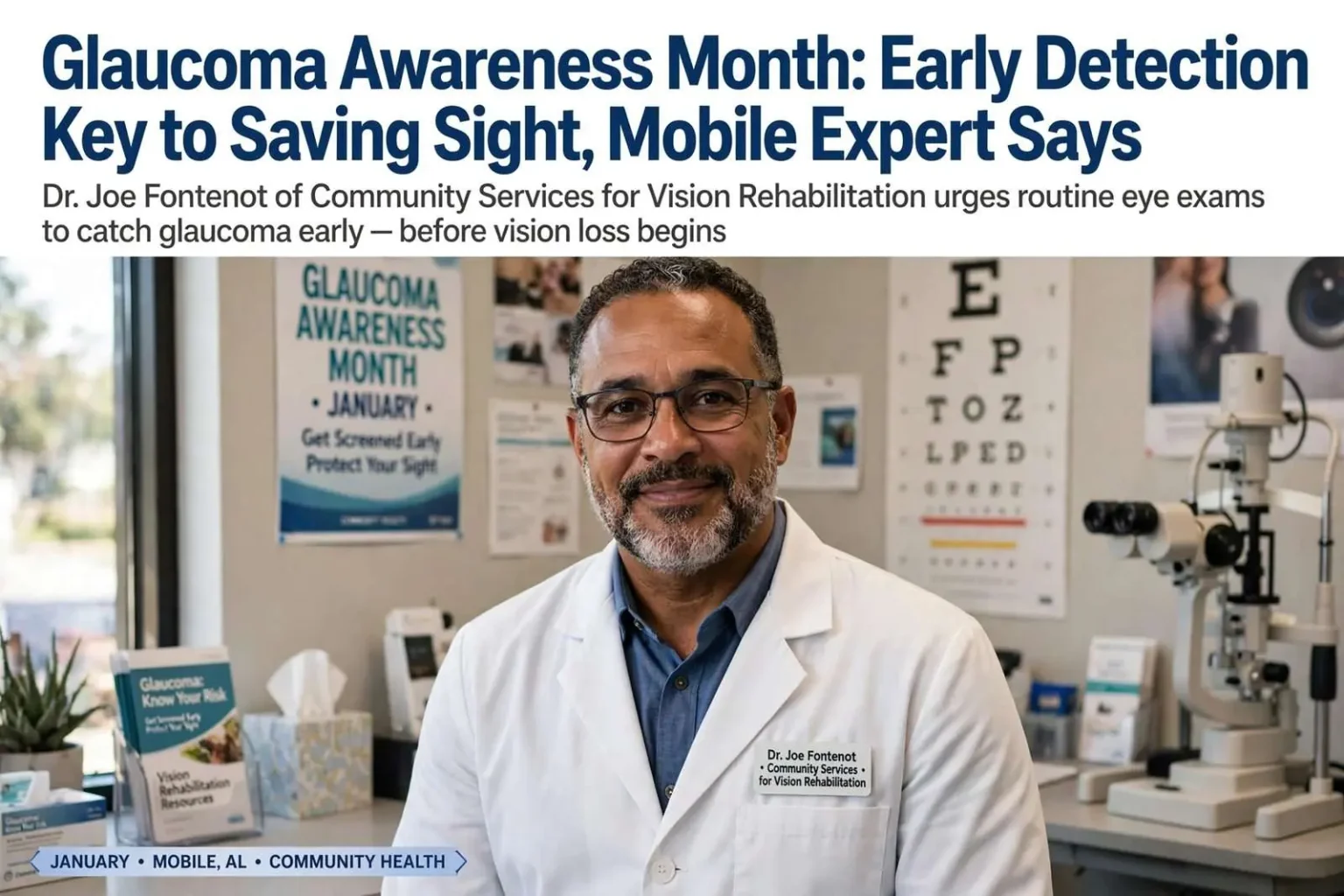
January marks Glaucoma Awareness Month, and a Mobile vision specialist is urging residents not to wait for symptoms before getting checked. Glaucoma damages the optic nerve and is one of the leading causes of vision loss and blindness in the United States, according to the National Eye Institute, affecting an estimated 2.8 million Americans.
The disease’s danger lies in its silence: by the time noticeable vision loss appears, damage already done cannot be reversed. Caught early, however, glaucoma can usually be controlled, and severe vision loss can often be prevented. That makes routine screening especially important for older adults and others at elevated risk.
Dr. Joe Fontenot of Community Services for Vision Rehabilitation has been spreading that message during the awareness month, talking with local audiences about prevention and management of the disease and about the vision rehabilitation options available to those whose sight is already affected.
The structure of glaucoma’s threat is what makes awareness campaigns like this one necessary. The condition most commonly develops when fluid pressure inside the eye rises and gradually damages the optic nerve, the bundle of fibers that carries visual information from the eye to the brain. Peripheral vision — the edges of the visual field — typically suffers first, and the brain is remarkably good at compensating. A person can lose a substantial portion of side vision and never notice, because the central vision used for reading, driving straight ahead and recognizing faces remains intact until late in the disease.
Why Early Detection Is Everything
That silent progression is why ophthalmologists describe glaucoma screening as the defining test in eye care for older adults. The examination itself is quick: an instrument measures the pressure inside the eye, the optic nerve is inspected for characteristic changes, and when suspicion arises, a visual field test maps the peripheral vision to detect early loss. None of it is painful, all of it fits into a routine eye appointment, and the tests find the disease years before any symptom a patient could report.
Once detected, glaucoma rarely goes away — but it almost always can be managed. Prescription eye drops that reduce the pressure inside the eye are the standard first line of treatment, and when drops are insufficient, laser procedures and surgical options can lower pressure further. Patients who follow their treatment preserve useful sight for life in the great majority of cases. The tragedy the awareness month exists to prevent is the patient who never got tested, whose first awareness of the disease is a field of vision that has already narrowed beyond repair.
The stakes are highest for the groups at elevated risk. Age is the most significant factor, with risk rising sharply after 40 and again after 60. Family history matters enormously — a parent or sibling with glaucoma multiplies a person’s risk. Race is a documented factor as well, with glaucoma striking Black Americans more often, at younger ages and with greater severity, a fact of particular relevance in Mobile and across the Deep South. Diabetes, past eye injuries and long-term steroid use add to the risk list.
A Local Voice for Vision Health
Dr. Fontenot’s work with Community Services for Vision Rehabilitation places the January message within a broader local mission. Vision rehabilitation as a field addresses the patients for whom medicine has done all it can — people whose sight is already impaired — and teaches them to maximize remaining vision and independence. That can mean low-vision devices and magnification, training in adaptive techniques, and practical guidance for navigating home and community with reduced sight.
Speaking to local audiences during Glaucoma Awareness Month, Dr. Fontenot has emphasized both halves of the message: get screened before symptoms appear, and know that help exists for those already affected. The combination is deliberate. Awareness campaigns succeed when prevention is paired with a realistic picture of what happens after diagnosis, and Mobile audiences hearing about glaucoma also hear about the rehabilitation resources that exist along the Gulf Coast.
The local dimension of the message matters because of who lives in south Alabama. The region’s population includes a large share of older adults, and the conditions that elevate glaucoma risk — family history, diabetes — are common here. Routine eye examinations are also less universal than they should be, particularly among residents without regular access to eye care. Every January, the awareness month serves as a reminder that the exam that catches glaucoma is painless, quick and widely available.
What Glaucoma Costs — and What Screening Costs
The national picture behind the Mobile message is sobering. The National Eye Institute counts glaucoma among the leading causes of vision loss and blindness in the United States, and its estimate of 2.8 million Americans affected continues to grow as the population ages. Researchers project that the number will keep climbing in the decades ahead as the large generations now entering their 50s and 60s move into the highest-risk age brackets.
The personal cost of late detection is measured in independence. Vision loss from glaucoma affects the ability to drive, to read, to move safely through unfamiliar places and to live alone — losses that arrive precisely at ages when they are hardest to absorb. The disease is a leading cause of blindness among older Americans, and because the damage cannot be undone, every case prevented by early detection is permanent value preserved.
The cost of prevention, by contrast, is small. A comprehensive dilated eye examination is the screening tool ophthalmologists recommend, and for those with insurance or access to community screening programs, the barrier is mostly awareness rather than money. Eye doctors advise adults to have baseline examinations by age 40, earlier for those with family history or other risk factors, and more frequent follow-ups as age advances. For patients diagnosed with glaucoma, the prescription eye drops that control the disease represent one of medicine’s best bargains — a daily routine that preserves a lifetime of sight.
As January’s awareness campaign continues across Mobile, the essential message from Dr. Fontenot and Community Services for Vision Rehabilitation comes down to a single sentence: do not wait for your vision to tell you something is wrong, because glaucoma will not warn you until it is too late to undo the damage. The time to find out is before the symptoms — and the time is now, while sight is still there to save.
Understanding the Disease Behind the Campaign
Glaucoma is not one condition but a family of related diseases, all united by damage to the optic nerve. The most common form develops slowly over years, which is precisely what makes it so dangerous: there is no pain, no redness, no blurring to alert the patient. A less common form, angle-closure glaucoma, arrives suddenly with severe eye pain, headache, nausea and blurred vision, and constitutes a medical emergency requiring immediate treatment — but that dramatic variety accounts for only a fraction of cases.
The fluid involved in the common form, called aqueous humor, circulates constantly inside the eye, nourishing surrounding tissue before draining out through a meshwork of channels. When those channels clog or the eye produces fluid faster than it can drain, pressure builds. The optic nerve, uniquely vulnerable among the body’s nerves, sustains damage fiber by fiber, and each fiber lost is lost permanently. Vision, unlike a cut on the skin, does not grow back.
Treatment aims to halt that loss by keeping pressure in a safe range, and the tools for doing so have multiplied over the decades. Modern eye drops work through several mechanisms — some reduce fluid production, others improve drainage — and patients often use combinations. Laser treatments can open the eye’s drainage channels, and surgical procedures create new pathways when drops and lasers are not enough. The management of glaucoma is lifelong, but with consistent care the overwhelming majority of patients keep functional vision.
The Case for Routine Eye Exams
Eye care professionals often compare the glaucoma exam to blood pressure screening, and the comparison is apt. Neither requires symptoms to justify it, both detect conditions that are dangerous precisely because they are silent, and both are quick enough to fold into routine care. The difference is that far fewer adults see an eye doctor regularly than see a primary care physician — a gap that awareness months like January exist to close.
For south Alabama residents, the practical advice during Glaucoma Awareness Month is straightforward. Adults who have not had a comprehensive eye exam in recent years should schedule one, and those with a family history of glaucoma, diabetes, or membership in higher-risk groups should say so when they call. Relatives of glaucoma patients have an especially strong reason to act, since knowing one’s family history is the cheapest risk assessment available.
Dr. Fontenot’s January message through Community Services for Vision Rehabilitation closes the loop between prevention and living with vision loss. For those who act early, the reward is sight preserved by drops and monitoring. For those already affected, the community’s rehabilitation resources offer training, tools and techniques for an independent life. Both paths begin with the same step — attention to eye health — and January, the month set aside for glaucoma awareness, is the moment south Alabama residents are asked to take it.