Government Street Methodist Church Draws African Refugee Congregation to Swahili-Language Service
Government Street Methodist Church in downtown Mobile has become a worship home for African refugees with a Swahili-language service.
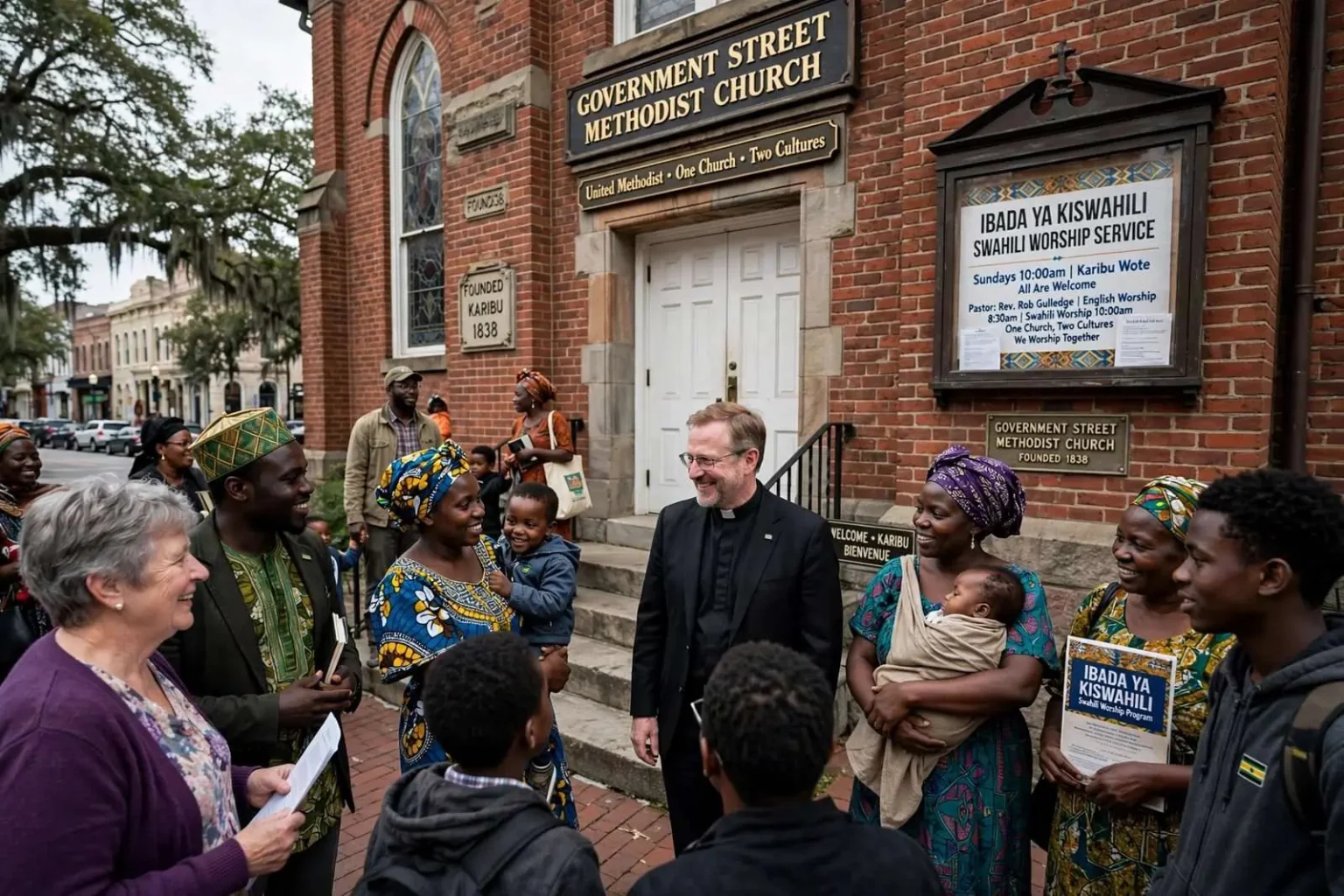
Government Street Methodist Church, one of the older congregations in downtown Mobile, has found itself home to a growing African worship community after opening its doors to refugee families several years ago, according to the church’s pastor. What began as a simple act of hospitality — offering a place to worship when a group of African refugees first arrived in Mobile — has grown into a distinct Swahili-language service that has become popular among African residents in the area.
The Rev. Rob Gulledge, pastor of Government Street Methodist Church, describes the arrangement not as a separate ministry housed at the church but as part of a single congregation spanning two traditions. “While they do not have a Methodist background, we see ourselves as one church with two cultures,” Gulledge said. The distinction he draws is deliberate. Rather than renting space to an independent congregation or operating a satellite outreach program, the church treats its African members as full participants in one body of worshippers who happen to gather in two languages.
For a historic downtown congregation, the shift represents both a practical accommodation and a statement of identity. Churches in older urban neighborhoods across Mobile have watched their surrounding populations change over the decades, and congregations that adapt to who actually lives, works, and settles nearby are often the ones that remain vital. Government Street Methodist’s experience shows one path that adaptation can take: instead of shrinking quietly, the church widened its welcome and let a new community shape its weekly rhythm.
Refugees Resettled in South Alabama
According to Gulledge, most members of the African congregation arrived in the Mobile area roughly three years ago as refugees, placed in south Alabama through Catholic Social Services’ Refugee Resettlement Program. That program has for years helped place refugee families from conflict zones around the world into communities across the region, connecting them with housing, employment assistance and other support as they resettle.
Catholic Social Services has long served as the local face of the national refugee resettlement system along the Gulf Coast. Under that system, the federal government works with national voluntary agencies, which in turn partner with local affiliates like Catholic Social Services to receive arriving families. The local office’s role is extensive: greet families at the airport, secure initial housing with basic furnishings, enroll children in school, help adults find work, and walk newcomers through the practical business of American life, from banking to transportation to health care.
For the families themselves, the journey to Mobile typically follows years of displacement. Refugees granted resettlement in the United States have generally fled war, persecution, or ethnic and political violence and spent time in camps or host countries before being vetted and approved for entry. Arriving in south Alabama places them in a region very different from the capitals and camps they passed through — a car-dependent metro area with humid subtropical weather, a deep port economy, and a strong network of congregations that often serve as the first point of contact for newcomers.
Gulledge notes that Africans in Mobile worship across a range of churches and denominations, reflecting the diversity of backgrounds within the city’s African community. Some newcomers find their way into established Black congregations, others into Catholic parishes or Pentecostal and Baptist churches, and still others gather in language-specific fellowships that meet wherever space is available.
One Church, Two Cultures
The congregation at Government Street Methodist is distinct, Gulledge says, in the way it has been folded into the life of an existing, historic downtown church rather than operating as a separate outreach ministry. In many cities, immigrant and refugee congregations worship as tenants — invited to use a building but organizationally separate from the host church, with different leadership, finances, and membership rolls. The Mobile arrangement Gulledge describes runs differently: the African fellowship and the traditional congregation are understood as one church with two expressions.
That model carries practical advantages for both sides. The African community gains not just a meeting space but institutional support — access to the church’s facilities, its standing in the neighborhood, and the experience of a longtime pastor and staff. The host congregation, meanwhile, receives new energy, new families, and a weekly reminder that its mission extends beyond the members who have attended for decades. Shared buildings also tend to generate shared projects, from joint meals to community service, even when Sunday worship happens in different languages at different times.
The choice of Swahili as the language of the new service reflects the makeup of the arriving community. Swahili serves as a common language across a broad stretch of East and Central Africa, spoken and understood in countries including Kenya, Tanzania, Uganda, Rwanda, Burundi, and the Democratic Republic of the Congo, and it frequently functions as a bridge language among refugees from the region who arrive speaking different mother tongues. A service conducted in Swahili can therefore draw worshippers from several nations at once, uniting people who might otherwise struggle to find worship in a language they share.
Regular worship conducted in Swahili has made Government Street Methodist a gathering point for the African community well beyond Sunday mornings. Houses of worship that offer familiar language and music often become anchors for refugee communities more broadly — places where news travels, where newcomers find their first friends, and where the customs of home are kept alive for children growing up in Alabama.
For the historic church itself, hosting the service adds a new chapter to a long institutional story. Downtown Mobile’s older churches were built for eras when the surrounding blocks were densely residential, and many have spent recent decades redefining their relationship to a changed neighborhood. A growing Swahili-speaking congregation fills pews that might otherwise sit empty and ties the church’s future to families who are building new lives in the city.
Part of a Larger Wave
The growth of the Government Street fellowship reflects the broader wave of refugee resettlement that has reshaped the makeup of some Mobile-area congregations over the past several years. As families placed by Catholic Social Services have put down roots — taking jobs, renting homes, enrolling children in Mobile County schools — they have sought the same community institutions any family seeks, and churches have been near the front of that list.
That ripple effect is visible across the region. Congregations of many denominations in Mobile, Prichard, and the surrounding communities have encountered new African members, new languages, and new musical traditions in recent years. For some churches, the adjustment has meant hosting an independent fellowship; for a smaller number, like Government Street Methodist, it has meant something closer to full incorporation, with two cultures sharing one denominational home.
For local residents, the story carries a practical lesson about how resettlement actually works at the ground level. Federal policy decides how many refugees enter the country, but it is local institutions — resettlement agencies, employers, schools, and congregations like Government Street Methodist — that determine whether those families thrive. A church that opens its doors does more than provide a room; it shortens the distance between a displaced family and a functioning life in a new country.
The Swahili-language service has become popular among African residents in the area, according to Gulledge, suggesting the fellowship has found a durable audience rather than a temporary one. Popularity of that kind typically compounds: established attendees invite relatives and acquaintances, word spreads through community networks, and a service that began with a handful of families grows into a recognized fixture on the church calendar.
The arrangement also reflects a broader truth about downtown Mobile’s religious landscape. Historic congregations near the city center have spent years searching for ways to remain relevant as residential patterns shifted toward the suburbs, and partnerships like this one offer a template: put existing buildings to work for the people who are actually arriving, rather than mourning the demographics of a previous generation. Each family that joins the Swahili service represents both a strengthened church and a smoother landing for newcomers navigating their first years in America.
Challenges remain inherent to any two-culture congregation. Language barriers must be bridged in administration and shared events, schedules must be balanced, and cultural expectations about worship style, leadership, and finance do not always align on their own. But the framing Gulledge offers — one church with two cultures — points toward the model’s central premise: that the differences are managed inside a single family rather than between a landlord and a tenant.
For now, Government Street Methodist Church stands as an example of how one of downtown Mobile’s oldest congregations has responded to a changing city — not by holding the door closed, but by opening it, and by learning to worship in two languages under one roof. For the refugee families who arrived in south Alabama with little more than the paperwork that brought them, that open door has become one of the clearest signs that they are no longer passing through Mobile. They are part of it.