Grand Bay Couple Facing Elder Abuse Charges Bound Over to Grand Jury
A Grand Bay couple faces multiple elder abuse charges after deputies found veterans living in deplorable conditions. The case is headed to a grand jury.
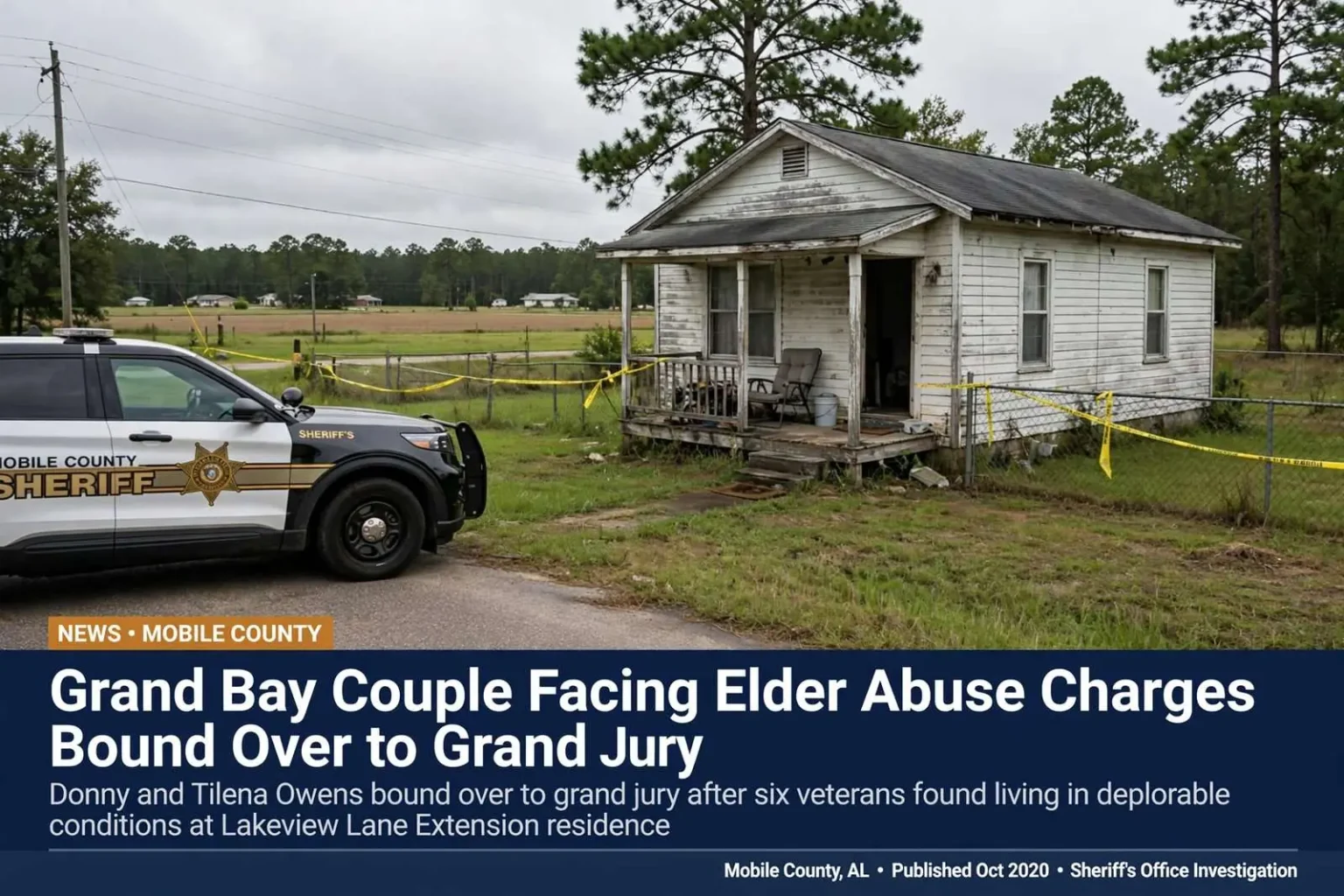
A Grand Bay couple charged with multiple counts of elder abuse appeared in court Monday as their case moved one step closer to indictment. Donny and Tilena Owens were bound over to a grand jury following the hearing, according to the Mobile County District Attorney’s Office, advancing a case that has drawn attention across Mobile County for its unusual circumstances and its vulnerable alleged victims.
The bound-over finding is a procedural milestone rather than a determination of guilt. In Alabama’s court system, a preliminary hearing gives a judge the chance to review whether the prosecution has presented enough evidence to justify moving forward, and a bindover sends the case to a grand jury, which decides whether to issue a formal indictment. Only after an indictment can the case proceed to trial in circuit court, meaning the Owenses’ legal journey remains in its early chapters.
Veterans Found Living in Deplorable Conditions
The couple was arrested after the Mobile County Sheriff’s Office responded to reports that veterans were living in deplorable conditions inside a home along Lakeview Lane Extension in Grand Bay. Grand Bay is a rural community in southwestern Mobile County, near the Mississippi line, an area of scattered residences and long stretches of farmland where neighbors tend to notice when something is out of place. Investigators said the men living there appeared to have gone without medical care for some time, a detail that shaped the direction of the inquiry from the outset.
All six people found in the home were taken to the hospital for evaluation and treatment. For deputies, the immediate priority shifted from investigation to welfare, ensuring that the residents received medical attention, adequate nutrition, and a safe place to stay once they left the Lakeview Lane property. The hospital evaluations also created a documented medical record of the residents’ condition, evidence that would matter as the case moved forward.
The identity of the residents added a layer to the case that distinguished it from other neglect investigations: every person found in the home was a military veteran. Sheriff’s officials said the six men had paid about $700 a month to live in the roughly 1,100-square-foot, three-bedroom house, where investigators counted five beds and a single recliner. The math of that arrangement — six men sharing a small house furnished with far fewer seats than occupants — became one of the more striking details in investigators’ account of conditions inside the home.
Charges and the Couple’s Boarding-Home Business
The Owenses, who operated the residence under the name Square One Life Management LLC, each faced one count of first-degree elder abuse and neglect along with five counts of second-degree elder abuse and neglect, according to the sheriff’s office. The structure of the charges tracks the alleged conditions: the first-degree count reflects the most serious allegations, while the five second-degree counts correspond to the five other residents found in the home.
Detectives and federal investigators seized hundreds of paper records from the home after the June 2020 arrests, which Capt. Paul Burch, the agency’s chief investigator, described as “mounds of documents.” The paper trail mattered because boarding-home operations of this kind often run on cash payments and informal agreements, leaving few digital traces. Receipts, ledgers, and correspondence could help investigators establish who lived in the home, what they paid, and what services the couple promised in return.
The involvement of federal investigators suggested the scope of the case reached beyond county lines. Veterans’ benefits, which flow from the U.S. Department of Veterans Affairs, fall under federal oversight, and authorities confirmed they were working to determine how the men came to live in Grand Bay in the first place. Burch said at least one resident received veterans benefits, raising questions investigators would need to answer about how those funds were used and whether the home’s operators had any role in managing them.
Tracing how vulnerable adults end up in unlicensed boarding situations is among the more difficult tasks in such investigations. Residents may arrive through word of mouth, family referrals, or acquaintances, often without written contracts or formal admission records. In rural communities like Grand Bay, where licensed assisted-living options are limited and distances to formal facilities are long, informal boarding arrangements fill a gap — and operate largely out of public view until something goes wrong.
The Regulatory Landscape Around Boarding Homes
The case also cast light on the regulatory framework that governs homes for elderly and disabled adults in Alabama. Licensed assisted-living facilities are regulated by the state, but smaller boarding arrangements can fall into a gray area between room rental and formal care, particularly when operators describe their services as help with daily living rather than medical care. That distinction sits at the heart of many elder-abuse prosecutions, because it determines what standard of care the operator agreed to provide.
The Alabama Department of Human Resources plays a central role in protecting vulnerable adults, conducting inspections and responding to complaints about facilities and living conditions. The agency’s oversight of the Owens case would become a point of contention between prosecutors and the defense, given the couple’s claim that other facilities they operated had been inspected and had remained open.
For the veterans’ community in Mobile County, the allegations struck a nerve. South Alabama is home to a significant population of former service members, drawn by the region’s military installations, VA healthcare presence, and veteran-serving organizations. The idea that six veterans had been found living in a crowded, neglected house — while paying monthly rent — prompted concern from advocates who work with older veterans and who point to such cases when arguing for stronger oversight of informal care arrangements.
Defense Disputed the Characterization
Attorney Dennis Knizley, representing Donny Owens, called the case overblown and disputed that conditions were deplorable, describing the operation as a voluntary boarding home where residents could leave at any time. The distinction between a locked facility and a voluntary residence is central to the defense’s view of the case: if the men were free to come and go, Knizley argued, the home was something closer to room-and-board lodging than to the kind of confinement contemplated by elder-abuse statutes.
Knizley said the home provided three meals a day, medication assistance and laundry service, and noted that family members visited and called regularly without complaint. From the defense perspective, those services described an operation that, whatever its shortcomings, met the practical needs of men who might otherwise have had nowhere to go. The absence of complaints from relatives, in the defense’s telling, suggested that the people closest to the residents saw nothing alarming about the arrangement.
The defense also pointed to the couple’s broader operation as evidence of good faith. Knizley said two other facilities owned by the couple remained open, and that the Alabama Department of Human Resources inspected both before and after the arrests. If state regulators had continued to allow the couple’s other homes to operate, the defense argued, that continuity undercut the picture of a systematically abusive enterprise.
One of the more unusual details of the case drew attention on both sides: the defense acknowledged that food cabinets and the refrigerator were padlocked overnight but said residents had access to snacks and water after hours. Prosecutors could view the padlocks as evidence of control over vulnerable adults, while the defense characterized the practice as routine household management in a shared home — a way of rationing groceries between scheduled meals rather than a form of deprivation.
Those competing interpretations are what the grand jury will weigh. The same facts — the padlocked cabinets, the five beds for six men, the $700 monthly payments — read very differently depending on whether one views the Lakeview Lane house as a negligent boarding operation or a modest home trying to serve men with limited options. Elder-abuse cases frequently turn on such questions of interpretation, because the statutory lines between frugal housekeeping, neglect, and abuse are narrower than the public often assumes.
What Comes Next in the Case
With the bindover complete, the case now sits with the Mobile County grand jury, which meets in secret to hear evidence from the District Attorney’s Office and decide whether the charges should proceed. Grand juries in Alabama do not determine guilt; they decide only whether probable cause exists to indict. If the grand jury returns indictments on the elder-abuse counts, the Owenses would be arraigned in Mobile County circuit court, where the case would move toward pretrial proceedings and, eventually, trial.
Meanwhile, the six veterans found in the home remain the case’s central concern. Their hospital evaluations opened the door to longer-term questions about their care, their benefits, and their living arrangements going forward. Advocates for older adults note that outcomes in cases like this one depend heavily on what happens after the arrests — whether residents find stable housing, whether family members step in, and whether the agencies involved coordinate follow-up rather than letting the matter end at the courthouse door.
The case has also resonated as a cautionary tale for families across Mobile County and the wider Gulf Coast. Social workers and elder-care advocates use cases like this to remind relatives to visit often, ask specific questions about meals, medications, and finances, and verify how a boarding arrangement is operated before placing a loved one in one. The warning is especially pointed in rural areas such as Grand Bay, where formal options are scarcer and informal arrangements are more common.
For the Mobile County Sheriff’s Office, the investigation reflected the kind of work that rarely makes headlines until charges are filed: responding to a complaint, walking through a small house on Lakeview Lane Extension, counting beds, and retrieving box after box of paper records. Capt. Burch’s description of the documents seized — mounds of them — suggested the office understood from early on that the case would be built as much on paperwork as on the conditions deputies observed.
As the case heads to the grand jury, both sides have staked out their positions clearly. Prosecutors will point to the crowding, the lack of medical care, and the padlocked food storage as evidence of neglect that exploited men who had served their country. The defense will counter that the home was voluntary, the services were real, and the state’s own regulators kept the couple’s other facilities open. The grand jury’s decision will determine which of those narratives gets the next hearing — and whether Donny and Tilena Owens ultimately face a trial on all twelve counts.