Grand Bay woman killed in Gold Mine Road crash in south Mobile County
ALEA says Theodora A. Trotter, 42, of Grand Bay died when her Cadillac collided with a GMC Yukon on Gold Mine Road East on Feb. 12.
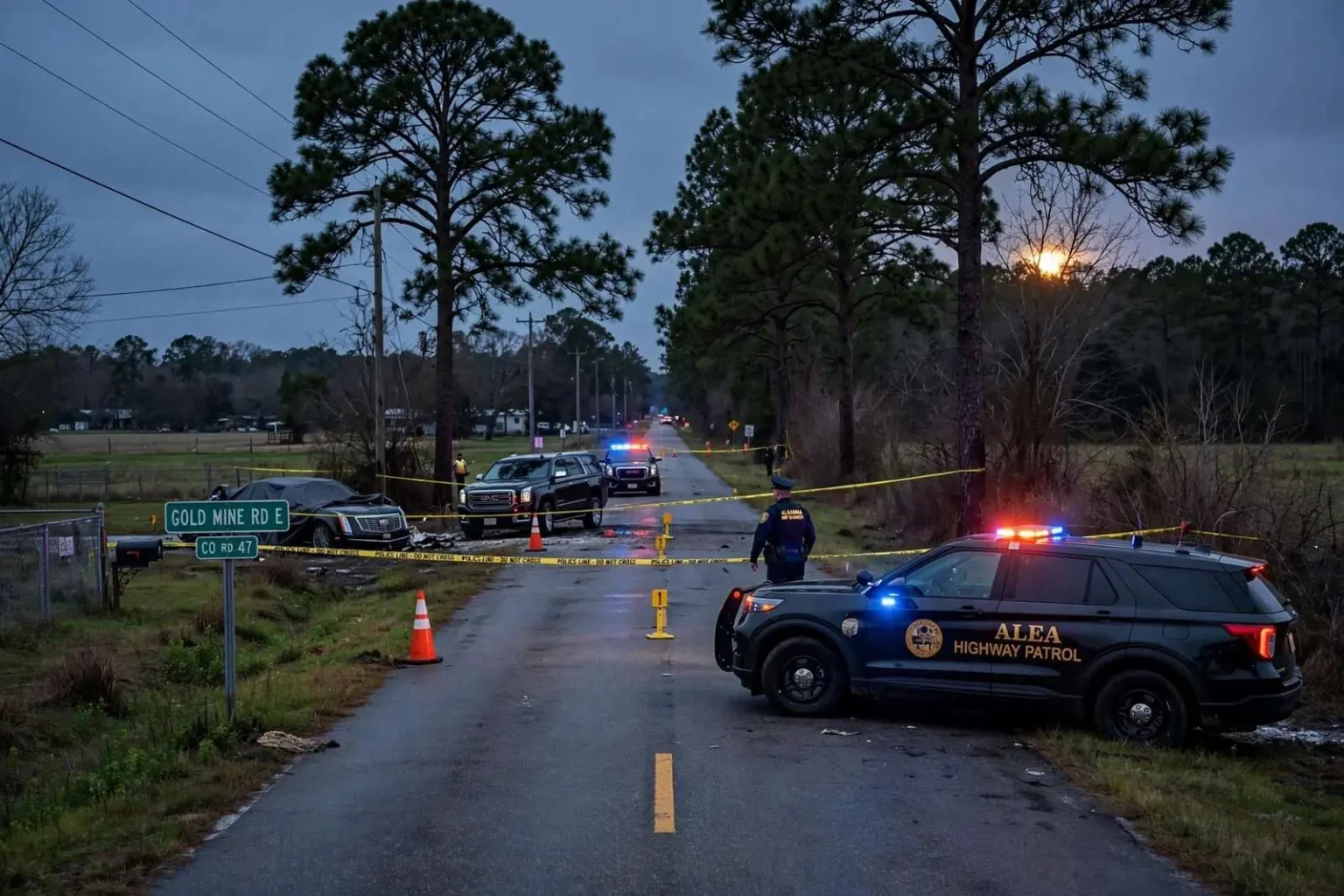
GRAND BAY, Ala. — A 42-year-old Grand Bay woman died Friday evening when her sedan collided with a sport utility vehicle on a rural road in south Mobile County, according to state troopers.
The Alabama Law Enforcement Agency said the two-vehicle crash happened at about 5:20 p.m. on Friday, Feb. 12, on Gold Mine Road East. Theodora A. Trotter was driving a 2011 Cadillac CTS when it struck a 2011 GMC Yukon operated by a teenager.
Trotter was pronounced dead at the scene. Troopers with ALEA’s Highway Patrol Division continued to investigate what led to the collision.
The crash and the response
The collision was reported in the early evening hours on Gold Mine Road East, a stretch of two-lane pavement that runs through the rural southern reaches of Mobile County. When the 2011 Cadillac CTS driven by Trotter struck the 2011 GMC Yukon, the impact proved fatal for the driver of the sedan. Emergency responders who arrived at the scene pronounced Trotter dead where the crash occurred, and no indication was given that the driver of the other vehicle was similarly injured.
Because the wreck involved a fatality on a public roadway, jurisdiction over the investigation passed to the Alabama Law Enforcement Agency rather than remaining with local deputies or municipal police. ALEA’s Highway Patrol Division handles crash investigation and reconstruction across the state, and its troopers document the scene, examine the vehicles, interview witnesses and work to establish what led to the collision. That process can take days or weeks, particularly where questions of speed, right of way or driver condition must be answered before a final crash report is completed.
The identity of the teenager operating the Yukon was not released, which is consistent with the handling of cases involving minors. Nothing in the initial information from troopers indicated what charges, if any, might result from the investigation.
Gold Mine Road and the southern county
Gold Mine Road runs through the Grand Bay area of southern Mobile County, where two-lane rural roads carry a steady mix of commuter and agricultural traffic. The community of Grand Bay sits near the Mississippi line, strung along US 90 and the old rail corridor, with branching county roads connecting neighborhoods, farms and churches to the highway.
Those connecting roads — including Gold Mine Road — are characteristic of rural south Alabama: no median, narrow or absent shoulders, and a combination of through traffic and slow-moving agricultural vehicles. At evening hours, sight lines can be reduced by the angle of the sun, and drivers accustomed to highway speeds sometimes carry that pace onto roads designed for much lighter use. The intersection points between commuter traffic leaving the Mobile area and farm traffic moving between fields create the kind of mixed-use environment where two-lane crashes tend to happen.
Grand Bay residents rely on this network daily, with many commuting north toward Mobile or west toward the Mississippi state line for work. The roads are shared with school buses, logging trucks, and equipment moving between agricultural properties, and traffic volume on individual segments can vary sharply between rush hours and the middle of the day. It is the kind of roadway environment where a single moment of inattention or a single misjudged passing decision can produce a fatal outcome, because there is little margin between opposing lanes of travel.
How fatal crashes are worked in Alabama
When a crash on an Alabama roadway results in a death, the response follows a set pattern that residents of south Mobile County have seen play out before. Local first responders secure the scene and attend to the injured, the county coroner takes jurisdiction over the deceased, and the Alabama Law Enforcement Agency takes over the technical investigation of the crash itself.
Troopers document skid marks, vehicle damage and final resting positions of the vehicles involved, and where the evidence warrants it, a specially trained reconstruction team is brought in to establish speeds and sequences of events. The findings feed into a final crash report that can support everything from insurance claims to criminal charges, depending on what the evidence shows. In this case, troopers said the investigation into what led to the collision was continuing, meaning the final determination of cause had not been made public.
Fatal crashes on rural two-lane roads make up a disproportionate share of Alabama’s roadway deaths year after year, a pattern the state has tracked across its network of county roads and rural state routes. The reasons are structural: opposing traffic separated only by paint, limited lighting, higher speeds, longer emergency response times, and greater distances between intersections where drivers might otherwise slow down.
Statewide safety appeal
ALEA urged drivers across the region to use extra caution on rural routes, particularly during evening hours. The agency issues that appeal regularly, and its troopers see the consequences when it goes unheeded.
The safety guidance that comes with such appeals is familiar: reduce speed on two-lane roads, keep headlights on at dusk even before full darkness, leave following distance around slow-moving farm and logging vehicles rather than attempting risky passes, and expect pedestrians, cyclists and animals in areas where shoulders are narrow or nonexistent. For drivers on roads like Gold Mine Road, the evening commute coincides with the hours when visibility is at its worst and wildlife movement near the roadway is at its highest.
For the Grand Bay community, the loss of a 42-year-old resident in a crash minutes from home is the kind of event that reverberates through a small community. Word travels quickly in south Mobile County, where churches, schools and civic groups overlap heavily, and where a fatal wreck on a local road becomes the topic of conversation at every gathering until the circumstances are better understood.
What comes next
The formal outcome of the investigation will arrive in ALEA’s final crash report, which typically names contributing factors and, where applicable, any violations of law. That report serves as the basis for any subsequent legal action and provides the family with the fullest available account of what happened.
In the meantime, the crash stands as the latest fatal incident on the rural road network of southern Mobile County, and the agency’s message to drivers in the region remains the one it delivered after the wreck: caution on rural routes, especially after the sun goes down. Roads that feel familiar enough to travel on autopilot are the ones where complacency costs lives, and the stretch of Gold Mine Road where Trotter died will serve as a reminder of that for the neighbors who drive it every day.
Anyone who witnessed the collision or who has information relevant to the investigation can contact ALEA’s Highway Patrol Division, which maintains channels for tips in ongoing crash investigations across south Alabama.
The vehicles involved
Both vehicles in the collision were more than a decade old at the time of the crash, a 2011 Cadillac CTS and a 2011 GMC Yukon. Vehicle age matters in crash outcomes in ways that researchers have documented repeatedly: older vehicles are less likely to carry modern crash-avoidance features such as automatic emergency braking, lane-departure warnings and blind-spot monitoring, and their structural designs predate a generation of improvements in occupant-compartment strength and airbag deployment logic.
A CTS is a mid-size sedan, a body style that fares worse than a full-size SUV in collisions between the two, because the taller, heavier vehicle tends to ride over the lower vehicle’s crash structure in a frontal or angled impact. That mismatch is a familiar factor in two-vehicle fatalities on rural roads, where a smaller passenger car and a larger utility vehicle meet at combined closing speeds that leave little time for either driver to react. Whether any of those dynamics applied in this crash is a matter for the troopers’ reconstruction, and no findings about the vehicles’ condition or the mechanics of the impact had been released.
The teenage driver of the Yukon, whose identity was withheld because of age, will remain part of the investigation until troopers complete their report. In cases involving minor drivers, Alabama’s handling of any resulting traffic charges proceeds through the juvenile system rather than open court, and outcomes are generally not made public.
Grand Bay and its roads
Grand Bay has grown steadily over recent decades as the Mobile area’s expansion has pushed south, but it remains a place organized around its highway and its branching rural roads. The community stretches along US 90 near the Mississippi line, with Gold Mine Road among the routes that connect residential areas to the highway and to the agricultural land that still defines much of the surrounding landscape.
South Mobile County’s road network dates to an era of farm-to-market travel, and many of its roads were laid out before modern traffic engineering standards existed. Shoulders are narrow, drainage ditches run close to the pavement edge, and curves follow property lines rather than design speed. Where those roads now carry commuter traffic at the pace of modern life, the mismatch shows up in crash statistics. Residents know the spots where visibility is limited and where crashes cluster, and many adjust their routes accordingly, but the roads themselves change slowly, since improvement projects depend on county funding cycles and right-of-way acquisition.
The Mobile County Public School System operates in the area, and school buses travel these same roads twice daily, adding another consideration for drivers on rural routes in the morning and mid-afternoon. Agricultural equipment moving between fields during planting and harvest seasons creates slow-moving traffic that can stretch sight lines to their limit on two-lane pavement.
The broader toll
Every fatal crash in south Alabama lands in a statistical record that state safety officials track closely, because the numbers shape where enforcement and engineering resources go. Rural counties across the state consistently record crash fatality rates higher than urban areas, despite carrying far less traffic, and Mobile County’s southern reaches share the characteristics that drive the pattern: distance from trauma care, higher travel speeds, and roads with minimal separation between opposing traffic.
For Trotter’s family and neighbors in Grand Bay, those statistics will matter far less than the loss itself. A 42-year-old resident died on a road she likely traveled often, in a community where such losses are felt personally rather than abstractly. The investigation into exactly what happened on Gold Mine Road East at about 5:20 that Friday evening will run its course, and its findings will eventually provide the account her family and the community are waiting for.