
Grief and Questions After an 11-Year-Old Is Killed in a Barrage of Gunfire Near R.V. Taylor Plaza
An 11-year-old boy died after a barrage of gunfire near Mobile's R.V. Taylor Plaza. Neighbors describe nine or more shots and demand change.
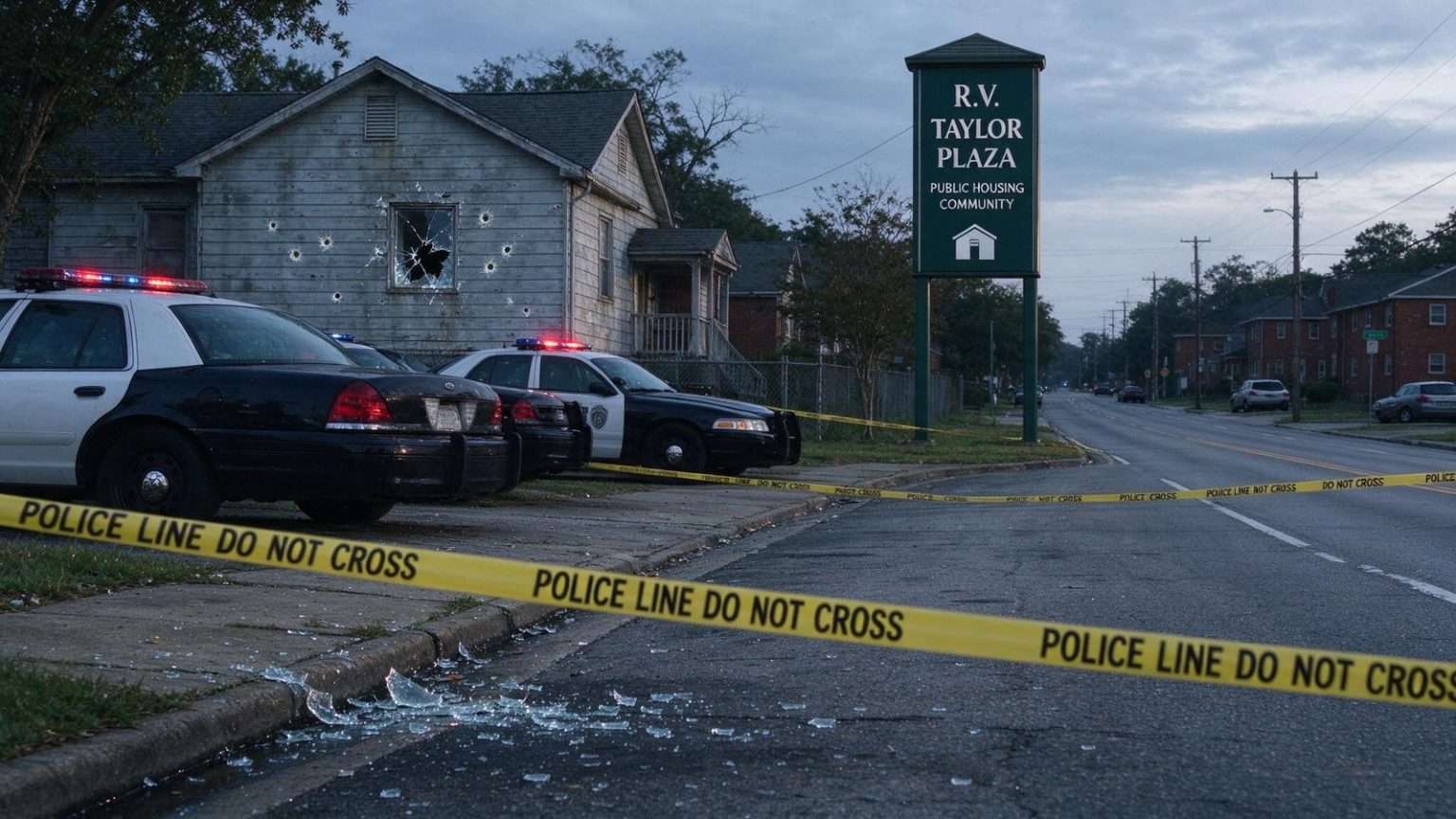
Less than a day after an 11-year-old boy was shot to death near R.V. Taylor Plaza, the neighborhood around Duval Street was still coming to grips with what happened — shattered car windows, spent police tape, and bullet-scarred homes marking the scene. Mobile police said the shooting broke out about 8 p.m. Monday. Witnesses described hearing nine or more shots ring out in quick succession, followed almost immediately by a heavy police response. The child was struck in the barrage and later died from his injuries.
The evidence left behind told its own story: shellfire appeared to have landed on both sides of the four-lane road, with at least one nearby home peppered by nine gunshots. The pattern of damage suggested the gunfire came in a rapid burst aimed across the roadway — the kind of shooting that turns an ordinary residential block into a hazard for everyone within range, whatever their connection to the dispute behind it.
R.V. Taylor Plaza, the public housing community in the area, has for years been one of the focal points of Mobile’s struggles with violent crime, and residents of the surrounding streets have repeatedly described living with the sound of gunfire as a fact of life. The death of a child in a spray of bullets — a bystander to a conflict he had nothing to do with — has renewed the anguish and the anger that follow each such loss in the neighborhood.
Nine Shots or More, Neighbors Say
Witnesses described hearing nine or more shots ring out in quick succession, followed almost immediately by a heavy police response.
In shootings of this kind, the volume of gunfire matters to investigators as well as to the people who heard it. The number of shell casings recovered, the locations where they fell and the damage to vehicles and homes all help detectives reconstruct how many shooters were involved, what direction the shots came from and whether more than one weapon was fired. Mobile police worked the scene into the night, and the physical evidence they collected — casings on both sides of Duval Street, bullet strikes in siding and windows — will be central to establishing the sequence of events.
The aftermath that residents woke up to the next morning was a familiar one for the neighborhood: cruisers parked along the curb, tape stretched across familiar corners, and families stepping outside to count the new marks on their homes and cars. Photographs and video of the damage circulated through the community, documenting block after block of property caught in the line of fire.
A Neighborhood Demanding Change
Residents who lived through it described running for cover, unsure where the gunfire originated, and questioned why children keep getting caught in the crossfire of disputes they have nothing to do with. Several said the area is normally quiet — a place where kids play outside — though many neighbors declined to speak on camera, citing fear of retaliation.
That reluctance is itself part of the story. In neighborhoods where shootings recur, witnesses often know more than they can safely say, and investigators routinely struggle to move cases forward when the people closest to the violence fear what cooperation would cost them. Police departments across the country, Mobile included, have worked to build alternative channels — anonymous tip lines, victim services and community liaisons — aimed at lowering the risk that residents take on when they come forward.
The fear of retaliation shapes daily life in other ways too. Families describe keeping children indoors after dark, knowing which corners to avoid, and listening for trouble on summer evenings. When a barrage of shots tears through a block where kids play outside, it confirms the sense that safety in the neighborhood depends as much on luck as on anything residents can control.
The Toll of Gun Violence on Children
The death of an 11-year-old in a neighborhood shooting places Mobile among the American cities confronting a grim national pattern: children killed not as intended targets but as bystanders to disputes carried out with guns in residential areas. Public health researchers have documented the ripple effects of such losses — classmates and neighbors grieving, families relocating, and entire blocks withdrawing from public life after a child is killed nearby.
The cost is measured in more than statistics. In the days after a child’s death, schools bring in counselors, pastors visit porches, and vigils draw crowds from across the city. What follows, residents say, is harder: the slow realization that nothing on the block has changed, and the question of whether the next barrage is a matter of when rather than whether.
Community advocates in Mobile have repeatedly pressed for a response that goes beyond arrests — violence intervention programs that reach young people before disputes turn deadly, investment in the neighborhoods where shootings cluster, and steady, visible policing that builds trust rather than fear. Each new victim, and especially each child, renews the argument that the city’s approach must treat the underlying conflicts and conditions, not only their aftermath.
The Investigation
Community members are calling for change as police work the investigation into who fired the fatal shots.
Homicide detectives investigating the boy’s death face the same constraints that shape most neighborhood shooting cases: a rapid burst of gunfire, multiple potential shooters, and a community where fear keeps many witnesses quiet. Detectives will be reconstructing the scene from physical evidence, canvassing for cameras — doorbell cameras and security systems have become critical sources of evidence in such cases — and following up on the accounts of those willing to talk.
The Mobile Police Department urges anyone with information to come forward through its investigators or through the department’s tip channels, where information can be provided without revealing a name. Officials have consistently said that cases like this one are solved, when they are solved, because someone in the neighborhood decides to speak.
For now, the block on Duval Street carries the physical record of Monday night: the broken glass, the bullet-scarred siding, the tape. The boy’s death has left a neighborhood grieving, a police department searching for those responsible, and a community once again asking how many more children will be caught in the crossfire before the pattern is broken.
Duval Street runs through the heart of the R.V. Taylor community, a four-lane road lined with homes, apartment complexes and the pedestrian traffic of a dense residential neighborhood. Its width and its traffic make it a natural corridor, but on Monday night the same geometry worked against the people who live along it: shots fired across a four-lane roadway put everyone on both sides at risk, and the damage police documented spanned the full width of the street.
The timing of the shooting — about 8 p.m. on a Monday — matters to those who live there. That is an hour when families are home from work and school, when children are outside in the last light of the evening, when the neighborhood is at its most populated. Residents said the block was carrying on an ordinary weekday evening when the shots began, and the immediate, instinctive response — diving for cover, pulling children inside — has become a grim measure of how practiced the community has grown at surviving gunfire.
The heavy police response that followed within minutes reflected the department’s protocol for shots-fired calls in residential areas. Multiple units converged on the scene, securing the block and beginning first aid efforts before medics arrived. The boy was rushed for treatment, but the injuries proved fatal, and the investigation shifted from a rescue to a homicide before the night was out.
City officials have faced recurring questions about conditions in and around R.V. Taylor Plaza, where aging housing stock, economic hardship and the geography of the neighborhood have combined to make the area a persistent flash point in the city’s crime data. Previous efforts — increased patrols, community meetings, youth programming run through churches and community centers — have each been aimed at the same problem the neighborhood confronted again this week: young people growing up within earshot of violence that too often reaches them.
What happens next depends on the two tracks that always follow a killing like this one. The first is the investigation, where detectives hope that physical evidence and a few courageous witnesses will identify who fired into a residential street. The second is the community’s response, where residents, advocates and city leaders must decide what — beyond grief and outrage — will change on Duval Street so that the next barrage of shots does not find another 11-year-old in its path.
Anyone with information about the shooting is urged to contact Mobile police or the department’s tip line, where details can be shared without giving a name. In a case that took the life of a child on a block where children play, investigators say, even the smallest detail — a voice heard before the shots, a car seen leaving, a phone video from a porch — could be what breaks it open.