Group pitches lower-cost alternative to the Mobile River bridge and Eastern Shore expressway
Backers of a new plan say their Mobile River bridge and expressway proposal would nearly halve the $2 billion cost of the killed state plan.
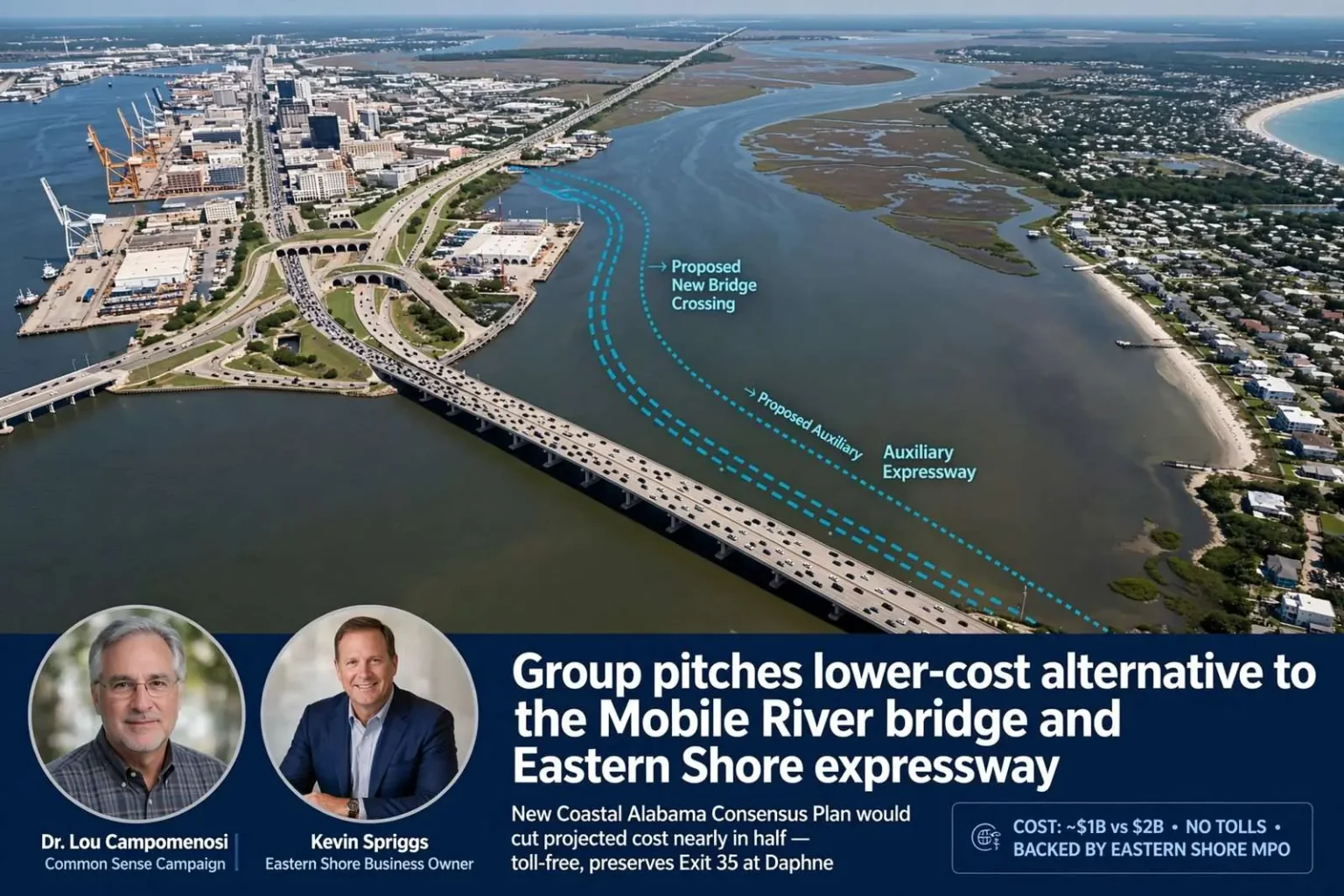
A newly proposed Mobile River bridge and expressway plan would nearly cut in half the $2 billion cost of the state-backed proposal killed last year, its backers say. The alternative, called the Coastal Alabama Consensus Plan, was put forward by Dr. Lou Campomenosi of the Common Sense Campaign and Eastern Shore businessman Kevin Spriggs, two of the most persistent critics of the toll-financed project that Alabama voters and officials set aside after years of public opposition.
The plan arrives at a delicate moment in the region’s long-running transportation debate. Last week, the Eastern Shore Metropolitan Planning Organization endorsed the alternative, while Mobile’s MPO took no action. Mobile Mayor Sandy Stimpson, who leads the city MPO, said his group would not act “until ALDOT says this is something we can embrace.” That split response leaves the plan with momentum on the Baldwin County side of the bay and an open question across the water, where the biggest congestion problems are located.
What the plan would build
The Coastal Alabama Consensus Plan calls for a new bridge over the Mobile River and an expressway to the Eastern Shore running alongside the existing Bayway, the elevated stretch of Interstate 10 that crawls through the Tensaw Delta between Mobile and Spanish Fort. Under the proposal, the existing routes would carry no tolls, sparing commuters and freight haulers the daily charges that turned the state’s earlier plan into one of the most contentious public issues in recent Alabama history.
The proposal also preserves Exit 35 at Daphne and the Eastern Shore, an access point that earlier designs threatened to eliminate. “Exit 35 is the key to what’s going on with the eastern shore,” Campomenosi said. Daphne’s exit serves as a lifeline for local traffic along the Highway 98 corridor, connecting residents to schools, businesses and medical offices without forcing them onto the interstate. Its removal was among the most resented elements of the state plan, and its preservation is a deliberate signal to Eastern Shore officials that the alternative is built around local access as much as through traffic.
Half the price, different financing
The cost argument is the plan’s central selling point. The state-backed Mobile River Bridge and Bayway project carried an estimated $2 billion price tag, a figure that officials planned to cover in large part through tolls — roughly $3 to $5 each way by most public descriptions — managed through electronic tolling. After sustained opposition from commuters, Baldwin County residents and officials on both sides of the bay, the project was shelved last year, leaving the region’s congestion problem unsolved and the search for alternatives underway.
By pairing a new river crossing with an auxiliary expressway beside the existing Bayway rather than a full replacement, backers say the consensus plan cuts the cost nearly in half. The reduced figure changes the financing conversation: without tolls on existing routes, the project would depend on conventional public funding, which is precisely why its backers have spent their energy in Montgomery rather than only at MPO meetings.
The push for state support
The focus now is on getting state leaders to take a look. “It’s in their interest to try to find a solution,” Campomenosi said, noting that other Montgomery officials have worked with the group on funding a non-toll plan. The reference is deliberate: without state money, no bridge over the Mobile River gets built, and the consensus plan’s backers have concluded that legislative support matters more than local endorsements at this stage.
To move forward, backers say the plan needs support beyond Eastern Shore leaders before Gov. Kay Ivey and ALDOT Director John Cooper re-engage on the issue. The governor’s office and the state transportation department effectively own the interstate corridor, and any project touching I-10 and the Mobile River crossing must pass through their desks. Campomenosi’s group has spent months assembling its case — cost estimates, traffic logic and endorsements — and now faces the harder task of persuading Mobile-area legislators, city officials and business groups that a non-toll plan deserves the state’s attention.
The Eastern Shore MPO’s endorsement is a first building block, but Mobile’s silence matters. The city MPO’s members represent the side of the bay where the new bridge would land, and without Mobile’s buy-in, the plan cannot claim the regional consensus its name advertises. Stimpson’s statement that the city will wait for ALDOT’s read on the proposal puts the burden of the next step on the state agency rather than on the city.
Why the bottleneck still exists
Underneath the debate is a problem no one disputes. The George Wallace Tunnel and the Bankhead Tunnel funnel Interstate 10 traffic through downtown Mobile in two of the oldest vehicle tunnels on the interstate system, and the Bayway across the Delta adds a second chokepoint. Freight traffic from the Port of Mobile and the Gulf Coast’s growing logistics industry mixes with local commuters in those bottlenecks daily, and hurricanes regularly turn the crossings into evacuation choke points.
ALDOT’s original solution — the massive river bridge and rebuilt Bayway with tolling — was engineered to fix all of that at once, but its cost and toll structure made it politically unpalatable. The consensus plan’s smaller footprint accepts less: a new crossing to relieve the tunnels, an auxiliary expressway to relieve the Bayway, and toll-free existing routes to protect local commuters. Whether that trade satisfies engineers and federal funding requirements is one of the questions state leaders will have to answer.
The toll politics that shaped the debate
Any discussion of the Mobile River bridge eventually returns to the tolls that killed the last plan. Under ALDOT’s original proposal, drivers using the new bridge and rebuilt Bayway would have paid electronically collected tolls each way, while the tunnels remained free — a structure critics said would push through traffic and price-sensitive locals alike into downtown streets or older alternate routes. Baldwin County officials voted formally against the toll plan, and grassroots groups organized for years around the slogan of a toll-free crossing.
The Coastal Alabama Consensus Plan is the direct descendant of that opposition. Campomenosi’s Common Sense Campaign was among the earliest and most consistent critics of the toll structure, and Spriggs brought a business perspective from the Eastern Shore, where daily commuting patterns made the toll’s cost a household budget issue. By marrying their opposition to an actual alternative — not just a rejection of the state’s plan — the two have tried to shift the debate from what they oppose to what they support.
What happens next
The sequence from here runs through Montgomery. Backers want legislators from Mobile and Baldwin counties to unite behind the non-toll concept and ask the state to evaluate the consensus plan formally. They want the Governor’s office and ALDOT Director John Cooper to re-engage, and they argue the state’s interest in finding a solution is self-evident: the congestion problem did not disappear when the toll plan was shelved, and neither did the freight traffic, the hurricane evacuation risk or the federal funding opportunities that require a locally supported project.
For now, the region watches two signs. The first is whether Mobile’s MPO follows the Eastern Shore’s lead or continues to wait on ALDOT, as Mayor Stimpson indicated. The second is whether state leaders signal any willingness to study a plan that costs roughly half as much and collects no tolls. Either development would mark real progress after a year in which the region’s biggest infrastructure question sat unanswered.
The geography of the problem
The corridors in question carry some of the heaviest traffic in Alabama. Interstate 10 is the primary east-west freight route for the entire Gulf Coast, linking the Port of Mobile — one of the busiest deepwater ports on the Gulf — with Florida’s panhandle and the broader interstate network. Every truck that rolls off a ship at the port and heads east must navigate the tunnels and the Bayway, and every hurricane season, that same route becomes the evacuation path for hundreds of thousands of coastal residents.
That is why the debate never really ends, even when the construction plans do. Local officials on both sides of Mobile Bay acknowledge that doing nothing is not a solution; the disagreement has always been about the shape and the financing of the fix. The consensus plan’s backers argue their approach threads that needle — a new crossing where the need is greatest, toll-free routes where the public has drawn its line, and a price tag a state budget can actually reach.
Until then, commuters on both sides of the bay remain where they started: creeping through the Bankhead and Wallace tunnels each morning, crawling the Bayway each evening, and waiting to see whether the third attempt at a Mobile River crossing — the consensus plan — fares better than the two that came before it.