
Gulf Coast Challenge moves to spring at Ladd-Peebles with capped crowd and $15 tickets
The Gulf Coast Challenge moved to spring at Ladd-Peebles Stadium, pairing West Alabama and Savannah State with a 7,000-seat cap and $15 tickets.
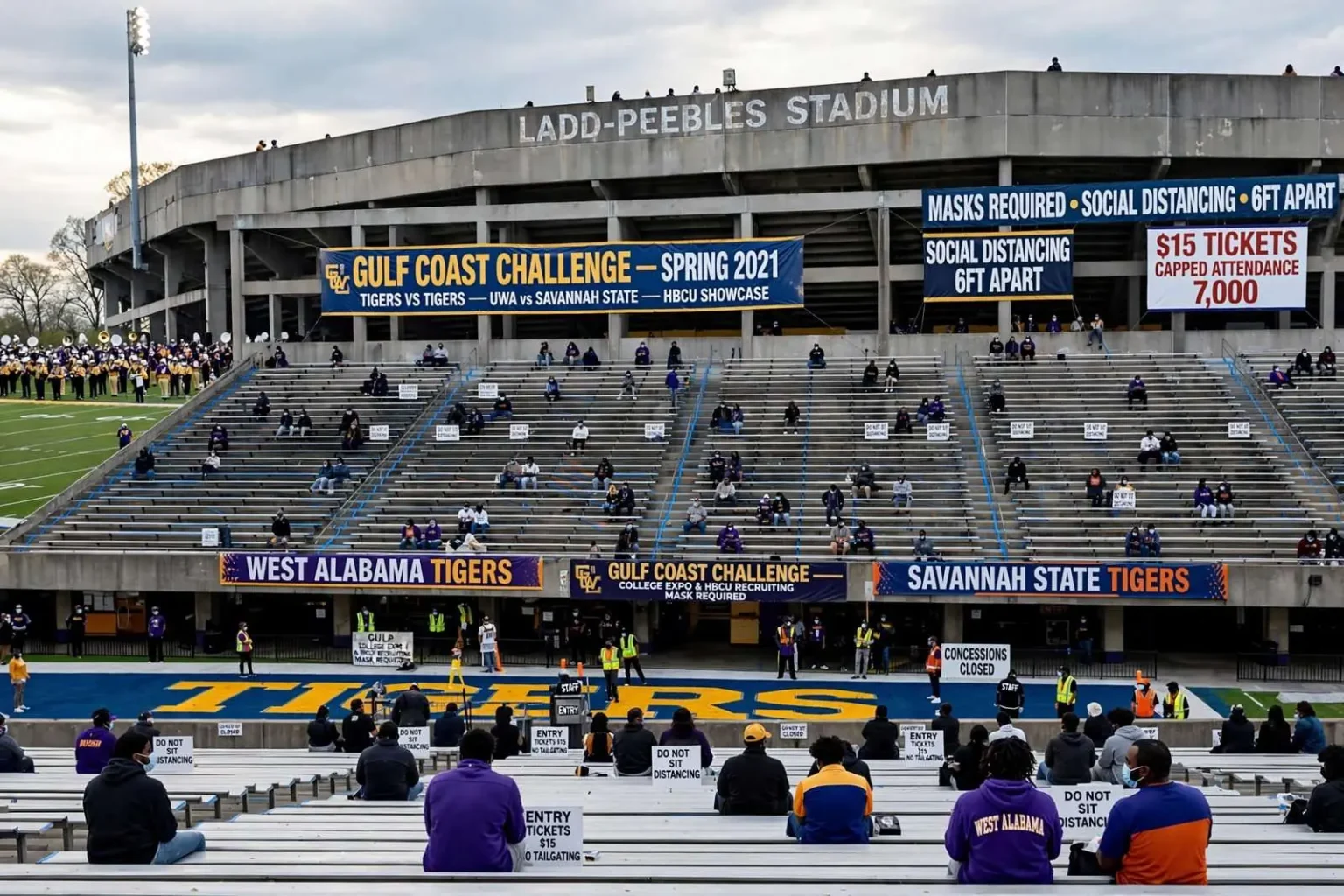
Mobile’s long-running showcase of Historically Black College and University football returned to Ladd-Peebles Stadium in an unfamiliar season and at a fraction of its usual size, as organizers pushed the Gulf Coast Challenge into the spring rather than lose it to the pandemic. The matchup pitted the University of West Alabama against Savannah State University — a meeting of two Tiger programs, and the first time the Challenge paired an HBCU with an in-state school.
The scheduling shift alone set the game apart. The Gulf Coast Challenge has traditionally been a fall fixture on Mobile’s sports calendar, drawing fans from across the Gulf Coast region for a weekend built around football, marching bands and the pageantry that distinguishes HBCU game days from any other in college sports. Moving the event to spring meant working around a different calendar, smaller crowds and health protocols that would have been unthinkable a year earlier.
Transforming the Stadium
Organizer Tim Hale Jr. said crews planned a full visual overhaul of the venue for the game. “They are about to transform the whole stadium. We got banners going up. They’re going to paint the field. The end zone will be painted,” Hale said.
For Hale, the game carries personal weight. He traces his own path to college back to watching an HBCU program play in that same stadium. “Seeing Southern University inside this stadium got me to the point where I said, ‘I got to go to college and I got to go to Southern University,’ and here we are today,” Hale said.
He went on to attend and graduate from Southern University, then returned home and has worked on the Gulf Coast Challenge for more than two decades. “I want the kids to see that going to an HBCU is beautiful. The heritage, the cultures, the traditions, it’s amazing,” Hale said.
That mission — using a football game as a recruitment pitch for higher education — is the thread that runs through every edition of the Challenge. Marching bands, Greek-letter organizations, alumni gatherings and college expos woven into the weekend all serve to put HBCU campus life on display for high school students from Mobile and beyond, the same way a single game once did for Hale himself.
A Scaled-Down Year
The event normally draws large crowds and brings millions of dollars into the city, but pandemic restrictions forced significant changes. Attendance was capped at roughly 7,000, with seats taped off to maintain at least six feet of distance. Masks were required, and tailgating was not permitted. Organizers dropped ticket prices to $15, citing the financial strain many families were under.
“This was a process. It was a hard process even coming through a pandemic. No one was prepared for this, but I feel if you put your mind to it, you work hard enough and you build the right relationships and the Gulf Coast will show you that it can get through this,” Hale said, summing up the effort behind the reduced but resilient edition of the game.
The restrictions reshaped every element of the game-day experience. Tailgating, the social centerpiece of HBCU football weekends, was eliminated, and the bands, dance teams and fan traditions that normally fill the concourses operated under the same distancing rules as the crowd. Fans who attended found an event familiar in spirit but unmistakably smaller, with taped-off sections standing in for the packed stands the Challenge usually produces.
Even so, staging the game at all counted as a win for Mobile. College sports programs across the country had canceled games, postponed seasons and closed stadiums to fans, and any event that could safely put thousands of people in seats represented a feat of planning. The Challenge’s organizers leaned on relationships with the city, the stadium, the schools and public health officials to pull it off.
The Matchup: Tigers Against Tigers
The pairing gave the game a storyline of its own. The University of West Alabama, located in Livingston, fields its Tigers at the NCAA Division II level as a member of the Gulf South Conference, with a football program long regarded as a regional power. Savannah State University, a historically black university in Savannah, Georgia, brought its own Tigers — a program with deep HBCU traditions and a fan base accustomed to traveling for showcase games.
The crossover made the game a first for the Challenge, which had previously matched HBCU programs against each other. Adding an in-state school broadened the game’s appeal in Alabama while preserving the event’s core identity, and it gave West Alabama a showcase against an opponent and an atmosphere the Tigers’ regular Gulf South schedule could not replicate.
For the players, games like the Challenge carry stakes beyond the scoreboard. Many roster members come from Alabama, Mississippi, Georgia and Florida, and showcase games played in major venues give athletes a professional-style stage in front of family, scouts and fans. For the seniors on both sidelines, a spring showcase offered an unexpected extra chapter to careers interrupted and reshuffled by the pandemic.
Ladd-Peebles and the Challenge’s Place in Mobile
Ladd-Peebles Stadium has been Mobile’s marquee football venue for generations, hosting high school championships, college bowls and HBCU showcases under the same lights. The Gulf Coast Challenge is part of that fabric, an event that fills hotels and restaurants along the I-10 corridor and puts Mobile’s hospitality industry to work in a season when the calendar would otherwise be quiet.
The economic footprint of a normal edition of the Challenge is substantial. Visitors fill rooms across the city, patronize restaurants and shops, and extend their stays around the game weekend, spending that reaches well beyond the stadium gates. The pandemic edition, with its capped attendance, delivered only a fraction of that impact, but even a reduced game kept the event’s brand alive through a year when so many regional traditions simply disappeared.
HBCU Football’s Broader Legacy
The Challenge belongs to a wider family of HBCU showcase games played across the South, from Labor Day classics to homecoming extravaganzas that draw tens of thousands. These games have always been about more than football: they are reunions, recruiting showcases and celebrations of institutions that produced generations of Black doctors, teachers, engineers, judges and business leaders, often in eras when those students were barred from flagship state universities.
Alabama itself sits at the heart of that story, home to institutions like Alabama State and Alabama A&M, and within driving distance of Southern University in Baton Rouge, Jackson State in Mississippi and dozens of other campuses that draw Gulf Coast students. For families in Mobile, the chance to see those schools represented on a local field — and to meet their recruiters and alumni in person — makes the Challenge a genuine bridge between the city and the HBCU tradition.
Hale’s own biography is the event’s best advertisement. A Mobile native who watched a game at Ladd-Peebles, chose an HBCU, graduated from one and came home to build an institution of his own, he embodies the pipeline the Challenge exists to promote. His stated hope — that kids in the stands see HBCU heritage, culture and tradition for themselves — is the pitch, delivered with the stadium as the prop.
Looking Ahead
Whether the spring experiment becomes a one-time accommodation or a recurring feature, the organizers’ goal is to return the Challenge to full strength: full crowds, tailgates restored, bands at full blast and the economic engine running at capacity. The 2021 edition proved the event could survive a pandemic, adapt to health protocols and still deliver a game worth attending at a price families could afford.
For Mobile, the game’s return — in whatever form — preserved an asset that cities around the region have tried to replicate: a signature HBCU football event with two decades of history, a loyal following and an organizer whose personal story gives it a mission beyond the scoreboard. The next edition of the Challenge will aim to restore what the pandemic took away, starting with the packed stands that make HBCU football unlike anything else in the sport.
Until then, the capped crowd, the $15 tickets and the painted end zones of this spring’s game will stand as the year the Gulf Coast Challenge refused to cancel — and the year another generation of Mobile kids got the same view of an HBCU marching band that once changed Tim Hale Jr.’s life.
Stadium staff and volunteers also absorbed a steep learning curve. Ticketing at a capped capacity, seated zones taped off by section, mask rules at the gates and a no-tailgating policy all required extra staffing and constant communication with fans, many of whom were attending their first public event since the pandemic began. That the game went off without major disruption reflects the behind-the-scenes work that rarely makes the highlight reel.


