Gulf Coast Ethnic and Heritage Jazz Festival Seeks Poster Artists for 17th Annual Event
The Gulf Coast Ethnic and Heritage Jazz Festival has opened its annual poster art contest earlier than usual, inviting artists to submit original designs ahead of a May 1 deadline for a chance at a cash prize and festival booth.
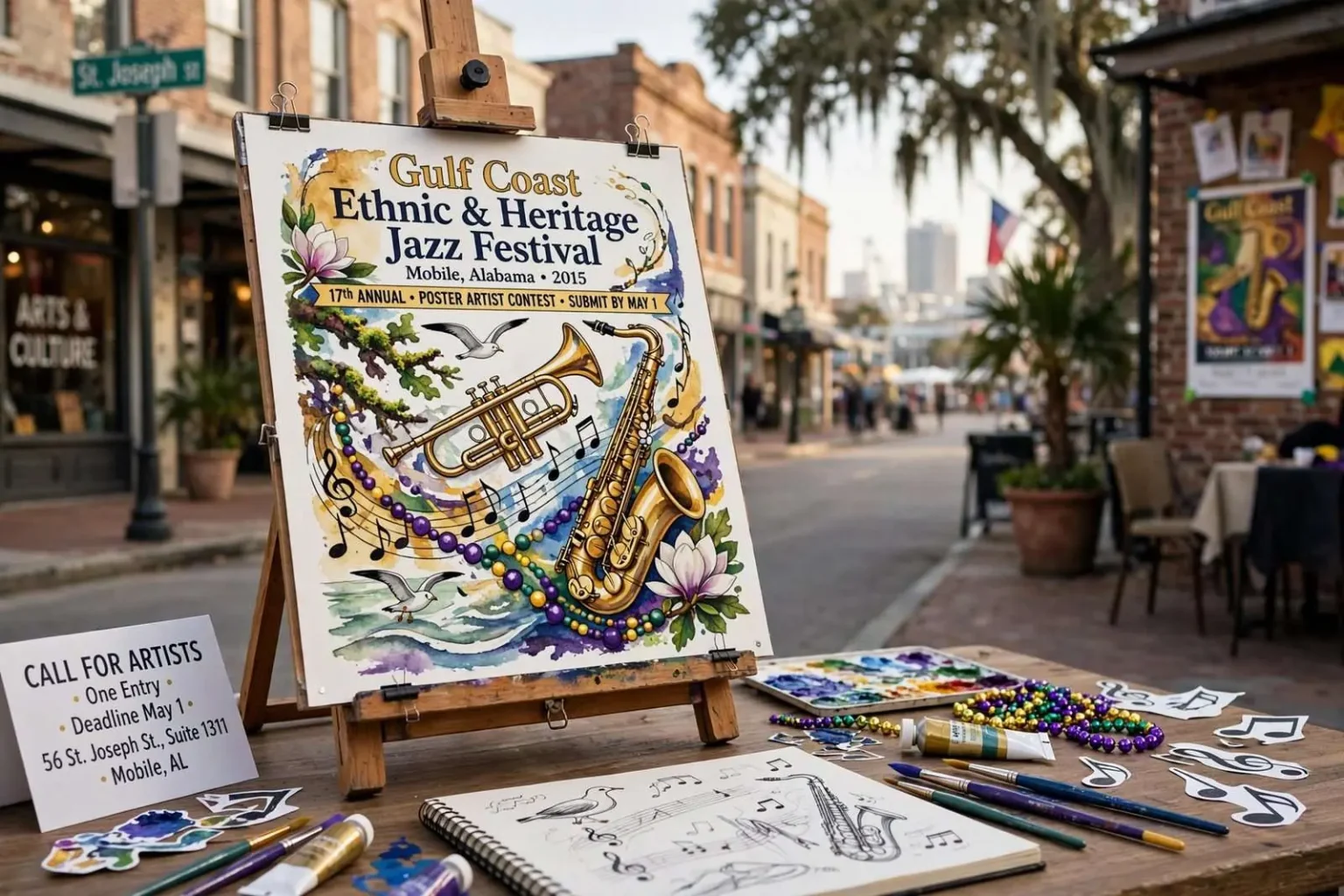
Organizers of the Gulf Coast Ethnic and Heritage Jazz Festival are inviting artists across the region to submit designs for the event’s official poster, opening the annual contest earlier than in past years in hopes of drawing a larger field of entries. The early start is a deliberate change to a competition that has become one of the more visible opportunities each year for Gulf Coast visual artists.
The festival, now heading into its 17th year, is scheduled to run July 27 through Aug. 2 in Mobile. Festival staff said moving up the poster contest timeline should give artists more breathing room to develop and submit their work before the deadline — a practical fix for a contest that, in past years, squeezed painters and illustrators into a compressed window alongside their other professional obligations.
The logic is straightforward. A poster commissioned to represent a jazz festival is the kind of piece an artist wants to get right, and good work rarely comes from a weekend scramble. By announcing the theme and specifications months in advance, organizers hope entries will multiply — and that the winning design will benefit from the extra polish a longer runway allows.
The contest at a glance
The competition is open to artists of all backgrounds and skill levels, though each participant may submit only one entry. Submissions must be original, unpublished two-dimensional works that have not appeared in any other contest or publication — a standard requirement that protects both the artist and the festival from disputes over rights when the winning design is reproduced.
The technical specifications are precise. Entries must measure 24 inches high by 18 inches wide and be mounted on white core foam board. Each piece is also required to incorporate the words “Gulf Coast Ethnic & Heritage Jazz Festival,” the phrase “Mobile, Alabama,” and the year “2015” somewhere in the design — ensuring the winning poster can do its real job as promotional material, identifying the event at a glance whether it hangs in a storefront window or runs in an advertisement.
Those requirements also shape the creative challenge. Artists must build legible text into a composition that still conveys the feeling of the festival: jazz as a living tradition on the Gulf Coast, with all the color, movement and heritage that implies. The best festival posters manage to be both fine artwork and functional signage at once, which is what makes the contest genuinely competitive year to year.
Completed artwork, along with a signed entry form, must be delivered to the festival’s offices at 56 St. Joseph St., Suite 1311, in downtown Mobile no later than May 1. The downtown address places the drop-off in the heart of Mobile’s arts and entertainment district, a fitting collection point for a contest tied to the city’s cultural identity.
Entry forms are available through the festival’s website. Organizers urge artists to read the requirements carefully before starting work, since pieces that miss the size, mounting or text requirements are typically disqualified regardless of their merit — a hard lesson that the early timeline is meant to help artists avoid.
Judging, prizes and the winning design
A panel of judges will review the submissions and select a winner in May. The chosen design, or elements of it, will be used as the official festival poster and may also appear across other promotional materials tied to the event — meaning the winning artist’s work will be reproduced on everything from printed programs to banners during festival week.
The winning artist will receive a $200 cash prize, along with a vendor booth to display and sell additional artwork during the festival’s “Jazz at the Temple” performance, set for Saturday, Aug. 1. For working artists, the booth may prove the more valuable prize: a booth at the festival’s marquee performance puts original work in front of an audience of jazz fans and arts buyers for an evening, with the winner’s poster already hanging across town as a calling card.
Past poster contests of this kind have served as career springboards for regional artists, and organizers have long promoted the contest as a chance for local talent to put a personal stamp on a beloved community event. With one entry allowed per artist, the field stays open — a first-time entrant competes on equal footing with a professional illustrator, and the judges’ May decision is the only verdict that counts.
The Gulf Coast Ethnic and Heritage Jazz Festival has become a fixture of Mobile’s summer arts calendar, drawing musicians and visitors from across the Gulf Coast for a week of performances celebrating jazz and its cultural roots. The name captures the event’s dual identity: it is both a music festival and a deliberate celebration of the African American heritage from which jazz grew.
The festival’s format gives Mobile audiences a full week of programming rather than a single day of music, with performances spread across venues in the city and culminating in the “Jazz at the Temple” showcase on Saturday, Aug. 1. That structure lets the event reach different audiences in different settings — an afternoon crowd at a community venue, an evening audience downtown — and gives touring and regional musicians several stages on which to play during their stay.
Jazz has deep roots along the northern Gulf Coast, where the musical traditions of New Orleans, Mobile and the port cities between them have circulated for more than a century. Mobile’s own musical heritage spans jazz, blues, gospel and the brass band traditions carried across the Gulf, and a festival devoted to the genre’s ethnic and heritage dimensions speaks directly to that lineage. For local musicians, it is one of the few weeklong showcases in the region; for visitors, it is a summer destination that keeps them in Mobile hotels and restaurants during a season when the arts calendar otherwise thins out.
Why the poster matters to the festival
Organizers say the poster contest gives local visual artists a chance to put their own creative stamp on the festival’s identity each year. The annual poster is more than decoration — it is the festival’s face for an entire year, appearing on flyers, advertisements and the shirts and programs that fans carry home, and past designs become part of the event’s collected visual history.
That annual artwork also documents the festival itself. A decade of contest-winning posters, hung side by side, tells the story of how the event has grown and how local artists have interpreted jazz and Gulf Coast heritage through their own eyes. Cities with long-running festivals — jazz or otherwise — treat their poster archives as cultural records, and Mobile’s is being built one May at a time.
For artists considering an entry, the math favors participation. The contest costs nothing to enter, the early deadline gives more than two months of working time between the announcement and the May 1 delivery date, and even a non-winning submission leaves an artist’s work in front of a panel of judges drawn from the region’s arts community. The single-entry rule concentrates the effort: one strong concept, executed well on the required 24-by-18 board, rather than a portfolio of scattered attempts.
Artists with questions about entry requirements or the submission process can contact festival organizers by phone at 251-459-2298 or visit the festival’s website for full contest rules. Organizers recommend calling early with technical questions — mounting materials, text placement and framing choices are the details that most often trip up otherwise strong entries.
Marking the calendar
The key dates are easy to keep straight. Artwork and signed entry forms are due at 56 St. Joseph St., Suite 1311, by May 1. Judges announce the winner in May. The festival runs July 27 through Aug. 2, and the winning artist sells work at “Jazz at the Temple” on Saturday, Aug. 1.
Between now and then, organizers will be promoting the contest through the same channels that carry word of the festival itself — local galleries, arts councils and the network of working artists who follow Mobile’s cultural calendar. The earlier announcement is intended to widen that circle beyond the painters and designers who have entered in past years, reaching art students, hobbyists and first-time entrants who might not otherwise have considered their work festival-poster material.
Seventeen years in, the Gulf Coast Ethnic and Heritage Jazz Festival has outlasted many events that once shared its summer slot, and its annual poster has been part of that staying power — an image that recurs each summer in storefronts and on lampposts across the city, announcing a week when Mobile’s jazz heritage takes the stage. This year, organizers are betting that a few extra months of creative room will bring out the strongest field of designs yet. Artists have until May 1 to prove them right.