
Gulf Coast Ethnic Heritage Festival 2013 Brings Free Jazz to Downtown Mobile
The 13th annual Gulf Coast Ethnic Heritage Festival returns to downtown Mobile with free jazz from Dionne Farris, Russell Gunn and more.
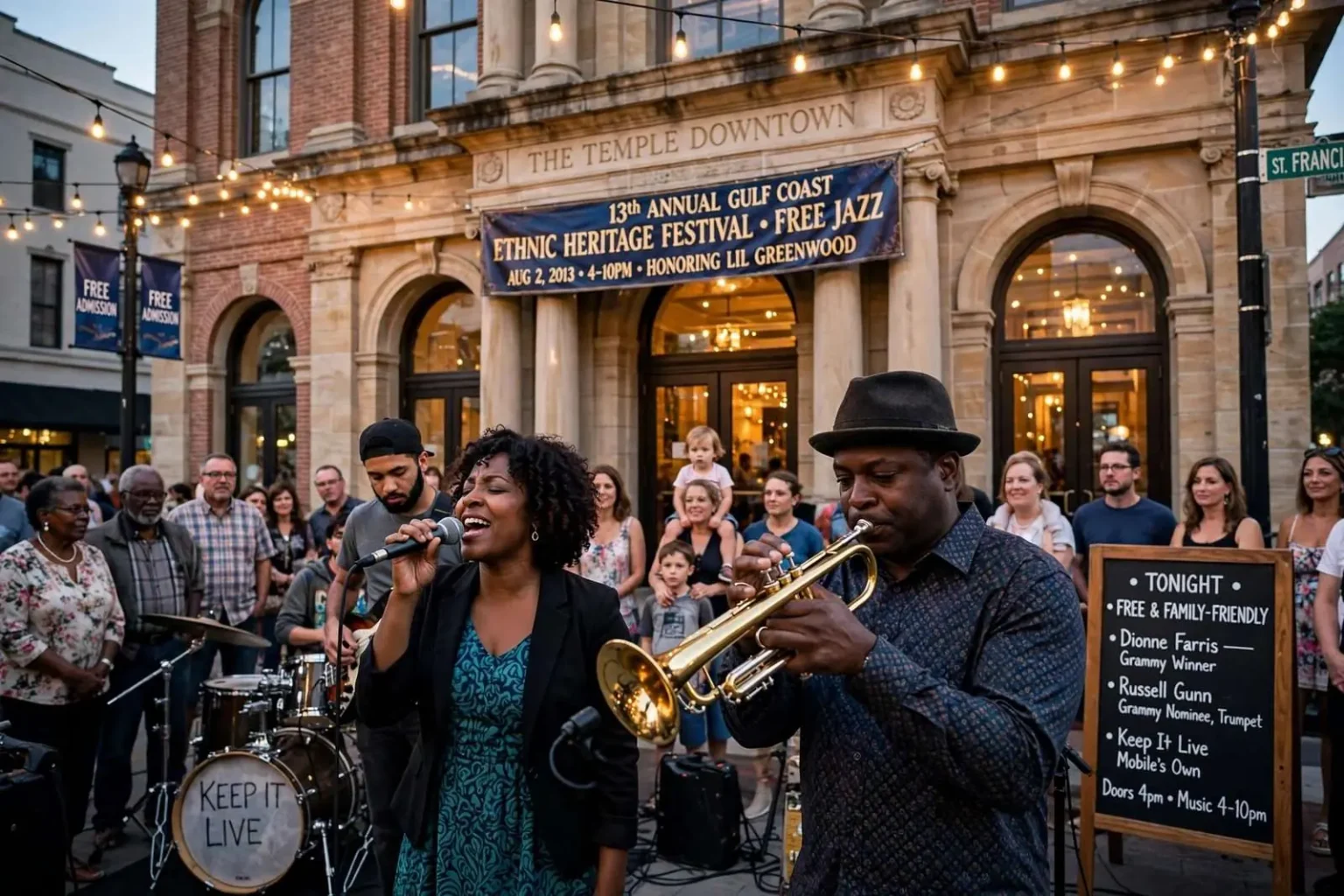
The 13th annual Gulf Coast Ethnic Heritage Festival will bring live jazz and celebration to downtown Mobile on Saturday, Aug. 2, 2013, with a free evening of music at The Temple Downtown on St. Francis Street. The family-friendly event runs from 4 to 10 p.m. and is free to attend, offering residents and visitors a chance to experience Gulf Coast heritage through music — and, in a year when the lineup pairs a Grammy winner with a Grammy nominee and a rising local band, one of the strongest bills the festival has assembled.
Honoring a Mobile-Born Star
The festival is held each year in honor of Lil Greenwood, the Mobile-born singer who performed for decades with Duke Ellington’s orchestra. Greenwood’s career carried her from Mobile to the biggest stages in American jazz, and her voice became part of the Ellington band’s sound during one of the most storied runs in that orchestra’s history. For a festival dedicated to the Gulf Coast’s ethnic heritage, Greenwood is the perfect namesake: a hometown artist whose talent took her to the top of her profession and whose roots never stopped mattering to the people who watched her leave.
Greenwood appeared at the GCEH Jazz Fest before her death in 2011, and organizers continue to celebrate her legacy through the event. That connection between the honoree and the festival itself gives the gathering a continuity most anniversary events lack — the audience includes people who heard Greenwood sing in person, and the stage she helped define now hosts the artists who followed her. Each edition doubles as a tribute and a passing of the torch, reminding attendees that the Gulf Coast’s contribution to American music runs deeper than the region’s size would suggest.
The 2013 Lineup
This year’s featured performers include Grammy-winning vocalist Dionne Farris, known for her work with the hip-hop group Arrested Development and her 1995 solo hit “I Know.” Farris’s path through American music — from the genre-blending success of Arrested Development to a solo career that made “I Know” one of the defining singles of the mid-nineties — gives her a catalog that spans hip-hop, soul, rock, and R&B, and a voice that critics have long ranked among the era’s most distinctive. Her booking signals the festival’s willingness to reach beyond straight-ahead jazz while keeping the music rooted in the Black American traditions the event celebrates.
Trumpeter Russell Gunn, a Grammy nominee celebrated for his recordings reinterpreting Miles Davis, also headlines, bringing his blend of jazz, hip-hop and electronic influences. Gunn is among the modern trumpeters who took the language of Davis’s electric era and pushed it into new territory, and his ensembles treat genre boundaries as porous rather than fixed — a stance that fits neatly beside Farris’s own cross-genre history. Rounding out the bill is Keep It Live, a young band from Mobile that previously performed at the city’s Bayfest alongside Dennis Nelson, giving the festival its local anchor and a glimpse of the region’s next generation on a bill with national names.
Organizers have long treated the festival as a teaching opportunity as well as a concert. Program notes, stage remarks, and community partnerships over the years have connected the music to the history behind it, giving audiences context for who Lil Greenwood was and why a Mobile-born vocalist matters to the story of American jazz. That educational thread is part of what distinguishes a heritage festival from a generic summer concert, and it reflects the organization’s founding purpose of preserving and passing on the Gulf Coast’s ethnic and musical inheritance.
The Temple Downtown
The venue itself adds weight to the evening. The Temple Downtown, a landmark building on St. Francis Street in the heart of downtown Mobile, has served as a music venue and event space with the kind of architecture and acoustics that modern clubs cannot replicate, and its sanctuary-style room has hosted touring acts, local showcases, and festival stages alike. For a jazz evening, a room with natural resonance and a seated, attentive audience does the music a favor: horn lines carry, vocals land cleanly, and the dynamics that make live jazz worth hearing in person survive the room rather than disappearing into it.
Locating a free festival downtown also puts it within walking distance of restaurants and businesses that feel the benefit of a few thousand attendees on a Saturday evening. Mobile’s downtown revival over the past two decades has leaned heavily on events that draw crowds to Dauphin Street and the surrounding blocks, and a 4-to-10 p.m. festival slots neatly into that pattern — early enough for families, late enough to hand the crowd off to the evening businesses when the final set ends.
A Festival Built on Heritage
The Gulf Coast Ethnic Heritage Festival has spent more than a decade using music to teach and celebrate the region’s shared cultural history, and its organizers have consistently framed the event as both entertainment and education. Jazz, the genre at the event’s center, is itself a Gulf Coast story: the music traveled the same waterways and rail lines that shaped Mobile, New Orleans, and the port towns between them, and the region produced its share of the musicians who built it. Thirteen years in, the festival has become a fixture of Mobile’s summer calendar, and its free admission policy remains central to its mission of making that history available to everyone.
Free admission is a statement of purpose as much as a pricing decision. Festivals that charge at the gate inevitably draw a narrower audience than their communities contain, while open-door events like the GCEH festival bring together audiences of every age and background — grandparents who remember Lil Greenwood’s era, parents introducing children to live jazz, and young musicians studying what the headliners do. The organizers’ bet, proven out over thirteen editions, is that the community will support the event’s mission when nothing stands between them and the music. That accessibility has also made the festival a recurring entry on the calendars of families across the Gulf Coast who plan their summers around free outdoor and indoor cultural events, knowing that a quality evening of music costs nothing more than the trip downtown.
The Artists’ Place in the Story
The 2013 bill reflects where American music stood at the intersection of jazz and everything it touched. Dionne Farris came to prominence with Arrested Development, the Georgia collective whose Grammy-winning fusion of hip-hop and Southern musical traditions reshaped what rap could sound like in the early nineties, before “I Know” proved her solo power on rock and soul radio. Russell Gunn’s career runs a parallel course on the instrumental side — a trumpeter raised on jazz who earned Grammy recognition while deliberately folding hip-hop production and electronic textures into his reinterpretations of Miles Davis, the musician whose own late-career openness to funk and pop made such experiments legitimate. Placing those two voices on the same stage creates the kind of pairing festival audiences remember: a singer and a trumpeter whose careers both argue that genre lines are drawn to be crossed, drawing on songbooks that connect the jazz tradition the festival honors to the contemporary music its younger attendees grew up on.
Booking those two names alongside a young Mobile band is more than a convenience of scheduling. Festivals like the GCEH event function as lineage in action: the headliners demonstrate where traditions can go, and the local act demonstrates where they come from. Keep It Live’s earlier appearance at Bayfest alongside Dennis Nelson already marked the band as one of the city’s acts to watch, and sharing a festival stage with a Grammy winner and a Grammy nominee is the kind of experience that changes what a young group believes is possible for a band from Mobile.
Why It Matters for Mobile
An evening of free music in a landmark downtown room honors the city’s musical inheritance in a way few other formats can. Mobile has produced artists who shaped American music far beyond the Gulf Coast, from Greenwood’s era with Ellington to the generations that followed, and events like the Gulf Coast Ethnic Heritage Festival keep those connections visible to a hometown audience that might otherwise know the names only from record sleeves. Each August, the festival gathers that history onto one stage and hands it to the crowd for the price of showing up.
The 13th annual edition runs from 4 to 10 p.m. Saturday, Aug. 2, 2013, at The Temple Downtown, the St. Francis Street landmark hall that has become one of the city’s reliable music rooms. Attendees can expect six hours of music from three acts spanning generations and genres, a tribute to Lil Greenwood woven through the evening, and the atmosphere of a community celebrating its own heritage — free of charge, family-friendly, and open to anyone who walks in off the street.