Gulf Coast Food Bank Preparing Nearly 200,000 Pounds of Thanksgiving Groceries
Feeding the Gulf Coast will distribute nearly 200,000 pounds of food to more than 7,000 families for Thanksgiving as grocery prices stay elevated.
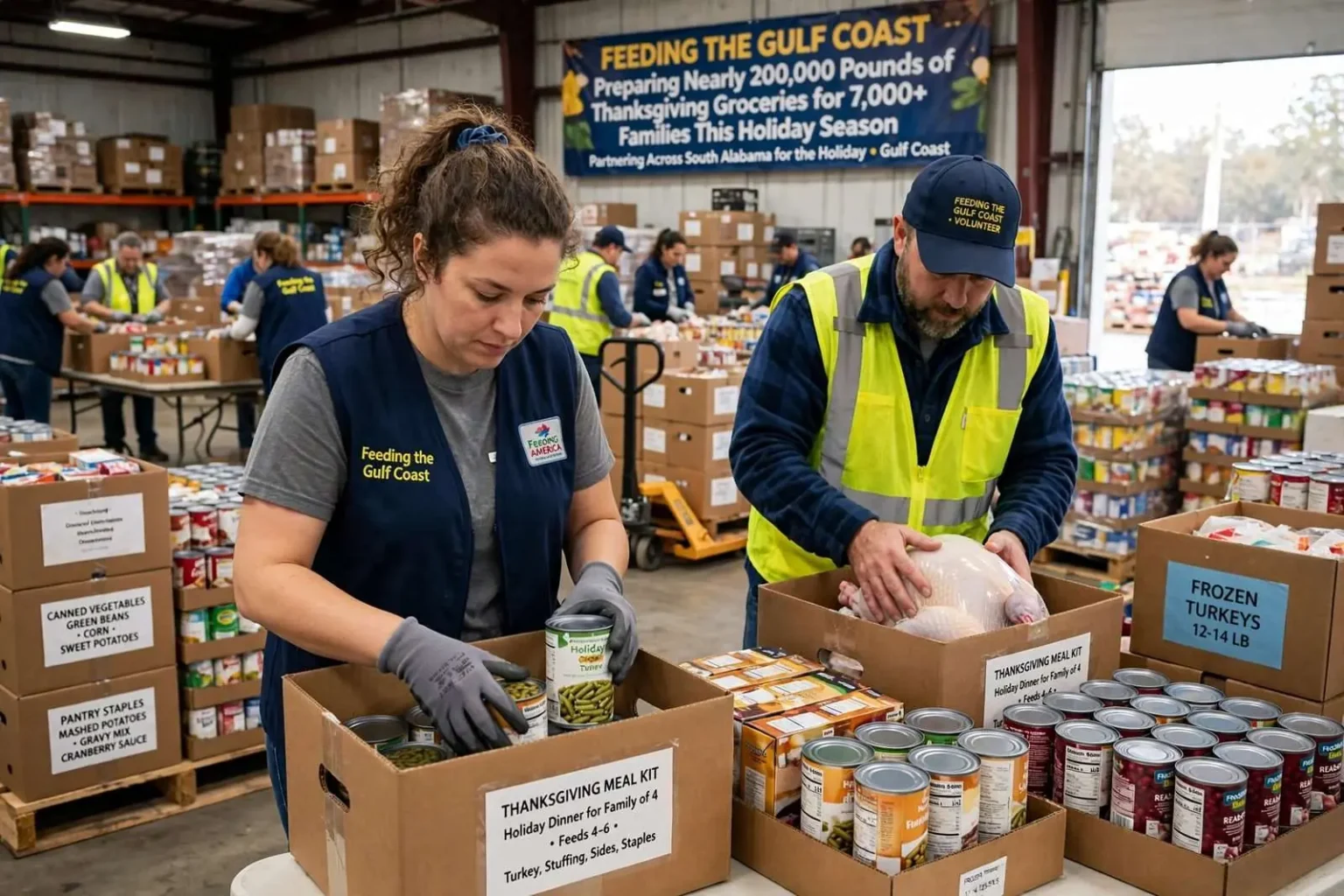
Nonprofits across the Gulf Coast are staging dozens of food distributions in the weeks before Thanksgiving, and the region’s largest food bank says demand is running well ahead of a typical year.
Feeding the Gulf Coast plans to move nearly 200,000 pounds of food to more than 7,000 families this holiday season, working through community partners and a series of distribution events spread across its service area.
The scale of the operation is easy to miss in a sentence. Two hundred thousand pounds of food moving through warehouses, volunteers and distribution lines in a matter of weeks requires months of planning — sourcing turkeys and shelf-stable sides, coordinating pickup schedules with partner churches and nonprofits, recruiting volunteer crews, and arranging the trucks that connect it all. The families on the receiving end see a box or a drive-through line; behind it sits one of the most complex logistics efforts the regional charitable sector runs each year.
Grocery Costs Driving Demand
The food bank attributes the increase to grocery prices that have remained elevated, squeezing households that were already close to the line. Nonprofits in the area report seeing more families seeking assistance this year than in past holiday seasons.
The economics behind that demand are straightforward. When grocery prices rise across the board — meat, produce, canned goods, baking staples — households with the thinnest margins feel it first and most. Families that were managing before the increases cut discretionary spending first, then cut necessities, and food assistance becomes the gap-filler. Food banks along the Gulf Coast have reported the same pattern food banks nationwide have described: demand that no longer spikes only during holidays but stays elevated through the year, with the holidays simply raising the peak.
Thanksgiving carries its own particular weight in that picture. The holiday is built around a meal with specific, recognizable components, and a family that cannot afford it feels the absence publicly — children talk about it at school, relatives ask about plans, and the gap between the season’s abundance and the cupboard’s emptiness is sharper in late November than in almost any other week of the year.
Rather than handing out loose surplus items, the organization says each family receives the components of a traditional holiday meal, so recipients can put together a full Thanksgiving dinner at home.
That design choice reflects years of lessons from food distribution work. Handing out whatever surplus is on hand fills pantries but does not necessarily put a holiday on the table; building boxes around the components of a traditional dinner — the centerpiece protein, the sides, the staples — lets families cook and host a meal that looks like the ones their neighbors are having. The dignity element matters as much as the nutrition: recipients are not receiving leftovers from the food system, but the same dinner everyone else will eat Thursday.
‘Gathering together in celebration’
Michael Ledger, president and chief executive of Feeding the Gulf Coast, framed the effort around what the holiday is supposed to look like for families who cannot count on a stocked kitchen.
“Thanksgiving is a time for gathering together in celebration and gratitude, but that is not possible for so many right here in our community who face the challenges and uncertainty of food insecurity,” Ledger said. “We are grateful for the opportunity to provide a hearty, traditional holiday meal this Thanksgiving for those who need it most,” he said.
The Food Bank Behind the Effort
Feeding the Gulf Coast operates as the regional food bank serving south Alabama and neighboring counties, functioning as the hub that collects, warehouses and distributes food to a network of partner agencies — churches, community kitchens, shelters and nonprofit pantries — across its coverage area. The organization is part of the national Feeding America network, which links regional food banks to national donors, manufacturers and the large-scale surplus channels that keep warehouse shelves stocked, while local partnerships determine where the food actually goes.
The hub-and-spoke model is what makes a 200,000-pound holiday push possible. The food bank handles the sourcing, storage and trucking that individual churches and small pantries cannot manage on their own; the partners contribute what the warehouse cannot — local knowledge, volunteers, distribution sites embedded in the neighborhoods where families actually live. A family in Baldwin County, Mobile County or the counties beyond reaches the food bank’s inventory through the pantry or distribution event nearest them, run by people from their own community.
Finding a Distribution
Because the distributions are run in partnership with churches, community groups and other local organizations, dates and locations vary by community across the food bank’s coverage area in south Alabama and neighboring counties. Families looking for help are directed to check with Feeding the Gulf Coast for the schedule nearest them.
The variation is deliberate rather than disorganized. A distribution that works in a rural county seat — a fixed site, a midweek morning — will not fit a densely populated city neighborhood, where drive-through models and weekend events reach more families. Partner organizations schedule around their own volunteer pools and facilities, which spreads the season’s demand across weeks and locations instead of stacking every family into a single line.
Families seeking assistance should not assume they need to qualify through paperwork at most of these holiday distributions. Many partner events operate on an honor basis during the holiday season, serving households that show up, and organizers generally encourage anyone who is uncertain whether they qualify to come anyway — food banks would rather have extra boxes left over than families going without a holiday meal because they were unsure of the rules.
How the Community Helps
Holiday food distribution runs on volunteers as much as on food. Sorting and packing meal components, loading cars at drive-through events, distributing boxes at fixed sites — each distribution event needs crews that only materialize when churches, businesses, school groups and individual residents sign up. Along the Gulf Coast, that volunteer surge has become as much a part of the holiday season as the distributions themselves, with companies giving employees service days and youth groups turning out in the cold mornings of late November.
Food and fund donations matter in the weeks before Thanksgiving as well. Monetary gifts go furthest: food banks buy at wholesale or through rescued-surplus channels that let a donated dollar move many times more food than the same dollar spent at a grocery store. The nearly 200,000 pounds headed to more than 7,000 families this season represents that leverage at work — national network, regional warehouse, local partner, and a community that shows up between the two.
For the families who receive them, the meal boxes will do what Ledger described: make possible the gathering, celebration and gratitude the holiday promises. For the region’s food security network, the season is both the year’s biggest effort and its clearest measure of how many neighbors still need it.
Food Insecurity on the Gulf Coast
The demand surge that Feeding the Gulf Coast describes this season sits on top of a longer pattern the region knows well. The Gulf Coast economy leans heavily on tourism, hospitality, fishing and seasonal work — industries with irregular hours, summer peaks and off-season slumps — and the households that depend on them experience income swings that steady-paycheck regions do not. When a tourist season disappoints, or a hurricane disrupts both work and housing, the effect shows up first at food pantries.
The regional food bank’s coverage area stretches from the Mobile area across south Alabama’s counties and into neighboring portions of the central Gulf Coast, a mix of urban neighborhoods, suburban growth corridors, small farming towns and barrier-island communities. Serving that geography means solving different problems in different places: shelf-stable box distributions work nearly anywhere, but fresh produce and frozen turkeys require refrigeration, fast turnaround and close coordination with the receiving site — logistics that multiply when demand doubles, as it does each holiday season.
Food insecurity itself is measured in more than empty cupboards. Households counted as food insecure are those that cannot reliably afford balanced meals, that skip meals or reduce portions near the end of the month, or that choose between food and other necessities — rent, utilities, medicine. Families in that position are often working families, and the holiday meal box the food bank provides can be the difference between hosting Thanksgiving and quietly telling relatives the trip is not possible this year.
The Season’s Numbers in Context
Nearly 200,000 pounds feeding more than 7,000 families works out to roughly 25 to 30 pounds of food per household — the components of a holiday dinner plus staples for the days around it, proportioned to make a real meal rather than a symbolic gesture. Achieving that across dozens of separate events, each with its own partner organization and volunteer crew, is the measure of how much coordination a regional food bank performs invisibly.
The holiday push also serves as a gateway into the broader system. Families who connect with a distribution event in November learn where their nearest year-round pantry operates, and many return to partner agencies in December and January — months when demand stays high but donations slow after the holiday giving season ends. Food banks describe the post-holiday dip in supplies as one of their hardest stretches, which makes the relationships built during Thanksgiving distributions valuable well beyond the meal itself.
For the region’s nonprofit sector, the season’s message from Ledger and his counterparts is consistent: the need is real, it is growing, and the system that meets it — network, warehouse, volunteers and donors — depends on participation from the same communities it serves. The families who gather around this year’s Thanksgiving meals will not see the machinery that delivered them, which is precisely the point: a holiday that simply works, on a table that is full, for 7,000 households that could not have stocked it alone.