Gulf Shores Considers $604K Overhaul of Aging Christmas Decorations
Gulf Shores city leaders reviewed a proposed three-year, $604,506 contract to overhaul the city's aging Christmas decorations with new lighting and illuminated displays at high-visibility locations.
Gulf Shores is planning a comprehensive refresh of its seasonal holiday displays after years of age, coastal weather and storage limitations left the city’s current decorations significantly deteriorated. The proposal, which would reshape how the beach city decorates for the season, went before the City Council during a work session Monday, July 20, at 4 p.m. at Gulf Shores City Hall, where public works leadership laid out a vision that trades quantity for quality and longevity.
Public works leadership is recommending the city move away from a scattered, citywide approach to holiday decorating in favor of a focused, professionally managed strategy that concentrates decorative resources at high-visibility locations. The shift reflects hard lessons learned along the coast. Salt air, summer heat, hurricane-season moisture and cramped storage conditions have historically shortened the lifespan of municipal holiday displays in Baldwin County beach communities, and pieces that would last for years inland often deteriorate far faster when stationed within reach of Gulf winds. Rather than spreading thin, aging inventory across every thoroughfare, the recommended approach would pool resources where residents and the millions of visitors who pass through the city each year will actually see them.
Under the proposed agreement, the city would partner with The Decor Group, Inc. on a three-year contract valued at $604,506, using TIPS cooperative purchasing to help control costs. Cooperative purchasing agreements like TIPS, the national procurement program used by governments across the country, allow municipalities to buy from pre-negotiated contracts that have already been competitively bid, cutting months out of the procurement process while locking in pricing vetted by other public agencies. For Gulf Shores, that means the decorative program can move from concept to installation without the city running its own lengthy bid cycle for each component.
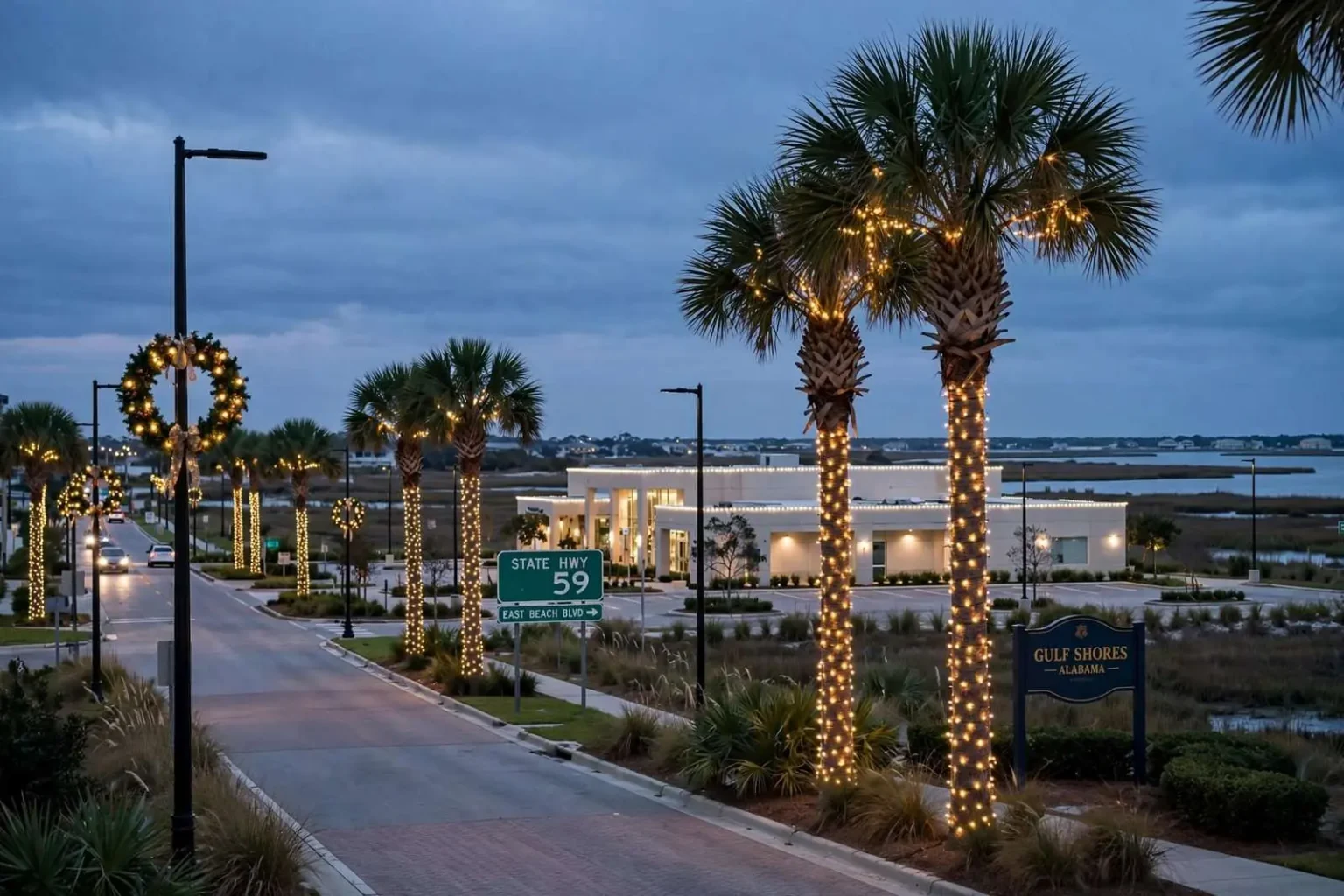
Year one alone would cost $237,448 and fund roofline lighting installations at eight municipal buildings, 150 pole-mounted fixtures, and illuminated palm tree displays at the Fort Morgan Trail and 59 Corner intersection as well as the 59 and East Beach areas. Those locations are among the most photographed and heavily trafficked spots in the city, sitting along the State Highway 59 corridor that funnels beach traffic through town and at the gateway where the Fort Morgan Trail corridor meets the main drag. Illuminated palm trees have become a signature look for coastal cities that want holiday decor reflecting their setting rather than importing mountain-town imagery, and pole-mounted fixtures spread consistent light and color along the routes visitors actually drive.
The professional-management model also addresses the storage problem that has plagued past displays. Commercial decorative programs typically include off-season storage and maintenance as part of the service, meaning the city no longer has to warehouse large artificial trees, fixtures and lighting strands in municipal space where humidity and heat accelerate their decline. Department staff would shift from fabricating and repairing decorations in-house to overseeing a contractor’s performance, freeing public works crews for the infrastructure work that dominates their off-season.
Pedestrian Bridge Change Order Also on the Agenda
The council’s work session agenda also includes Change Order #4 for the city’s Pedestrian Bridge project with Harrison Construction, carrying a net increase of $37,221.46. The change order covers structural steel fabrication designed to meet 160-mph wind loads, along with structural glass walkway components, funded through the project’s contingency reserves. Wind-load requirements of that magnitude reflect the engineering reality of building on Alabama’s coast, where any permanent structure must be designed to survive hurricane-force gusts that regularly batter the region. Structural glass walkway panels, meanwhile, point to a design that prioritizes views — appropriate for a span intended to give pedestrians safe passage while taking in the waterfront scenery that defines the city.
Using contingency reserves to fund the change order keeps the project’s base budget intact, a standard practice when unforeseen fabrication requirements surface mid-construction. Change orders are a routine feature of large municipal projects, but they draw public attention because they alter the bottom line, and the work session format gives council members a chance to question the scope before any formal vote. The pedestrian bridge itself has been one of the most visible infrastructure undertakings in the city in recent years, designed to move foot traffic safely over busy roadways that separate beach accommodations from the shoreline.
Staffing Changes and Budget Additions
Human Resources Director Tonya T. Wilson is expected to present organizational changes adding $51,000 in personnel costs, including reclassifying Blake Phelps as Director of Strategic Initiatives and promoting Amy McKenzie to Planning and Budget Manager. The reclassification signals how quickly the city’s administrative needs have grown alongside its population and tourism economy. Strategic initiatives roles have become common in fast-growing Southeast cities as municipal governments coordinate long-range projects — infrastructure, resiliency planning and economic development — that cut across traditional department lines. A dedicated Planning and Budget Manager position, likewise, formalizes oversight of a capital program that has expanded with the city’s swelling revenues from tourism.
The $51,000 figure represents the net added cost of the changes, meaning the council will weigh new spending against the organizational value of clearly defined leadership roles. In cities along the Baldwin County beach strip, where seasonal population swings and storm recovery cycles strain staff capacity, such reorganizations have become a recurring item on agendas.
Rounding out the work session, the council will recognize Ellie Flaig as June’s Lifeguard of the Month, continuing the city’s practice of highlighting the beach patrol personnel who guard miles of Gulf-front shoreline each season. Lifeguard recognition has become a fixture of Gulf Shores council meetings during the summer, when the beach safety operation runs at full strength and the city’s flag warning system is updated daily based on surf conditions.
Additional Agenda Items: Recruiting and Tourism
The agenda’s remaining items touch on the breadth of a modern resort-city government. Recruitment contracts under consideration reflect the hiring challenges that have hit municipalities nationwide, with coastal cities competing for public safety officers, engineers and skilled trades workers against private-sector pay. Public safety technology purchases on the agenda follow a pattern of investment in equipment for police, fire and beach safety operations, departments whose workloads climb with the city’s seasonal population surges.
Athletic championship hosting agreements, likewise, connect to the city’s broader economic strategy. Gulf Shores has built a national reputation as a host site for youth and amateur sporting events, using its sports complex facilities and beach venues to draw tournaments that fill hotels and restaurants during shoulder seasons when regular beach traffic dips. Hosting agreements typically commit city resources — staffing, facility preparation and promotional support — in exchange for the visitor spending that championships bring. For a city that markets itself year-round, each signed hosting agreement extends the tourism calendar beyond the traditional summer months.
Taken together, the July 20 work session agenda captures a city managing simultaneous demands: a holiday program that needs professional reinvestment, a signature pedestrian infrastructure project moving through its final change orders, a government workforce restructuring to match its growth, and the ongoing operational commitments of beach safety, public safety and sports tourism. Work sessions like this one do not produce votes, but they shape the decisions that reach the council’s regular meeting agendas in the weeks that follow.
For residents, the decorative overhaul proposal is the item most likely to draw comment. Holiday displays along the Highway 59 corridor have long been a point of civic pride, and a shift to concentrated, professionally managed installations will change what drivers see — fewer decorations spread across side streets, but more elaborate presentations at the intersections and landmarks that define the city’s image. The three-year structure of the proposed contract also gives the council a measurable way to evaluate the program: if the first year’s installations at the eight municipal buildings, the 150 pole-mounted fixtures and the illuminated palm tree displays perform as intended, the city can extend the approach with confidence, and if they fall short, the agreement’s structure allows for adjustments before the bulk of the $604,506 commitment is spent.
The council’s deliberations come as Gulf Shores continues to rank among the fastest-growing communities on the Alabama coast, with each agenda item — from lifeguard recognitions to budget manager promotions — reflecting the scale of government required to serve a city that swells each summer with visitors from across the Southeast.
How the TIPS Purchasing Cooperative Works
The cooperative purchasing route deserves a closer look for taxpayers following the spending. TIPS, administered through a Texas-based education service center, is one of several national purchasing cooperatives that public entities use to satisfy competitive bidding requirements while tapping contracts other agencies have already vetted. Members range from school districts to municipalities across multiple states, and vendors on the contracts have cleared a formal solicitation process before joining. The approach has grown popular among Southern cities because it compresses procurement timelines from many months to weeks, a meaningful difference when a seasonal program like holiday decorating must be scoped, approved, fabricated and installed on a calendar that will not move.
The three-year term of the proposed Decor Group agreement also spreads the investment across multiple budget cycles, with year one carrying the heavy upfront cost of the initial installations and later years shifting toward additions and maintenance. That structure mirrors how cities handle other contracted services, and it gives council members a clear off-ramp if performance or finances change. Year one’s $237,448 covers the foundational build-out — roofline lighting at eight municipal buildings, the 150 pole-mounted fixtures and the illuminated palm displays at the Fort Morgan Trail and 59 Corner intersection plus the 59 and East Beach areas — establishing the backbone of a program the city can refine in subsequent seasons.
Residents with opinions on the plan will have the standard avenues to weigh in. Work session items in Gulf Shores typically return as action items on regular council agendas, where public comment rules apply, and the July 20 session at City Hall marked the first public airing of the decorative overhaul. Between the holiday program, the pedestrian bridge change order, the personnel reorganization and the recognitions, the session’s agenda offered a snapshot of a beach city government juggling tradition, growth and the unforgiving coastal environment that shapes every asset it owns.