Gulf Shores Council Approves $408,000 for Pedestrian Bridge Lighting
<p>Gulf Shores City Council has approved roughly $408,000 for color-changing decorative lighting on the new Intracoastal Waterway pedestrian bridge, pushing the project's total cost to about $24.7 million.</p>
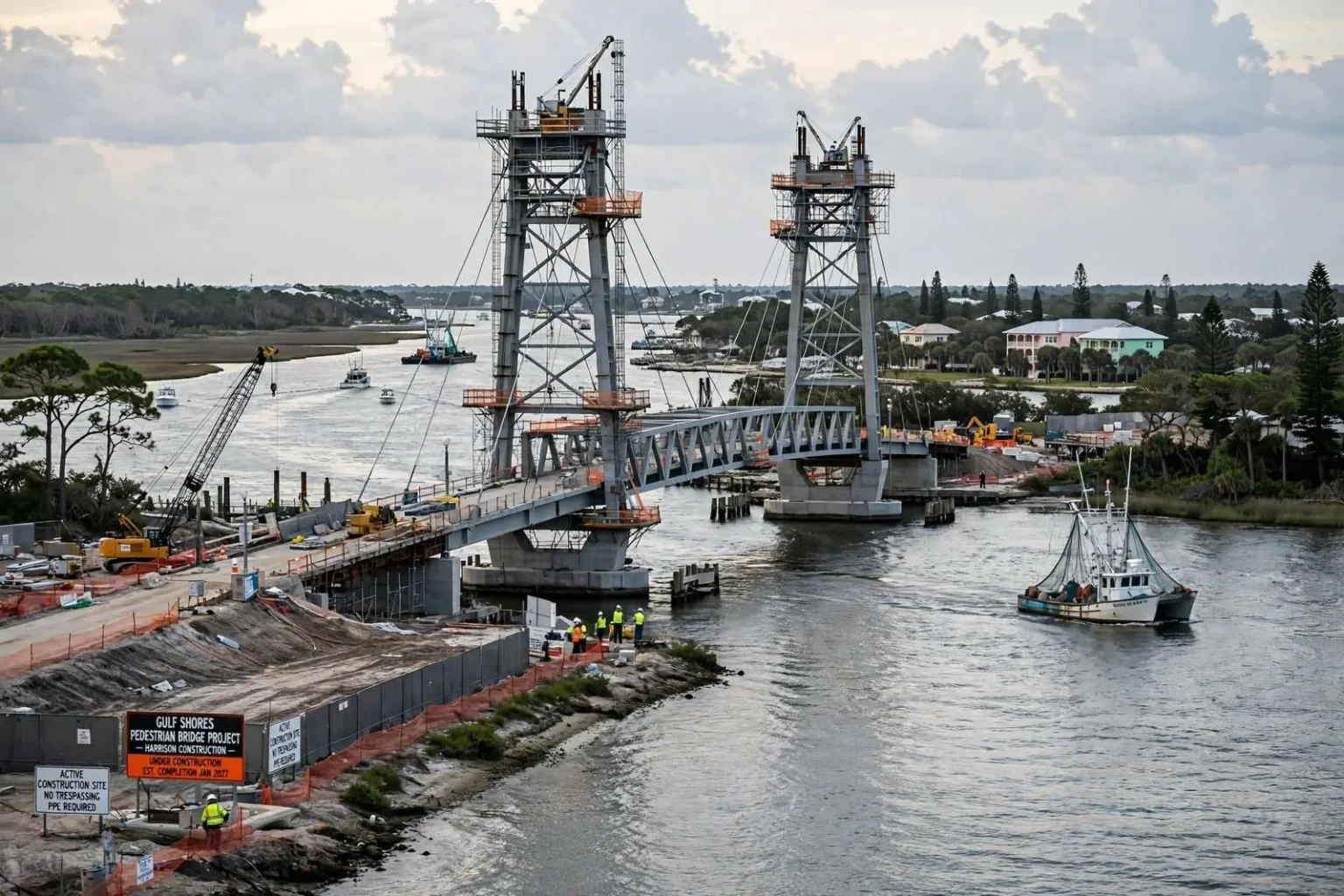
Gulf Shores City Council members have signed off on nearly $408,000 in additional spending to add decorative lighting to the pedestrian bridge now under construction over the Intracoastal Waterway just east of Highway 59, adding another line item to one of the city’s most closely watched infrastructure projects. The council approved the lighting package unanimously in June, a quick and quiet end to a decision that had been pending as the bridge’s towers rose over the waterway.
The system will give the bridge and its towers a customizable look, with 30 available color options that can be used to mark holidays, events or simply change the bridge’s nighttime appearance. For a city whose calendar is built around festivals, fishing tournaments and a national shrimping celebration, a bridge that can turn red, white and blue in July or holiday colors in December is more than decoration — it is a piece of the brand Gulf Shores has spent two decades cultivating as a walkable, design-conscious beach destination.
With the addition, the total cost of the pedestrian bridge project now stands at roughly $24.7 million. That figure places the span among the most expensive single public works projects in the city’s history, a fact city officials have acknowledged freely while arguing that the bridge is as much about connectivity and safety as it is about aesthetics: it carries pedestrians and cyclists over one of the busiest waterway crossings on the Gulf Coast without forcing them onto the Highway 59 corridor’s shoulder traffic.
Plazas at Both Landings
In a separate but related expenditure, the city plans to spend $3.6 million from a Gulf of Mexico Energy Security Act grant on plazas at each end of the bridge. Those spaces are expected to include shade trees, restrooms, seating, sidewalks, viewing areas and room for community events, effectively creating new public gathering spots at both landings of the span. The money comes from GOMESA, the federal law that shares offshore energy revenue with coastal states and their communities, which has become a significant funding stream for infrastructure in places like Gulf Shores that sit closest to the Gulf’s energy activity.
The locations are specific. The north plaza will sit near East 25th Avenue and East 2nd Street, while the south plaza will be located at East 2nd Street and East 22nd Avenue, anchoring each end of the crossing with a defined public space rather than a bare ramp. City planners have treated the plazas as part of the project’s promise: the bridge is not just a way across the waterway but a destination in its own right.
The viewing areas capitalize on what the waterway offers. The Intracoastal at Gulf Shores carries a steady parade of shrimp boats, barges and recreational vessels, and a bridge with benches, shade and restrooms turns watching that traffic into an amenity. The event space likewise gives the city room to program the bridge — races, markets, ceremonies — in a way that bare concrete approaches never could.
A Simpler Design After a Sticker Shock
The current version of the bridge represents a significant cost reduction from an earlier design. That original concept, which included spiraling ramps on both ends, drew a lowest bid of $47 million, prompting the city to pursue a simpler and less expensive structure. The redesign cut the price by more than $20 million while preserving the core function — a safe crossing for pedestrians and cyclists over the waterway — and illustrates the kind of scope discipline cities increasingly apply to signature projects after bids come in above expectations.
The decision to simplify was not without tradeoffs. Spiraling ramps would have delivered longer, gentler grades for cyclists and a more dramatic architectural profile, but at a cost the city was unwilling to carry. The chosen design keeps the crossing accessible within the footprint of conventional approaches, and the decorative lighting approved in June adds back some of the visual identity the simpler structure alone would lack.
Construction crews are expected to begin work on the bridge’s superstructure soon, with the span set to be placed on its substructure over the Intracoastal Waterway in the weeks that follow. Setting the span is the project’s most visible milestone, the moment the crossing stops being pilings in the water and starts being a bridge residents can picture using.
The Roadwork That Comes With It
Once the structure is in position, workers will lay the final asphalt surface on the north side of East 2nd Street and complete the remaining roadway sections near 25th Avenue. Those street-level details matter as much to daily users as the span itself, because they determine how riders and pedestrians actually reach the bridge from the surrounding street grid. East 2nd Street and the avenues around it carry a mix of neighborhood traffic and visitors heading toward the water, and the connector work is what ties the new crossing into the city’s existing network.
Harrison Construction, the contractor overseeing the project, has until January 14, 2027, to substantially complete the work, though city officials have said the schedule provides room for the project to be finished ahead of that deadline. Infrastructure contracts of this size typically carry milestone dates rather than a single finish line, with “substantial completion” marking the point at which the public can use the project even as minor items remain. For Gulf Shores, that date defines when the city’s investment starts paying daily dividends.
The pacing has been watched closely by residents, since waterway crossings of this kind involve staging that can affect boat traffic beneath the bridge and road access around it. Coordination with the U.S. Coast Guard and the waterway’s users is routine on Intracoastal projects, and the sequence described to the council — superstructure first, span placement next, roadway surfaces last — reflects the standard choreography for a project of this type.
What the Bridge Means for the City
The pedestrian bridge sits at the center of Gulf Shores’ longer effort to remake itself around connectivity. The city has spent years on projects that encourage walking and biking — shared-use paths along its main corridors, streetscape improvements, and the gradual separation of beach traffic from neighborhood movement. A dedicated crossing over the Intracoastal links the beachside city to the areas north of the waterway on foot and by bike for the first time, without the danger of mixing with the truck and boat-trailer traffic that dominates Highway 59 and the waterway’s commercial crossings.
The $24.7 million total, spread across the bridge, lighting and plaza work funded through GOMESA, represents a deliberate stacking of funding sources. Federal energy-revenue sharing covers the plazas, the city carries the core structure, and the lighting package came through as a discrete council decision. That layering has allowed Gulf Shores to build a signature project without placing its full cost on a single budget line — a pattern coastal Alabama cities have increasingly followed as GOMESA dollars flow.
For residents, the visible milestones ahead are straightforward: the span going into place over the waterway, the asphalt connecting it to East 2nd Street and 25th Avenue, and the plazas taking shape at each end. When the lights come on — in one of 30 colors, chosen for the occasion — the bridge will join the short list of structures that visually define Gulf Shores, and the city will have a new gathering place on both sides of the water.
A Project Built on Course Corrections
Perhaps the most instructive part of the bridge’s story is how it evolved. A $47 million lowest bid on the original design could have sunk the project or left the city committed to years of debt; instead, officials went back to the drawing board and produced a structure that preserves the crossing’s purpose at roughly half the cost, then enhanced it selectively with lighting and plazas where the value is highest. Each council decision since — the lighting package, the plaza funding — has been made against that backdrop of a project already disciplined by its first encounter with the market.
The unanimity of the June vote on the lighting suggested the council sees the project that way: not as a controversy but as a nearly finished asset worth finishing well. The remaining question is simply construction sequencing, and with Harrison Construction’s deadline set for January 2027, the city has a clear runway to the day the bridge opens and the Intracoastal becomes something residents cross on foot rather than an obstacle that divides the community.
How the City Is Paying for It
The financing structure behind the bridge is worth understanding, because it shows how a city of Gulf Shores’ size funds a project of this scale. The core construction is funded through the city’s capital budget, built up over years of tourist-driven sales and lodging tax revenue, while the plaza work taps GOMESA — the 2006 federal law that directs a share of offshore energy revenue to Gulf producing states and, through them, to the coastal communities that bear the brunt of offshore activity’s impacts. Alabama has directed its GOMESA dollars toward coastal infrastructure, and Gulf Shores has been among the principal beneficiaries.
That structure means the bridge is, in effect, partially paid for by the energy activity happening off the same coastline the city promotes. Officials have used GOMESA dollars for a range of resilience and access projects in recent years, and the plazas at the bridge’s ends fit the program’s logic: permanent public infrastructure that improves how residents and visitors use the coast.
The lighting package, approved separately, follows the same incremental logic. Rather than bundling every enhancement into the base contract and risking a bid that overshoots, the city kept add-ons discrete, approving each on its own merits once the core project was locked in. The nearly $408,000 lighting cost is a rounding error next to the $24.7 million total, but as a council decision it received the same unanimous support as the project itself — a sign that members view the enhancements as completing the asset rather than inflating it.
Waterway Crossings and City Identity
The Intracoastal Waterway is more than a line on Gulf Shores’ map; it is the boundary that shapes how the city moves. North of the waterway sit established neighborhoods, schools and the city’s civic core, while the beachside district to the south carries the tourism economy. Until now, crossing between them on foot or by bike meant sharing narrow bridge shoulders with vehicles or improvising along commercial routes, and the dedicated pedestrian span is designed to end that improvisation.
Coastal cities across the Southeast have invested in similar crossings as walking and cycling tourism has grown, and the experience elsewhere suggests the bridge will see steady use from both residents and visitors. The viewing plazas, restrooms and event space push it further into the destination category, giving the city programming options — sunset events, charity walks, holiday gatherings — that its current infrastructure does not offer.
The 30-color lighting system fits that same strategy. Cities that light signature bridges — in colors matched to seasons, causes and celebrations — turn infrastructure into civic ritual, and Gulf Shores’ calendar, dense with festivals and tournaments, gives the system plenty of occasions to serve. The council’s decision to fund it was, in that sense, a decision about how the city wants to look and feel after dark.
What remains now is execution. The superstructure work and span placement come first, then the asphalt and roadway connections near East 2nd Street and 25th Avenue, then the plazas, and finally the opening itself. With Harrison Construction’s substantial completion deadline set for January 14, 2027, and city officials expressing confidence in the schedule, Gulf Shores’ most watched infrastructure project is moving from plans and appropriations into the visible stages residents will recognize as the finish line approaching.