Gulf Shores International Airport to Get Commercial Terminal, First Airline Service
Gulf Shores International Airport has signed a $3.7 million deal with TBI/VINCI Airports to build a commercial terminal, with three airlines already seeking to add service by March.
Gulf Shores International Airport is preparing to welcome commercial airline passengers for the first time in its history, under a new agreement that will bring a dedicated terminal building to the growing coastal Baldwin County airfield.
Airport officials have finalized a $3.7 million agreement with TBI/VINCI Airports, a firm that specializes in building and operating airport facilities, to design, construct and manage a commercial air terminal on the property.
The move marks a major step for an airport that has long served private pilots, corporate flights and military traffic but has never before hosted scheduled commercial air service.
TBI/VINCI is the kind of specialist partner a first terminal usually requires. The firm builds and operates airport facilities for communities adding commercial service, which means Gulf Shores is not inventing its terminal from scratch — it is buying a model that has been run at other small airports, adapted to a coastal site and a beach-market passenger profile.
Airport Director Scott Fuller said the demand for a closer commercial option has been building for years, as travelers heading to the beaches of Gulf Shores and Orange Beach have had to route through airports in Pensacola, Mobile or farther afield.
“We get calls every day on how to get here, multiple calls about what’s the closest airport, and right now it’s Pensacola,” Fuller said. “Soon it will be Gulf Shores.”
The geography behind those calls is simple. The beaches that anchor Alabama’s tourism economy sit at the southern tip of Baldwin County, more than an hour’s drive from the nearest commercial airports. A vacationer flying in from the Midwest lands in Pensacola or Mobile and then spends another hour and a rental car getting to the sand. Every mile of that drive is friction the beach towns would rather not sell.
A modest but functional terminal
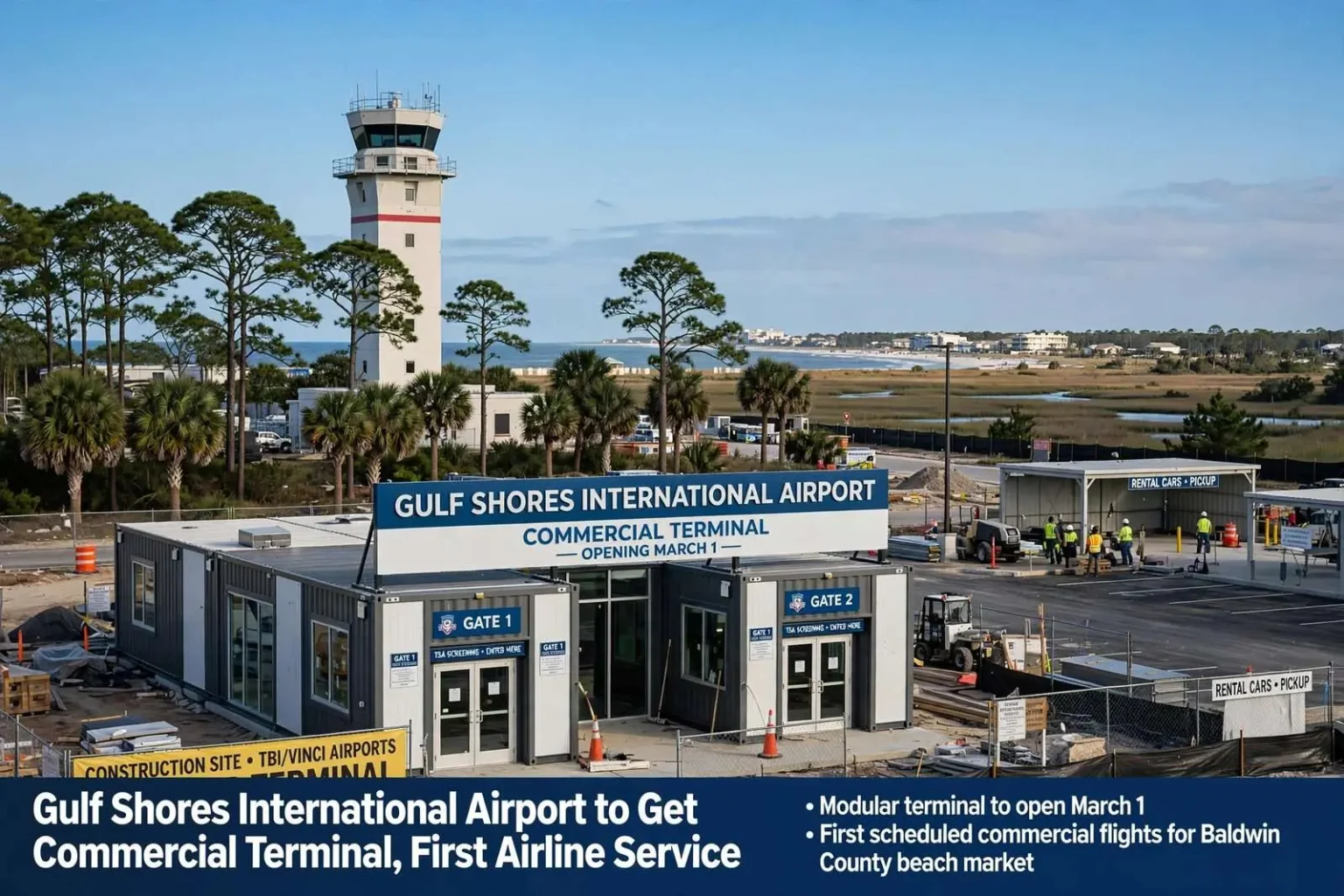
According to Fuller, the planned facility will be modest in scale but fully functional, featuring two passenger holding rooms, two gates and two Transportation Security Administration screening stations, though only one is expected to be staffed by TSA personnel when the terminal first opens. The building will also include space for rental car operations and related passenger services.
The two-gate layout is a statement of intent rather than a ceiling. Small-market terminals around the country typically open at this scale and expand bay by bay as carriers add routes, and the rental car space built into the footprint acknowledges how Gulf Shores passengers will differ from business travelers: they arrive to stay for a week and need a car waiting when they do.
The terminal will initially be a temporary, modular structure while airport officials plan for a permanent building down the road.
Site preparation work has already begun near the airport’s air traffic control tower, with crews grading and building out parking areas.
“They are working on the parking lots now and we’ve ordered the modular facilities,” Fuller said, adding that the modular units are expected to arrive by the end of the year.
The modular-first approach trades polish for speed. A permanent terminal takes years to design, fund and build; a modular one can be on the ground in months, proving the market while the permanent version is planned. If the airlines come as expected, the temporary building will have done its job by making the case for the permanent one.
Airport leadership says the interest from airlines has already materialized well ahead of the terminal’s completion.
Fuller pointed to the roughly eight million annual visitors who travel to the Gulf Shores and Orange Beach area as a major draw for carriers looking to add new routes.
“There is considerable interest in the fact that we have eight million visitors a year here and we do not have air service,” Fuller said. “So that makes us attractive to a lot of airlines.”
Eight million annual visitors with no commercial air service is, in airline terms, an anomaly. Resort markets of that size usually grow their own routes long before the numbers reach that height, because passengers with money and intent are already flying somewhere nearby and driving the last leg. What Gulf Shores offers a carrier is the chance to capture a share of a demand that has been proven for years at someone else’s airport.
Three airlines have already submitted letters of intent to begin operating flights out of Gulf Shores International Airport, with a fourth carrier reportedly in active discussions with the airport.
Officials have not yet released the names of the airlines involved or specific route plans, but say more details are expected as agreements are finalized.
Letters of intent are early-stage commitments rather than signed schedules, but three of them, with a fourth in the pipeline, is an unusually strong showing for a field that has never seen a scheduled flight. The route patterns, when announced, will tell Baldwin County a great deal — whether the first flights target the hub cities that feed the beach market, or the secondary cities in the Midwest and Texas that supply so much of its summer traffic.
The timeline
The project’s timeline calls for the new terminal to be operational by March 1, positioning the airport to potentially begin commercial service in time for the spring and summer tourist season, when the Gulf Coast draws its heaviest visitor traffic.
The date is chosen with care. A terminal opening in March catches the front edge of spring break travel and builds operating experience through the shoulder season, so that by June — the busiest stretch on the coast — the facility, the TSA staffing and the airline schedules have months of shakedown behind them. Missing the window would push meaningful service a full year.
If the schedule holds, Gulf Shores would join a small number of Alabama Gulf Coast communities offering direct commercial air access, giving travelers a new option beyond driving to Pensacola or Mobile.
For Baldwin County, that would complete a slow shift in the region’s transportation map. The county’s growth over recent decades — in population, in beach tourism, in the commercial corridors along Highway 59 and the beach expressway — has always been shaped by its distance from scheduled aviation. An airport at the beach reorganizes that map around the coast itself.
Local business leaders have long viewed direct air service as a potential boost to the area’s tourism economy, reducing travel friction for vacationers and opening the door to convention and corporate travel tied to the beach market.
The addition of scheduled flights could also ease congestion on regional highways during peak travel weekends, when traffic backs up along coastal routes into Baldwin County.
Every family that lands at Gulf Shores instead of Pensacola removes a car’s worth of traffic from the summer corridor — a small difference per flight, a noticeable one over a season. The relief matters most on the holiday weekends when the beach roads reach capacity and the region’s economy is at its most exposed to its own popularity.
Airport officials say additional updates on construction progress, terminal design and confirmed airline partners will be released as the project moves forward.
What the airport means for Baldwin County
The terminal agreement caps years of groundwork at an airport that has quietly outgrown its role. Gulf Shores International has functioned for decades as a general aviation field — private aircraft, charters, corporate flights and military traffic — serving a community whose permanent population and visitor volume have both multiplied since the field was built. Commercial service is the stage that matches what the coast has become.
The economics ripple outward from the fence line. Airlines that base crews and maintenance at an airport spend locally; passengers who land in Gulf Shores eat dinner in Gulf Shores on arrival night instead of on the highway; and the rental car and lodging taxes paid by arriving visitors stay in Baldwin County rather than Escambia County, Florida, or Mobile. Municipal leaders who have watched visitor dollars leak to out-of-state gateways have a direct financial interest in the new terminal’s success.
The convention and corporate angle deserves its own note. Beach markets with no air service effectively price themselves out of the meetings trade, because conventions fly. Scheduled service does not make Gulf Shores a convention city overnight, but it removes the objection that has kept the region’s conference facilities competing for a drive-in audience only.
How a first terminal usually unfolds
The pattern Gulf Shores is following — modular building, two gates, letters of intent before construction finishes — mirrors how other resort-area airports made the same jump. The early routes typically run to a carrier’s hub, sized to prove the market without betting on it; the schedules thicken each season that load factors hold; and the temporary facilities give way to permanent ones once the traffic is no longer hypothetical.
The risks are the standard ones. A new terminal needs TSA staffing commitments, airline schedules that survive their first season, and a passenger base that chooses the short drive over the cheaper fare at a distant airport. Gulf Shores enters with advantages most first-terminals lack: a visitor count in the millions, three letters of intent already in hand, and a community that has asked for the service by phone, every day, for years.
The promise in Fuller’s line — that the answer to “what’s the closest airport” will soon be Gulf Shores — is now a construction schedule with a date attached. By the time the summer crowds return to the public beaches, Baldwin County expects to be selling the one thing its tourism economy has never had: a runway at the beach with an airline waiting on it.