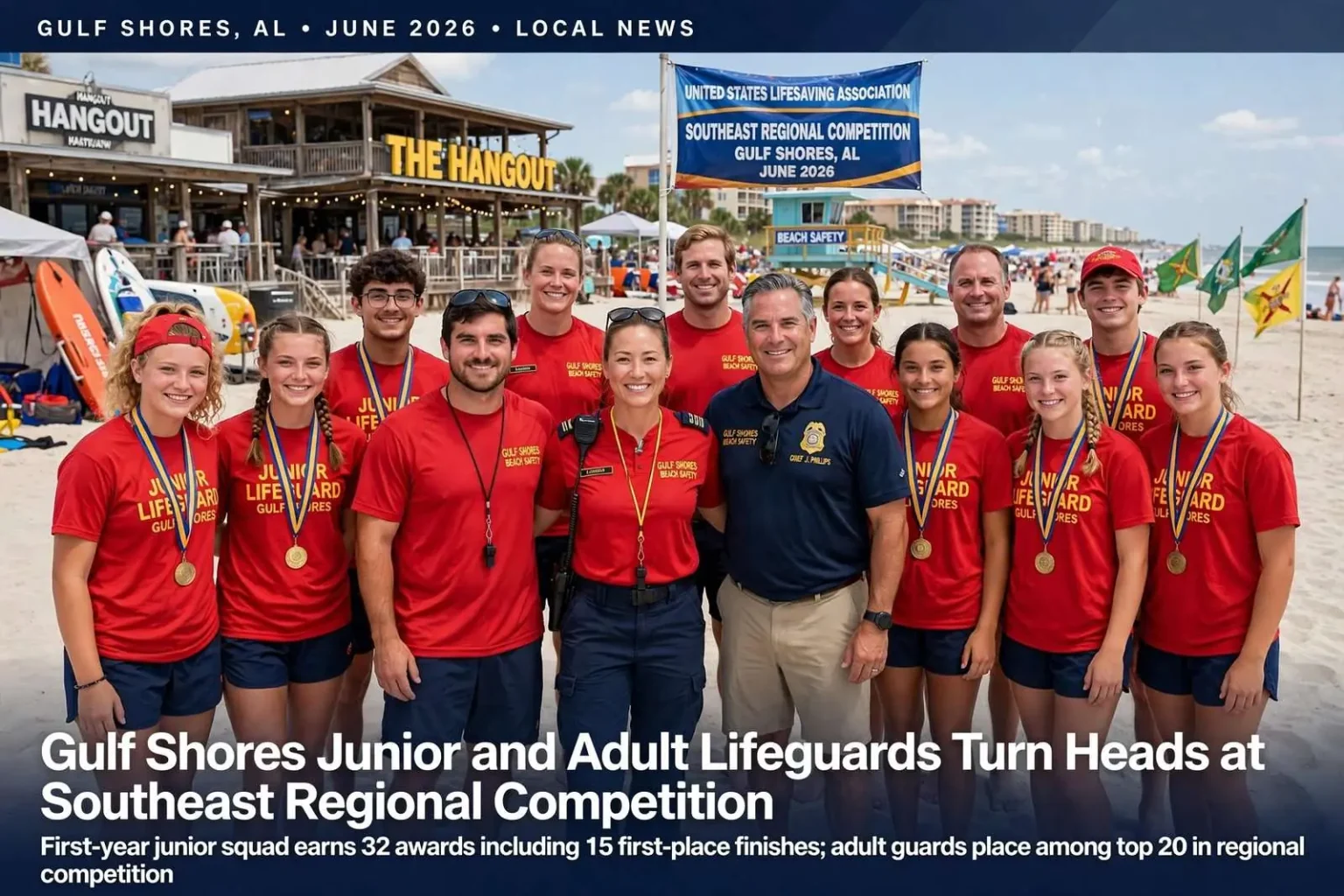
Gulf Shores Junior and Adult Lifeguards Turn Heads at Southeast Regional Competition
Gulf Shores lifeguards brought home dozens of awards at the Southeast Regional Lifeguard Competition, debuting a junior team while earning praise from national officials.
Gulf Shores Beach Safety Division put on a standout showing at the Southeast Regional Lifeguard Competition, an annual gathering that brings junior and adult lifeguard teams from beach communities across the region together to test their rescue, swimming and surf skills. The Hangout served as the event’s command center, and visiting teams got a taste of Gulf Shores hospitality along with the competition. For a department whose day job is guarding one of the busiest stretches of beach on the Gulf Coast, the regional stage offered a chance to measure its crews against counterparts from Florida, the Carolinas and beyond.
Lifeguard competitions are built around the core skills of the profession: rescue races, run-swim-run events, surf entries, flag races and simulated victim relays, all conducted under the standards of the United States Lifesaving Association, the national body that sanctions regional and national championships. The events compress into minutes the physical demands that guards spread across a season on the sand, and results at the regional level are often a reliable indicator of which departments will contend at nationals.
A first for the junior squad
For the first time, Gulf Shores fielded a squad in the junior lifeguard division, a milestone for the local Beach Safety Division. Junior lifeguard programs, which train teenagers in water safety, rescue technique and physical conditioning before they are old enough to work as guards, have become the development pipeline for beach safety departments across the country, and Gulf Shores’ decision to enter a competitive team marks the program’s arrival on the regional stage. The division’s move into competition followed a season of expanded training, with instructors putting the young guards through the same physical benchmarks and water drills the adult staff uses, scaled to their age group.
Coached by instructors Kylan Winter, Lieutenant Kim Lee and Chief Joyson Phillips, the seven-member team — Berkeley Lewis, Penelope Key, Elizabeth Key, Brooklyn Key, Natalie Haskin, Amelia and Joseph Campbell — went up against 45 competitors from other programs and came away with 32 total awards, including 15 first-place finishes. The results could be strong enough to send the young team to the national competition in Fort Lauderdale, where junior guards from across the country gather each summer. For a first-year squad to medal at that rate against established programs was the headline of the weekend for the local delegation.
City officials credited the showing to months of training as well as the parents who help make that training possible. Junior lifeguard programs demand a substantial commitment from families — early practices, travel to competitions and the cost of equipment and registration — and Gulf Shores officials acknowledged that the squad’s rapid success rests on that behind-the-scenes support as much as on the athletes themselves.
The adults held their own
Gulf Shores’ adult lifeguards held their own as well, with five local guards finishing in the top 20 out of roughly 150 competitors. Lieutenant Lee placed seventh overall in the men’s open division, while Kylan Winter took third in the women’s division. Adam Foley, Sarah, Ellie and Will also placed among the event’s top competitors, giving the department strong finishes across both divisions and confirming the depth of a staff that patrols Gulf Shores’ public beaches through the long tourist season.
Competing at that level while working the beach is a balancing act familiar to every seasonal department. Gulf Shores guards spend their summer days on towers and roving patrols along the city’s public beach access points, managing rip current rescues, lost children and the daily tide of visitors, then training for competition on their own time. The dual load is one reason regional results carry weight within the profession: they show a department that is sharp on the sand, not just in the pool.
Representatives from the United States Lifesaving Association, who help oversee competitions like this one nationally, told city officials it was the best-organized event they had seen in 40 years of involvement with the sport. The praise landed on more than the hosts’ egos — departments that can run a large, smooth regional event position themselves for bigger competitions, and the USLA’s endorsement is the kind of credential that bid committees notice.
Organizers pulled off the competition during an already packed June schedule, leaning on support from the local community, The Hangout and the city’s public works department to make it happen. June is high season in Gulf Shores, when the beaches are at their most crowded and every city department is stretched thin, so hosting a regional competition meant adding an event to the calendar at the moment the Beach Safety Division’s workload peaks. The Hangout’s role as command center put the venue’s oceanfront facilities at the center of the operation, while public works crews handled the logistics on the sand.
Looking toward bigger stages
Buoyed by the reviews, Gulf Shores is now looking into bidding for larger events down the road, including conversations about the World Games and possible ESPN coverage. World-class multi-sport events have put Gulf Coast beaches in front of international audiences before, and a city that can claim one of the region’s best-organized lifeguard competitions has a plausible case for hosting at a higher level. Television exposure would be a new frontier for a sport that rarely leaves its regional circuits, and city officials say the department’s reputation makes Gulf Shores a credible candidate.
Any expanded hosting ambitions will compete with the division’s primary obligation, which never pauses: the safety of the swimmers, surfers and boogie boarders on the city’s beaches. Gulf Shores patrols its public beaches with a combination of fixed towers and mobile units, and the department’s seasonal staffing swells with the tourist crowds that fill the condos and rental houses from Memorial Day through Labor Day. Competition success and beach operations draw on the same conditioning and judgment, which is why officials treat the medals as evidence about the day job as much as about the sport.
Regional competition weekends also serve a recruiting purpose that departments rarely say out loud. Guards from across the Southeast meet on the sand, compare departments, and sometimes decide to spend a season working a busier beach; for Gulf Shores, whose seasonal staffing needs grow with every new condominium tower, a well-run event that shows off the city’s operation is also a showcase for prospective summer hires. The medals and the reputation, in other words, feed directly back into the staffing pipeline the department depends on each May.
The department’s competitive success lines up with what officials describe as a broader culture of excellence on the beach day to day. Ellie Flag, a third-year lifeguard and Auburn University microbiology student, was named the Gulf Shores Beach Safety Division’s Lifeguard of the Month for June 2026. During the month, Flag logged 365 public contacts, responded to 60 calls, carried out two rescues and completed 357 preventative actions on the beach.
Those monthly numbers illustrate what guard work on a Gulf Coast beach actually looks like. The overwhelming majority of a guard’s interactions are preventive — moving swimmers away from rip currents, flagging sandbars, warning paddleboarders about winds — and a count of 357 preventative actions in a single month means Flag was intervening, on average, more than a dozen times a day before situations became emergencies. The two rescues and 60 calls fit the typical pattern in which the visible drama of the job is the smallest part of it.
Chief Phillips said the level of performance seen both in competition and in daily beach operations reflects standards the city expects across all of its departments. Gulf Shores has built its municipal brand around the quality of its beach experience, and the Beach Safety Division sits at the center of that promise; a department that wins regional medals and posts strong preventive numbers supports the city’s broader argument that its beaches are managed as carefully as any in the Southeast.
Beyond the medals, Gulf Shores lifeguards continue to focus on their core mission of keeping beachgoers safe and training the next generation of guards. The junior program that produced this year’s surprise results is expected to grow, feeding future seasonal staffs with teenagers who already know the water, the flags and the rhythm of the beach. And with a possible trip to nationals in Fort Lauderdale on the table, the city’s guards — junior and adult alike — have a new set of goals for the rest of the summer.
For residents and visitors, the takeaway is practical as much as civic: the men and women on the towers at Gulf Shores’ public beaches are among the most decorated guards in the Southeast this summer, and the training that earned those medals is the same training they bring to work every morning. Officials encourage beachgoers to swim near a lifeguard, check the flag conditions posted at each access point and treat the guards’ instructions as the safety system working as designed.