Gulf Shores Justice Center Hits 95 Percent Complete With Police and Court Move-In Targeted for Late September
The Gulf Shores Justice Center on Medical Village Boulevard is about 95 percent complete, with commissioning and final inspections underway. The facility will consolidate the Police Department, jail and Municipal Courts in one location.
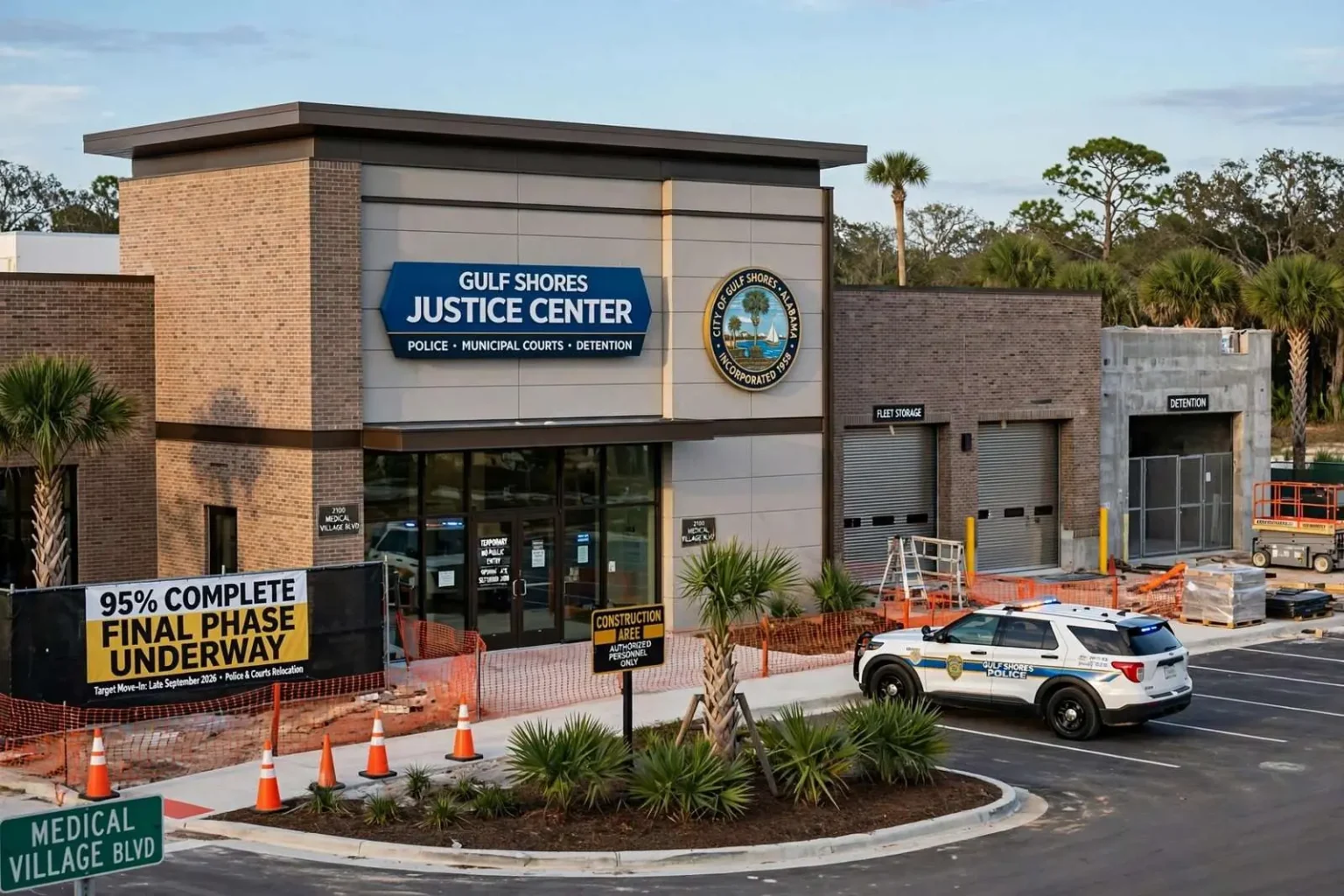
GULF SHORES, Ala. — The City of Gulf Shores Justice Center is about 95 percent complete, with final inspections, permit closures and mechanical, electrical and plumbing commissioning underway. Crews are working through punch-list items as the project enters its final phase.
Move-in for the Police Department and Municipal Courts is targeted for the end of September 2026.
The facility on Medical Village Boulevard will bring the Police Department, jail and Municipal Courts together in one centralized location — a consolidation the city says will improve efficiency, communication and accessibility for first responders and for the public.
“This investment strengthens our ability to serve a growing community and ensures our officers have the modern resources they need,” said Mayor Robert Craft.
What the Project Includes
The Medical Village Boulevard project involves renovations to a 44,000-square-foot building to house police operations and municipal courts, along with new detention and fleet storage facilities built to support the city’s growth.
The reuse of an existing 44,000-square-foot structure rather than new construction from the ground up is a notable choice. Adaptive reuse of a large commercial building for public safety purposes can substantially reduce cost and schedule compared with new construction, though it introduces its own complications: existing structural systems constrain layout, and specialized requirements such as detention-grade construction, secure sallyports and evidence storage must be fitted into a shell designed for something else.
The detention and fleet storage components were built new, which is typical — those functions have requirements that are difficult to retrofit into general commercial space.
Why Consolidation Matters Operationally
Police departments, jails and municipal courts have historically been scattered across separate buildings in many small and mid-sized cities, an arrangement that accumulated by circumstance rather than design as each function outgrew its space at a different time.
The costs of that arrangement are mostly invisible to the public but real to the people working in it. Transporting a person in custody from a jail to a courtroom in another building requires officers, vehicles and time, and each transport carries a security and liability exposure that does not exist when a defendant walks from a holding cell to a courtroom down a secure corridor. Records move between buildings. Officers drive between locations to file reports or appear in court. Evidence handoffs cross parking lots.
Consolidating the three functions eliminates most of that friction. For the public, the benefit is a single address: a resident paying a fine, appearing for a court date, obtaining a report copy or filing a complaint goes to one place rather than navigating a set of buildings.
The Growth Behind the Building
Gulf Shores has changed substantially over the past two decades, and the Justice Center is one visible response to that change.
The city’s year-round population has grown steadily, but the more consequential number for public safety planning is the seasonal one. A beach city’s service population swells dramatically during peak months, when visitors and short-term renters multiply the number of people within city limits several times over. Calls for service, arrests, court dockets and detention needs follow that curve.
Facilities sized to a year-round population do not function well under that load. A municipal court operating out of a space designed decades earlier, or a police department working from a building that predates the city’s current staffing, becomes a constraint on service delivery.
The city has invested across several fronts in recent years — the airport terminal expansion, water treatment capacity, road and drainage projects — that share the same underlying driver. Infrastructure built for the Gulf Shores of an earlier era is being replaced with infrastructure sized for what the city has become.
What 95 Percent Complete Actually Means
The final phase of a construction project is frequently the least visible and the most detail-intensive, and the terminology in the city’s update describes real work rather than a formality.
Commissioning of mechanical, electrical and plumbing systems is the process of verifying that installed building systems actually perform as designed. HVAC systems are balanced, control sequences are tested, emergency power transfer is verified, and life safety systems — fire alarm, sprinkler, emergency lighting — are tested and documented. In a facility with detention space, additional systems require verification, including door control, intercom and surveillance.
Final inspections and permit closure involve the authorities having jurisdiction signing off on building, electrical, mechanical, plumbing and fire code compliance, culminating in a certificate of occupancy. A building cannot be occupied without it.
Punch-list work is the correction of defects and incomplete items identified during walkthroughs — paint touch-ups, hardware adjustments, tile and trim, and any item not built to specification.
The gap between substantially complete and ready to occupy is where most construction schedules slip, which is why a targeted end-of-September move-in is described as a target rather than a date.
The Move Itself
Relocating a police department is not a matter of loading boxes. Dispatch and communications systems, evidence and property rooms, records, network infrastructure and vehicle fleet operations all have to transition without a gap in service, because a police department cannot pause operations for a moving day.
Departments typically manage this through phased moves, with critical functions running in parallel at both locations until the new systems are verified. Evidence transfers require documented chain of custody for every item, since any break in that documentation can be challenged later in court.
Municipal court relocation carries its own requirements: case files, docket scheduling, public notice of the new location, and coordination with attorneys and defendants who have appearance dates spanning the transition.
What Comes Next
The city said more updates will be shared as the Justice Center approaches full completion. Move-in for the Police Department and Courts is targeted for the end of September 2026.
Residents with business at the police department or municipal court should watch for city notices about when services shift to the Medical Village Boulevard address, and should verify the location of any scheduled court appearance during the transition period.
South Alabama News will report when the facility opens to the public.