Gulf Shores Sandcastle Ritual Inspires Memoir by Charles Chumley
Longtime Gulf Shores visitor Charles Chumley turned his daily sandcastle-building ritual into a 44-chapter memoir, with all author royalties donated to Family Promise.
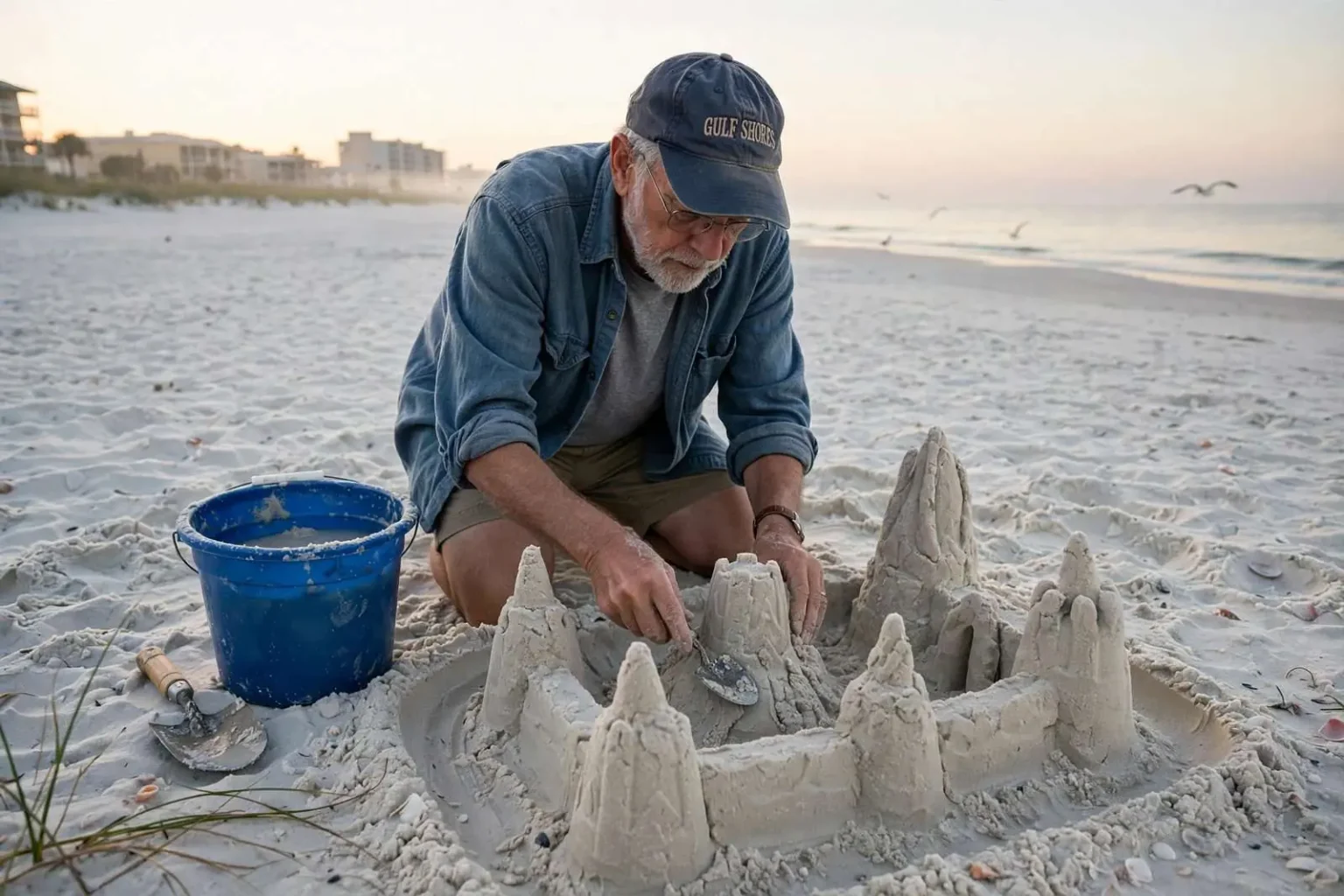
What can a handful of sand teach someone willing to kneel down and pay attention? That is the question at the heart of a new memoir by Charles E. Chumley, a longtime Gulf Shores visitor whose daily habit of building sandcastles on the beach grew into a book. Titled “Every Grain Is Real – What The Sand Teaches,” the memoir traces a practice Chumley began about twenty years ago while on vacation. Morning after morning, whenever he is in Gulf Shores, he walks down to the beach and builds a sandcastle.
There was no master plan behind it, by the author’s own telling — just a man with a bucket, a spade and a stretch of sand in the early hours before the umbrellas went up. Over the years, the castle itself became less the point than the act of building it: the discipline of showing up, the small tolerances of sand and water, the strangers who stop to watch or kneel down to help. Those accumulated mornings eventually arranged themselves into forty-four chapters of reflection on what a transient, washed-away artwork can teach a person about permanence, failure and attention.
After retiring, the pastime became a daily ritual carried out across two beaches, Playa del Carmen and Gulf Shores. The pairing gives the book its dual setting — a Caribbean beach on Mexico’s Riviera Maya and the popular Baldwin County resort town on Alabama’s Gulf Coast — and two very different audiences of passersby. “For years now, whenever I’m fortunate enough to be on the beach in Gulf Shores, usually in the early morning before it fills up, I build a sandcastle,” Chumley said. Gulf Shores readers will recognize the scene he describes: the wide, white-sand beach at the edge of town, quiet in the morning cool, before the day’s crowd arrives with chairs, coolers and boogie boards.
Gulf Shores has long been one of the busiest beach destinations on the Alabama coast, drawing families from across the Southeast to its public beach access points and its walkable strip of condominiums and rental houses. Sandcastle building is part of the town’s shared culture, passed down through generations of vacationers the way boogie boarding and dolphin-watching are. Against that backdrop, a memoir built on sandcastle mornings is a distinctly Gulf Shores story, even when its setting wanders as far away as Mexico.
A Local Inspiration
The book is set in part on Gulf Shores beaches, and one chapter centers on a local figure, Janel Hawkins of Sand Castle University. Chumley said many locals and visitors would recognize her, and her words appear on the back cover. “Sand sculptures, just as life, are not made to last forever. That makes them more valuable, not less. Enjoy it while you can and appreciate it when it’s gone,” Hawkins said.
Sand Castle University is a fixture of the Gulf Shores beach scene, known for teaching visitors the craft of sand sculpting in lessons right on the beach. For a book about what building sandcastles teaches, a sculptor who teaches the art for a living was a natural subject — someone who has thought professionally about why the work matters even though the tide takes it. Hawkins’ back-cover reflection doubles as a statement of the book’s theme: impermanence is not a flaw in the sandcastle, or in the day, but the very thing that gives the effort its meaning.
Structured as a memoir in forty-four chapters, the book reflects on daily practice, the people who show up alongside you, and what gets built when no one is watching. The chapter titles and stories move between the two beaches, the regulars and one-time helpers who drift into the frame, and the author’s own working life before retirement. Each chapter closes with a short passage called Bucket Wisdom, meant to be brief enough to carry in a pocket — the distilled lesson of the day, written in the register of something a person might actually remember while standing in the surf.
Russ Powell, a San Francisco-based leadership coach, praised the work. “What begins as the story of a man who builds extraordinary sandcastles quietly becomes a master class in how to live. Chuck writes about failure, discipline, attention, and generosity with a precision and warmth that I found genuinely transformative. I laughed out loud. I took notes. I aspired to be better,” he said. The endorsement from outside the beach world underscores what the book is actually about: not sculpting technique, but the habits of mind that a humble daily practice can build as surely as any formal training program.
What the Sand Actually Teaches
The mechanics of the practice are almost absurdly simple, which is part of the memoir’s argument. Sand, water, a bucket and a stretch of unclaimed beach make up the entire studio, and the raw material actively resists the work — a wall that is too dry crumbles, one that is too wet slumps, and the whole structure depends on packing the grains at exactly the right moment. Every morning presents the same problem with a different tide, a different crowd and a different mood, which is precisely why the author found twenty years of material in it. The book suggests that the qualities a good castle demands — patience, acceptance of imperfection, the willingness to start over — are the same ones a good life demands, and that the beach simply teaches them faster.
Royalties Support Family Promise
Chumley said 100 percent of his author royalties will be donated to Family Promise, a nonprofit that works to fight homelessness. The gifts will be split between the Baldwin County affiliate and the affiliate near his Atlanta home. The choice ties the book’s proceeds to the two communities the author calls home — the Alabama beach town where the castles are built and the Georgia suburbs where he lives — and directs its earnings toward families who have lost far more stable ground than a morning’s sandcastle.
Family Promise operates through a national network of local affiliates that serve families with children facing homelessness, providing shelter, meals, case management and help with the practical steps that move a family back into housing of its own. Affiliates rely heavily on community volunteers, which makes donations to a local chapter unusually visible: the money stays close to where it is raised, supporting families from the same county as the donors. For Baldwin County — one of the fastest-growing counties in Alabama, where the tourism economy that fills Gulf Shores in the summer sits alongside working communities with their own housing pressures — the local affiliate’s work touches a side of the beach towns that visitors rarely see.
Among the book’s Bucket Wisdom passages are these reflections: “The best decisions are not made in perfect conditions. They are made by people who are clear enough about what they want that the conditions stop mattering.” “Presence is not a technique. It is a decision to be fully in what you are doing.” “Different languages, different faiths, different everything. They get along perfectly.”
The last of those belongs unmistakably to the beach. A public stretch of sand is one of the few places where strangers of every background stand side by side, and the author’s two beaches — one on the Gulf of Mexico, one on the Caribbean — put him among crowds that spoke different languages and still managed to cooperate over a common project in the sand. It is the kind of observation that only accumulates after years of mornings in the same place, watching who stops, who helps and who simply smiles and keeps walking.
From Corporate America to the Waterline
Chumley spent three decades in corporate America before retiring to find out what the sand had to say. He lives in Roswell, Georgia, with his wife, Pam, whom he describes as quieter and funnier than he is. The arc — a long career spent in offices and conference rooms, followed by a retirement ritual conducted on a beach at dawn — is what gives the memoir its frame. The castles began as a vacation diversion and became, over roughly twenty years, a practice the author treats with the seriousness usually reserved for a vocation.
That trajectory also explains the book’s central tension between careers and castles. The lessons the author draws from the sand — discipline, presence, generosity, the willingness to have the day’s work erased overnight — are aimed squarely at readers whose working lives are built around the opposite assumption: that output should accumulate, that permanence is the measure of value, and that failure is the thing to be engineered away. The beach argues otherwise, one tide at a time, and the author seems content to let it make the case.
“Every Grain Is Real: What the Sand Teaches” is available in paperback for $19.99 or as an eBook for $12.99. It is free with Kindle Unlimited. For Gulf Shores readers, the book doubles as a portrait of a familiar place rendered from an angle most guidebooks never take — the beach before it fills up, from the builder’s side of the bucket, with the whole day’s crowd still hours away and the castle already doomed by the tide it was built beside.