Gulf Shores Swimmer Leigh Anne Landrum Wins Bronze at 2026 Special Olympics USA Games
Gulf Shores swimmer Leigh Anne Landrum helped Team Alabama win bronze in the 4x25 relay at the 2026 Special Olympics USA Games while posting personal-best times in the 100 and 200 meter swims.
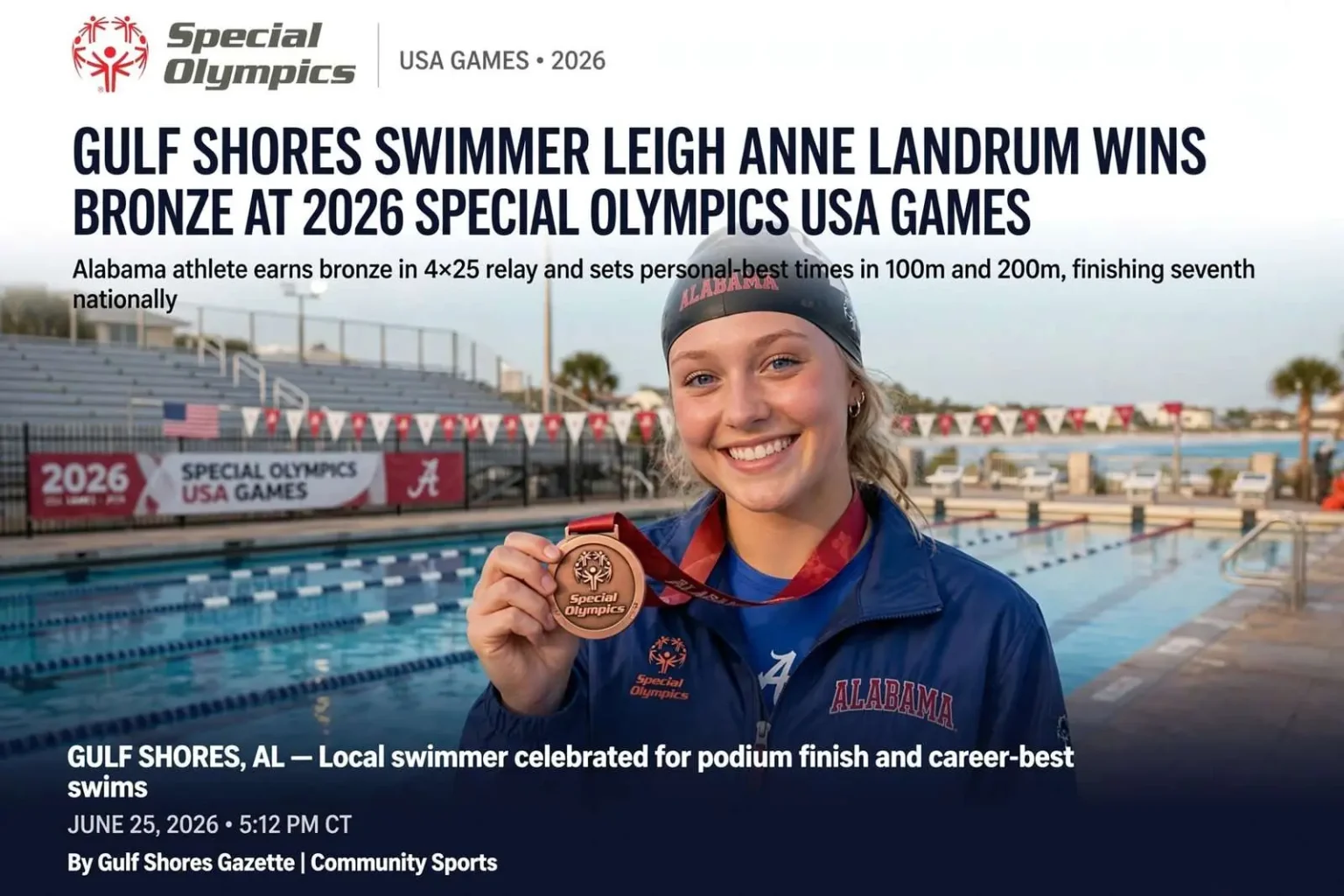
A Gulf Shores athlete is being celebrated this week after helping bring home a bronze medal from one of the nation’s biggest sporting events. Leigh Anne Landrum represented Alabama at the 2026 Special Olympics USA Games, competing alongside some of the top athletes in the country — and she came home a medalist.
Landrum helped her team earn a bronze medal in the 4×25 relay, the event that puts four swimmers’ combined effort into a single race and rewards the kind of teamwork that Special Olympics competition is built to develop. Beyond the relay podium, she delivered the strongest individual swims of her career: Landrum posted personal-best times in both the 100-meter and 200-meter swimming events, finishing seventh nationally in those individual events against a field of the country’s best.
Community members and supporters of Alabama’s Special Olympics program say Landrum’s performance reflects the dedication and training that go into representing the state on a national stage. Gulf Shores residents have been quick to congratulate Landrum on her achievement, calling her a source of local pride and an example of what it means to compete at the highest level.
The USA Games stage
The Special Olympics USA Games bring together thousands of athletes from every state for a week of competition held every four years, staging the national games across multiple venues with the pageantry — opening ceremonies, torch runs, medal presentations — of a major international event. For the athletes selected to attend, qualification itself is the product of years of training, local competition and advancement through state-level meets.
Swimming is among the games’ marquee sports, and the pool schedule compresses heats and finals into a demanding stretch of days. Athletes compete in individual events and relays, with divisioning — Special Olympics’ practice of grouping competitors by ability and past performance — designed to ensure every race is genuinely competitive and every medal is earned against athletes of comparable speed.
That structure makes a relay medal and a pair of seventh-place national finishes against personal-best times a rare combination: podium success in the team event, and peak individual performance in the longest, most grueling events on the program. The 100-meter and 200-meter freestyle distances demand the kind of conditioning that only consistent training produces, and Landrum’s personal-best swims in both — on the same week as relay duty — speak to the fitness behind the results.
The road to bronze
No athlete reaches the USA Games without a support structure years in the making. Landrum’s path ran through Alabama’s Special Olympics program, which organizes training and competition across the state and selects its delegation to the national games from athletes who compete and qualify at the local and state level. Coaches, training facilities and the volunteer network that runs year-round competition are the machinery behind every athlete who walks into opening ceremonies wearing the state’s colors.
For a Gulf Shores athlete, that training happens in a coastal community with a deep swimming culture — a city whose residents live around water, whose recreation programs teach children to swim early, and whose aquatic facilities have supported competitive swimming for decades. Landrum’s relay bronze and personal-best swims add a national medal to that local tradition.
The 4×25 relay itself is a showcase of what makes Special Olympics competition distinctive. Four swimmers, each swimming a leg at their own best, combine into one result — and the medal goes to the team, not to any single athlete. Landrum’s role in delivering bronze means the achievement is shared with her teammates and coaches, in keeping with the movement’s emphasis on competition that builds community rather than ranking individuals.
What the results mean
Seventh place nationally does not carry a podium, but in the context of the USA Games it represents the top tier of a field drawn from the entire country — a placement that reflects years of work and a level of performance the athlete had never reached before. Personal-best times are the currency of swimming at every level, and setting two of them at a national championship meet, in the biggest competition of an athlete’s life, is the outcome every coach trains toward and few achieve.
For Alabama’s Special Olympics program, Landrum’s medal and swims are also a statement about the depth of the state’s delegation. Every USA Games produces stories of athletes who exceed expectations, and Alabama’s contingent returned from the 2026 games with its own — a Gulf Shores swimmer standing on the relay podium and swimming faster than she ever had in two individual events.
The community response
The congratulations that followed Landrum’s return carried a particular Gulf Shores flavor — a coastal town that rallies around its own, and that knows something about swimming. Community members and supporters of the state’s Special Olympics program framed the achievement as the visible product of an invisible process: the early-morning practices, the local meets, the volunteer coaches and the years of consistent effort that a national medal represents.
Local pride in athletes like Landrum serves a purpose beyond celebration. Special Olympics Alabama depends on community visibility to sustain its volunteer base, its fundraising and the pipeline of athletes who see competitors from their own hometown succeeding nationally and decide to try out themselves. Every return like hers seeds the next group of athletes who will represent the state four years from now.
Special Olympics in Alabama
Alabama’s Special Olympics program serves thousands of athletes across the state, offering year-round training and competition in dozens of sports and building the local-to-state-to-national pipeline that carried Landrum to the USA Games. The organization’s mission extends well past competition — through sport, it works to build inclusion, health and confidence for people with intellectual disabilities, and its athletes’ achievements on the national stage are the movement’s most visible argument for that mission.
The USA Games sit one tier below the World Games in the Special Olympics competition structure, and selection to the national delegation is among the highest honors the state program can bestow. Athletes who make the team train for years to get there, and the games themselves — with their ceremonies, their venues and their national audience — are designed to give those athletes the full measure of recognition their effort has earned.
Landrum’s bronze medal now belongs to that story: a Gulf Shores swimmer, wearing Alabama’s colors on a national stage, helping her team to the podium and swimming the fastest races of her life in the process. Her hometown noticed. So did the program that sent her there — and both will be watching what comes next.
The training behind the podium
What spectators see at a national games — the races, the medals, the ceremonies — is the visible tenth of a routine that occupies the rest of an athlete’s year. Competitive swimmers train in the water multiple times per week, working strokes, turns and endurance in increments that only add up over months. For Special Olympics athletes, that training happens alongside work, school and family life, coordinated by volunteer coaches who plan seasons the way any competitive coach does.
The improvement curve Landrum carried into the 2026 games — personal bests in two distances at the national meet — is the typical signature of that kind of sustained preparation. Swimmers who train consistently do not drop time randomly; they peak, and a national meet with personal bests in the 100 and 200 indicates a training cycle that built toward those days in the pool.
The relay adds a team dimension to that individual work. Relays require synchronized starts, clean exchanges at the wall and four swimmers whose combined times hold up against the best teams in the country. Bringing home bronze means the Alabama team’s four legs added up on the day that mattered — a tribute to the practice sessions where exchanges are drilled until they are automatic.
Why these games matter to the athletes’ hometowns
For every athlete at the USA Games, there is a hometown that supplied the pool, the coaches, the carpools and the cheering section. Gulf Shores is one of those hometowns, and its celebration of Landrum is the other half of the transaction that produces national medals: the community invests in its athletes, and the athletes return with results that give the community something to gather around.
That cycle is how sports programs grow. A bronze medal from a national games is a recruiting poster more persuasive than any brochure — proof to young athletes and their families in the area that the path from a local pool to a national podium runs through programs they can actually join. Special Olympics programs across the country recruit their next generation of athletes in exactly this way, one celebrated hometown achievement at a time.
Landrum’s results — a relay bronze, two personal-best swims and two seventh-place national finishes — now stand as that proof in Gulf Shores, and the celebration this week is both an acknowledgment of what she accomplished and an invitation to whoever comes next.