Gulf Shores Weighs Neighborhood Ambassador Program Ahead of Hangout Festival Permit Renewal
Gulf Shores officials and Hangout Music Festival organizers are developing a neighborhood ambassador program to address residents' complaints about parking and other issues, as the city weighs renewing the festival's permit for its 11th year.
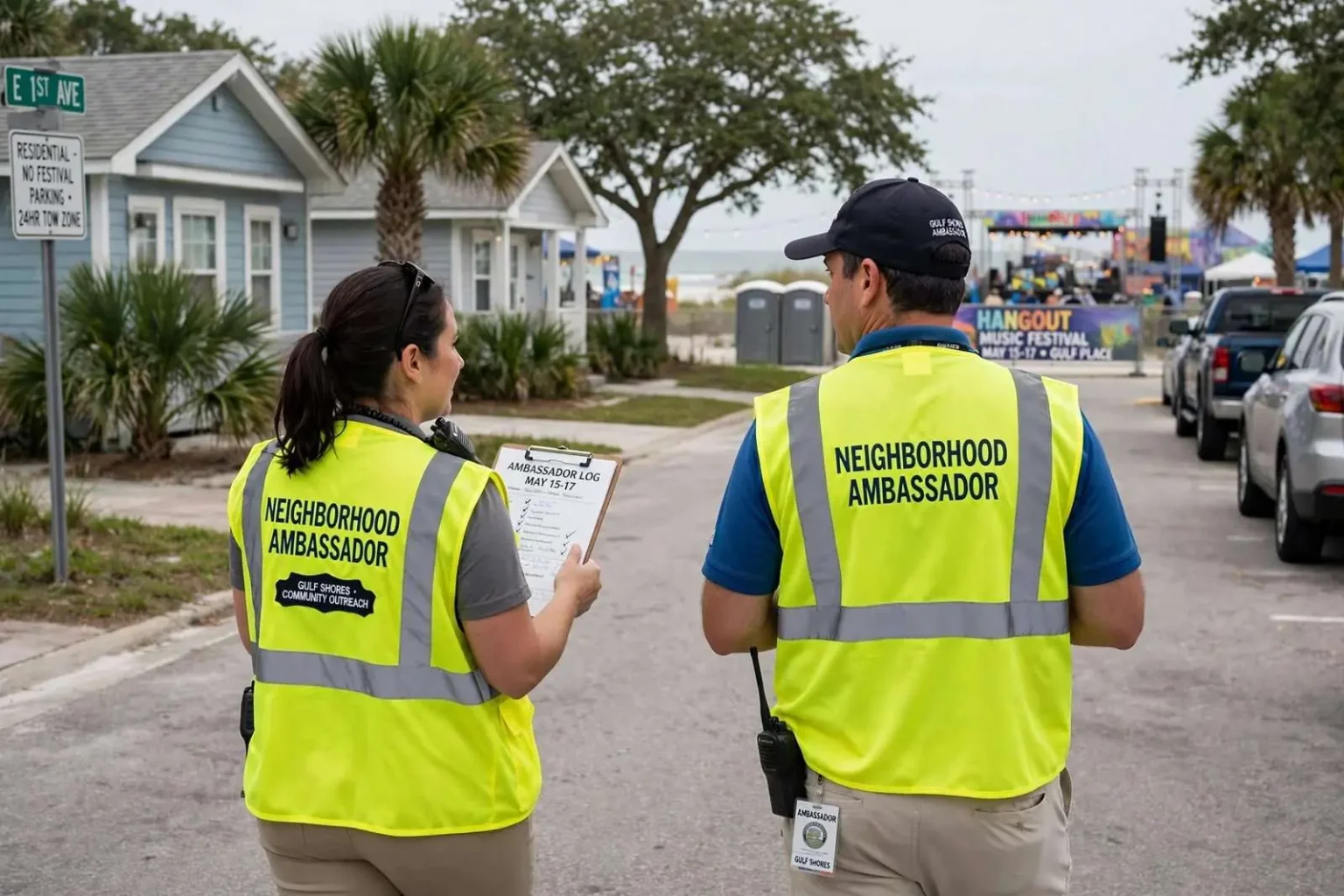
Gulf Shores officials and organizers of the Hangout Music Festival are working out the details of a new neighborhood ambassador program meant to ease long-standing friction between festivalgoers and residents who live near the beachfront event site, as the city considers whether to renew the festival’s public assembly permit for another year.
Under the proposal, roving ambassadors would be stationed throughout the residential blocks near Gulf Place during the festival to keep an eye on problem behavior, but they would not confront festivalgoers directly or attempt to enforce the law themselves. Instead, ambassadors would be trained to notify police if they spot trouble, allowing officers to respond to conflicts as they arise.
The design is deliberate. Festival organizers want a visible presence in the neighborhoods that signals accountability; the city wants to keep private volunteers out of the enforcement business, where an untrained confrontation could escalate the very conflicts the program exists to prevent. Routing every problem through police dispatch keeps the law on one side of the line and hospitality on the other.
Mayor Robert Craft said the ambassador program is expected to be spelled out formally as part of the festival’s public assembly permit, which the city issues annually and can decline to renew if organizers fail to address residents’ concerns. “The details of that are going to be part of this public assembly permit because that’s a big concern of ours,” Craft said. “And in coordination with the police. They will be instructed if they see something going on, they’ll contact the police and we’ll have someone be able to go help them if there’s a conflict of interest.”
Writing the program into the permit rather than a side agreement gives it force. The public assembly permit is the legal instrument that allows the festival to occupy the beachfront public land at Gulf Place, and conditions attached to it become enforceable obligations. Organizers who fall short of a promised ambassador deployment would not merely be disappointing neighbors — they would be violating the terms under which the event was allowed to proceed.
A neighborhood under pressure three days a year
For several years, residents in the six- or seven-block neighborhood surrounding the festival grounds have complained about festivalgoers parking illegally in yards and along narrow residential streets, as well as using residents’ yards as restrooms. Those complaints have become a recurring sticking point in the city’s annual review of the festival’s permit.
The geography explains the intensity. The festival site sits on public beach adjacent to one of Gulf Shores’ oldest established residential districts, where the streets are narrow, lots are small and homes sit close to the roadway. When tens of thousands of attendees converge on Gulf Place over a May weekend, the neighborhood absorbs the overflow: driveways blocked, lawns turned into improvised parking lots, and the three-day festival turning quiet residential blocks into something closer to a festival campground.
Hangout founder Shaul Zislin introduced the ambassador concept at a community meeting he organized at Big Beach Brewing Company on Dec. 7, an event aimed specifically at reaching residents who live closest to the festival footprint.
“They sent out fliers specifically to people that are in the six- or seven-block neighborhood that surrounds what is used as the festival site,” Gulf Shores spokesman Grant Brown said. “The goal was to get the people that had concerns over some of the items the mayor and City Council are requesting the festival address and come up with a plan to mitigate some of those concerns in that core part of the city.”
The choice of venue and audience was itself a gesture. Rather than a general-town-hall format that would fill the room with festival supporters, the brewery meeting was aimed squarely at the affected blocks — the residents whose yards, driveways and sleep are at stake — and was structured as a listening session rather than a defense of the event.
City leaders have pushed organizers to hold public meetings like the one at the brewery so residents can air grievances directly. David Zislin, Shaul’s brother, told the Gulf Shores City Council at its Dec. 9 meeting that another community meeting is being planned for January.
“He’s going to advertise it for people that are concerned and don’t like it and limit it to that to where they’re not having proponents in there that are lobbying for it,” Craft said of the planned January meeting. “They’re trying to get the people that are not in favor of it to give them their issues so he can react to them.”
The January session represents an unusual inversion of the usual public-meeting dynamic. Instead of courting supporters, organizers are deliberately excluding them, on the theory that the festival already knows what its fans think and needs a candid catalog of what its neighbors do. For the opponents, it offers something rare: a room in which their complaints are the entire agenda.
The December council meeting
At the Dec. 9 council meeting, Shaul Zislin opened with a presentation outlining the festival’s economic and community benefits, and most attendees who spoke expressed a favorable view of the event. Residents who oppose the festival or have concerns about its effects were also given the opportunity to address the council.
“There were some residents that were willing to speak up and how the festival impacts them and their quality of life,” Brown said. “They did so in a way that the Hangout was able to hear and we believe they are going to address those concerns. That’s what they are being asked to do this year to show that they can positively affect some of those items.”
The economics Zislin laid out are real and familiar to every coastal Alabama municipality: the festival fills hotels from Gulf Shores to Orange Beach and across the Foley corridor during a shoulder-season weekend in May, generates lodging tax and sales tax revenue the city would not otherwise collect, and markets the beach to a national audience of young travelers. The city’s position, articulated through Craft and Brown, is that those benefits come with obligations — and that May’s permit renewal is where the balance gets struck.
The leverage of an annual permit
The stakes for reaching an agreement are significant for both sides. Gulf Shores and Hangout organizers have a contract keeping the festival at Gulf Place through 2025, but the agreement includes a yearly renewal clause that gives the city leverage to demand changes. If the mayor and council are not satisfied that organizers are addressing neighborhood concerns, they can decline to issue the assembly permit needed to hold the event.
That structure — a long-term site contract paired with an annual permit — keeps the festival committed to Gulf Shores while preserving the city’s ability to tighten conditions every year. Organizers cannot credibly threaten to move the event elsewhere within the city, and the cost of relocating a destination festival built around this beach would be enormous; the city, for its part, benefits from an anchor event it can hold to an improving standard rather than a fixed one.
The 11th annual Hangout Music Festival is scheduled for May 15-17 at Gulf Place. City officials say the ambassador program and continued resident outreach will be key factors as they decide whether to grant the festival’s permit for another year.
What the city is watching, in practical terms, is whether the promises made in December and January become visible behavior in May: ambassadors actually deployed through the six- or seven-block core, illegal parking reduced, incidents reported and answered quickly, and residents able to reach a live person when a problem develops on their street. A favorable report on those items would make renewal straightforward. A repeat of past years would hand the council, for the first time, a documented basis for refusal.
The ambassador idea also carries lessons from elsewhere in the festival world. Large events across the country increasingly rely on trained goodwill staff — noticeable by their credentials and their visibility — to serve as early-warning sensors in surrounding neighborhoods, defusing minor annoyances before they harden into grievances and giving police a faster, better-informed picture of what is happening block by block. For Gulf Shores, whose police force absorbs the festival weekend along with everyone else, an extra set of trained eyes in the residential core is a modest cost against a recurring problem, and it puts responsibility for the festival’s own conduct where the organizers argue it belongs: with the festival.
For the residents of the blocks around Gulf Place, the measure is simpler. The festival is not going away — the contract through 2025 settled that — so the question they are really asking at the brewery meetings and the council podium is whether three days each May can be made livable. The ambassador program is the organizers’ first structural answer to that question, and the annual permit is the city’s way of making sure the answer does not end up as another promise that dissolves in the noise of the first band’s soundcheck.