Gulf Shores Weighs $46,000 Sponsorship to Revive Zydeco & Crawfish Festival in 2027
The Waterway Village Merchants Association is asking Gulf Shores for roughly $46,000 in cash and in-kind support to revive the Zydeco & Crawfish Festival in April 2027 at the plaza beneath the new pedestrian bridge’s south tower.
GULF SHORES — City officials will consider next week whether to put about $46,000 behind the return of the Zydeco & Crawfish Festival, an event that drew crowds to the Waterway Village district before it went dormant three years ago.
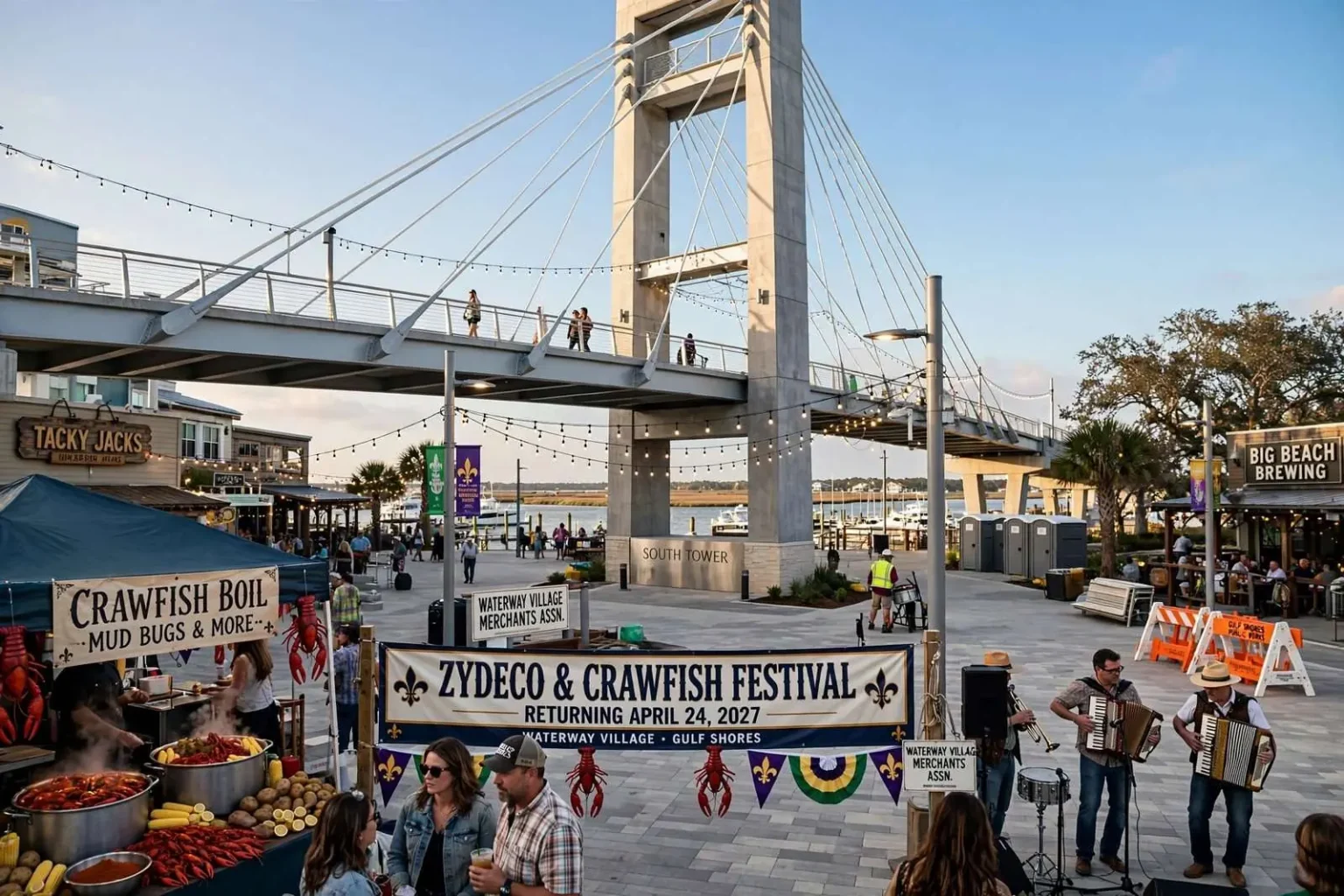
The request comes from the Waterway Village Merchants Association, which wants to stage the revived festival on April 24, 2027, in the plaza on East Secord Street leading up to the south tower of the city’s new pedestrian bridge, near Tacky Jacks and Big Beach Brewing.
What the Merchants Are Asking For
The roughly $46,000 request is not a single check. It combines cash with in-kind services from city departments — Public Works, police, fire and special events staff — along with help promoting the festival.
That structure is typical of how municipalities support community festivals, and the in-kind portion is often the larger share of the real cost. A single-day outdoor event with several thousand people in attendance requires barricades and traffic control, street closures, uniformed police officers, fire and medical standby coverage, trash collection and portable restrooms, electrical hookups, and setup and breakdown labor. A city that already employs the crews and owns the equipment can supply all of that at cost, where an organizing group buying the same services on the open market would pay considerably more.
The trade-off for the city is that those hours are real. Officers assigned to a festival are officers on overtime or officers pulled from regular assignments, and public works crews setting up barricades on a Saturday are not doing something else. That is the calculation a council makes when it weighs an event sponsorship.
The Schedule at City Hall
The merchants will formally present the request at a council work session on Tuesday, Sept. 8. The council is meeting Tuesday rather than its usual Monday because of the Labor Day holiday.
A vote could follow at the next regular session on Sept. 14.
The two-step process is standard in Alabama municipal government. A work session is where a council hears a presentation, asks questions and works through details without taking formal action; the vote happens at a regular meeting. For an organization asking for money, the work session is the substantive hearing — it is where the objections surface and where the number can still change.
A New Setting Under the Bridge
The proposed location is what makes this proposal different from the festivals that came before it.
Previous editions were held near the State Route 59 bridge, in open areas north of East 24th Avenue and in the city’s parking lot on the south side of 24th Avenue in the same area — functional spaces, but ones that had to be converted into a festival ground each year.
The new proposal would put the event in the plaza at the foot of the south tower of the city’s pedestrian bridge, a $24 million project officials hope to complete early next year. Much of the work on the south plaza where the festival would be staged is already finished.
That timing is part of the pitch. A purpose-built public plaza with hardscape, lighting and utilities already in place is a fundamentally different venue from a parking lot, and cities that build them generally expect them to be programmed. A festival scheduled for April 2027 would land after the bridge is finished and would give the plaza one of its first large-scale public uses.
How the Festival Started
The Zydeco & Crawfish Festival began in 2015. After the success of that first year, the merchants worked to turn it into an annual event, with support from the Coastal Alabama Business Chamber and the Alabama Beaches Tourism Organization, formerly known as Gulf Shores and Orange Beach Tourism.
“The festival quickly became one of the region’s most anticipated events, attracting 10,000-plus attendees and showcasing the community’s cultural vibrancy,” according to a memo from Laura Waldrop, the city’s assistant director of recreation and cultural affairs.
“After being paused for the past three years, the Waterway Village Merchants Association now intends to bring the festival back to its original prominence for the community to enjoy once again,” Waldrop’s memo states.
What the Festival Looked Like
Past editions built the day around Cajun and Creole culture. Highlights included Cajun music with a second line band, food and beverages, fine arts displays, a children’s area and information on the history of the Waterway District.
And, as the merchants’ own materials emphasize, lots and lots of mudbugs.
The cultural elements are borrowed from just west of here, and they travel well. Zydeco is the dance music of Louisiana’s Creole communities, built around the accordion and the rubboard — the corrugated metal vest played with bottle openers — and blending Creole French tradition with blues and R&B. A second line is the New Orleans parade tradition in which a brass band leads and the crowd falls in behind it, dancing along the route.
The crawfish are the other half. Louisiana’s crawfish crop is farmed largely in flooded rice fields, and the season runs through the late winter and spring, generally peaking in the months when the animals are biggest and the price is lowest. An April date is squarely in that window, which is why crawfish festivals across the Gulf South cluster in the spring rather than the summer.
Why the Date and the District Matter
April 24 is a deliberate choice for a beach town. It falls after the spring break rush has cleared, before the summer season begins in earnest, and in a stretch of the calendar when Gulf Shores has capacity in its hotels and condominiums but not yet the crowds. Coastal tourism agencies spend considerable effort filling exactly those weeks.
The Waterway Village district has its own stake. The area sits along the Gulf Intracoastal Waterway, away from the beachfront where most visitor traffic naturally concentrates, and the businesses there have long worked to draw people north of the beach. A one-day festival that puts 10,000 people on East Secord Street is, for those merchants, a marketing investment as much as a cultural one.
What Comes Next
The merchants’ presentation is set for Tuesday, Sept. 8, with a possible vote Sept. 14. If the council approves the sponsorship, organizers will have roughly 19 months to line up entertainment, vendors, permits and logistics for an April 24, 2027, event — a long runway by festival standards, and one that would let the association book talent and sponsors well in advance.
If the council balks at the amount or the structure, the more likely outcome is a smaller package rather than a flat rejection. Cities routinely negotiate event sponsorships down to the in-kind services and a reduced cash contribution, leaving the organizing group to close the gap with vendor fees, sponsorships and ticket or wristband sales.