
GulfQuest Needs $3 Million More to Finish; Museum Board Won’t Fundraise and the City Has Until July 20
Mayor Sam Jones proposed borrowing $3 million more for GulfQuest as the board refused further fundraising, leaving Mobile until July 20, 2011 to decide.
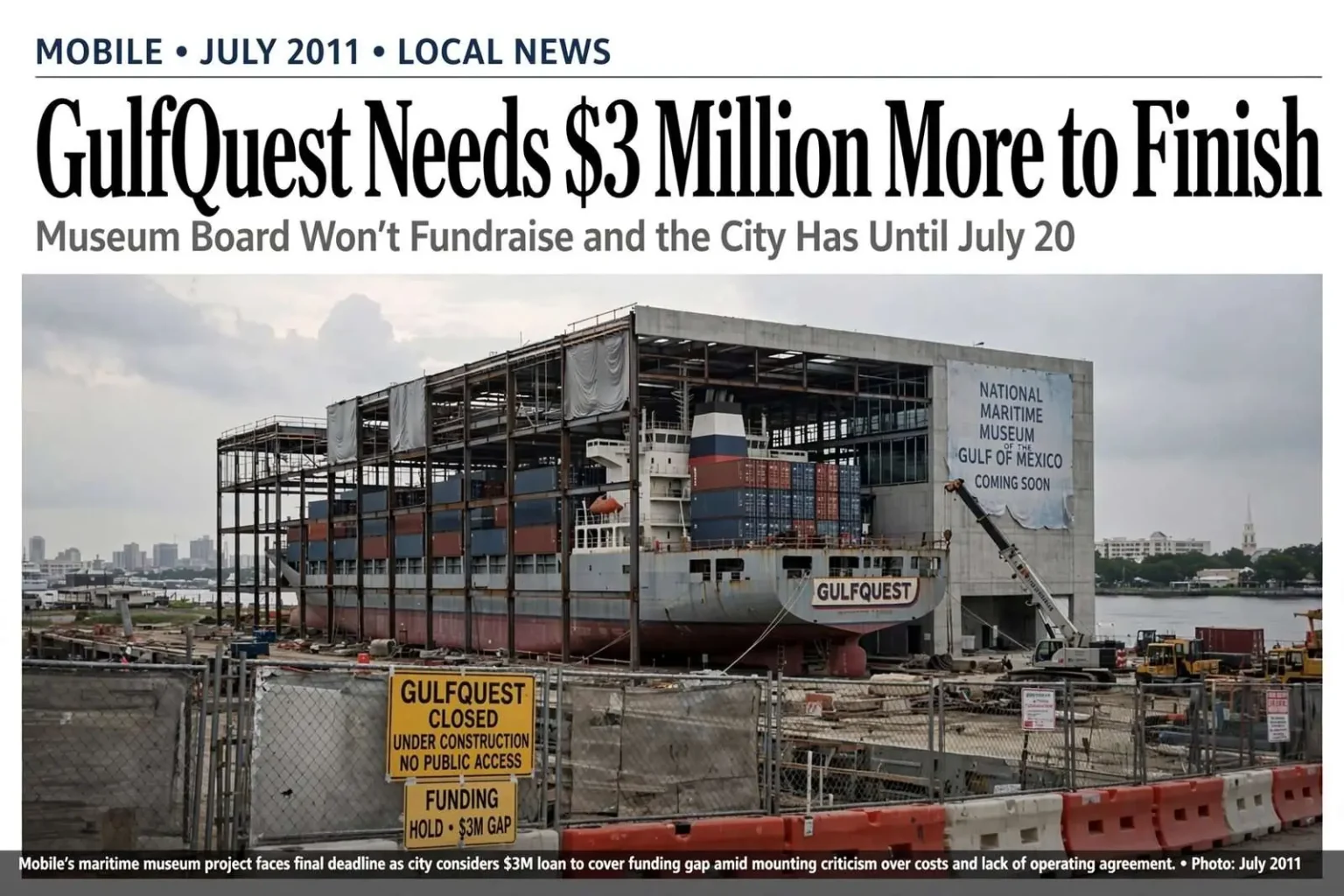
Mobile’s still-unfinished GulfQuest maritime museum needed another $3 million in July 2011 — and Mayor Sam Jones proposed the city borrow it, on top of roughly $25 million in city money already spent on the project. The proposed loan would carry an estimated $16.7 million in total debt service, and the city faced a July 20 deadline to finalize the deal before an offered interest rate expired. The request set off one of the sharpest funding debates of the Jones administration, pitting the museum’s board against taxpayers and council members who asked why the city should keep writing checks for a project that had yet to open its doors.
A Board That Won’t Fundraise
The sharpest point of contention was who should pay for the gap. The museum’s board, drawn from Mobile’s maritime interests, said it refused to conduct any more fundraising for its own project. Mayor Jones initially indicated he expected private interests to contribute, then backed away from that position, leaving the city itself as the only party standing ready to cover the shortfall. For critics at City Hall and in the community, the board’s stance crystallized everything they considered wrong with the arrangement: a civic institution built largely with public money, overseen by private interests, with the public expected to absorb the final cost.
Critics also noted the city had not yet signed a contract spelling out who covers maintenance and other ongoing costs if attendance falls short of projections. That omission mattered, they argued, because operating costs for a facility the size of GulfQuest would run into the millions every year — and if the museum’s revenues came in below expectations, the difference would land on the city’s budget, year after year, long after the construction debt was paid.
The museum projected 350,000 visitors a year — a figure skeptics called unrealistic for a facility whose centerpiece is a full-size replica of a container ship docked inside the building, surrounded by exhibits on maritime commerce, shipbuilding, navigation and offshore oil and gas platforms. Skeptics pointed to comparable regional attractions and argued that a city of Mobile’s size, without a major cruise terminal or aquarium drawing, would struggle to sustain attendance anywhere near that level once novelty wore off.
Who Really Paid
Although many residents believed GulfQuest was privately funded, private donations covered only a small fraction of the cost; the majority of the museum’s financing came from Mobile taxpayers. That reality ran counter to the impression many residents carried, and it became a central point in the council debate. Opponents argued the money could be better spent on education, police and small business development, and pushed the council to slow down, demand realistic revenue projections and consider public-private options such as leased waterfront retail or dining space rather than rush through what they saw as an emergency deadline.
The July 20 deadline itself drew scrutiny. Council members who wanted more time to study the loan terms were told the offered interest rate would lapse, effectively forcing a decision on the city’s own schedule. To opponents, that structure — a hard deadline tied to a lender’s rate — looked less like sound municipal finance and more like pressure designed to preempt a full debate.
Residents Take Their Case to City Hall
The opposition soon put its case in writing. A group calling itself Concerned Mobile Residents sent a letter to the mayor and city council citing an informal online poll of more than 200 respondents in which only 7 percent supported the city borrowing the additional money. The letter became a rallying point for opponents, who argued it demonstrated what they heard constantly in their neighborhoods: that the public had lost patience with a project that kept coming back for more money while offering no firm opening date and no operating agreement.
Speakers who addressed the council during the debate made the same argument from different angles. Some questioned the city’s capacity to take on roughly $16.7 million in debt service at a time when budgets for basic services were under strain. Others argued that a waterfront museum could succeed — but only with a governance and funding structure that put private partners on the hook alongside the city, and with attendance projections grounded in regional market data rather than aspiration.
What GulfQuest Was Meant to Be
GulfQuest was conceived as a one-of-a-kind attraction: an interactive National Maritime Museum of the Gulf of Mexico, built on the Mobile riverfront, with its full-size container ship replica as the signature exhibit. Visitors would board the ship and work through exhibits on the maritime commerce that drives the Port of Mobile, the shipbuilding traditions of the Gulf Coast, the science of navigation, and the offshore oil and gas industry that employs thousands across the region. Backers framed it as both an educational asset for schoolchildren across South Alabama and an anchor for downtown redevelopment along the waterfront.
The concept had been years in the making by the summer of 2011, and its delays had become a running frustration. Each delay carried its own costs — construction escalation, extended financing obligations and the slow erosion of public goodwill. The $3 million request was presented as the amount needed to finish the facility and get it open, but the repeated rounds of gap funding were exactly what had turned the project into a political liability.
The dispute also reflected a broader question facing Mobile in that era: how much the city should invest in downtown attractions and quality-of-life projects while neighborhood needs went unmet. Proponents of the museum argued that investments like GulfQuest were how a city built a future — drawing visitors, supporting jobs and giving the port city a signature attraction worthy of its maritime heritage. Opponents countered that a city’s first obligations were to its schools, its public safety and its small businesses, and that a museum that required repeated public bailouts was not the right use of scarce dollars.
What It Meant for Residents
For Mobile taxpayers, the arithmetic of the debate was straightforward. The city had already sunk roughly $25 million into GulfQuest. The proposed loan added another $3 million of principal and, over the life of the debt, an estimated $16.7 million in total debt service — money that would be committed to the museum before a single admission ticket was sold. And with no signed agreement on maintenance and operating costs, the city faced the prospect of open-ended annual exposure if the 350,000-visitor projection proved too optimistic.
The council’s dilemma was complicated by the deadline. Rejecting the loan risked losing the offered rate and potentially stalling the project indefinitely; approving it committed the city to years of debt service on an unfinished attraction with no guaranteed operating partner. Either choice carried political risk in an environment where residents, organized as Concerned Mobile Residents, had already made their skepticism known in writing and in person at council meetings.
The Larger Lesson
The GulfQuest fight of July 2011 became a case study in how Mobile debated public spending on signature projects. It highlighted the tension between a city’s ambition to build destination attractions and its obligation to fund core services, and it underscored the cost of proceeding without clear contracts, realistic projections and shared financial risk. For residents watching from the galleries and reading at home, the message of the debate was hard to miss: the question was never simply whether Mobile wanted a maritime museum, but who would pay for it — and for how long.
As the July 20 deadline approached, the city faced its choice under the clock it had accepted. Whatever the council decided, the episode ensured that future public-private projects in Mobile would be scrutinized more closely — with more attention to who signs the operating agreements, who validates the attendance forecasts, and who is on the hook when the projections fall short. For a project meant to showcase the port city’s maritime heritage, the hardest question in the summer of 2011 was not about ships or commerce at all. It was about municipal finance, accountability and trust.
Community advocates also framed the debate in terms of opportunity cost. Every dollar committed to debt service on the museum was a dollar unavailable for resurfacing streets, funding after-school programs or supporting the small businesses the city said it wanted to grow. With council districts watching closely, several members found themselves balancing a constituency that wanted the waterfront finished against neighborhoods that wanted to know when their own priorities would move to the front of the line. That balancing act, as much as any single vote, defined the GulfQuest debate in the summer of 2011.
The episode also illustrated how deadlines shape public decisions. When a rate offer expires on a fixed date, the window for public comment, council study and negotiation compresses to almost nothing — and residents who follow city government closely argued that major borrowing decisions deserved more time than that. Whether or not the council agreed, the July 2011 deadline became part of the story Mobilians told about the museum for years afterward.


