
Gun from MPD shootout was stolen from a Mobile officer’s home
Court documents show a gun recovered after a Mobile police shootout was reported stolen from a Mobile officer's home in April, according to authorities.
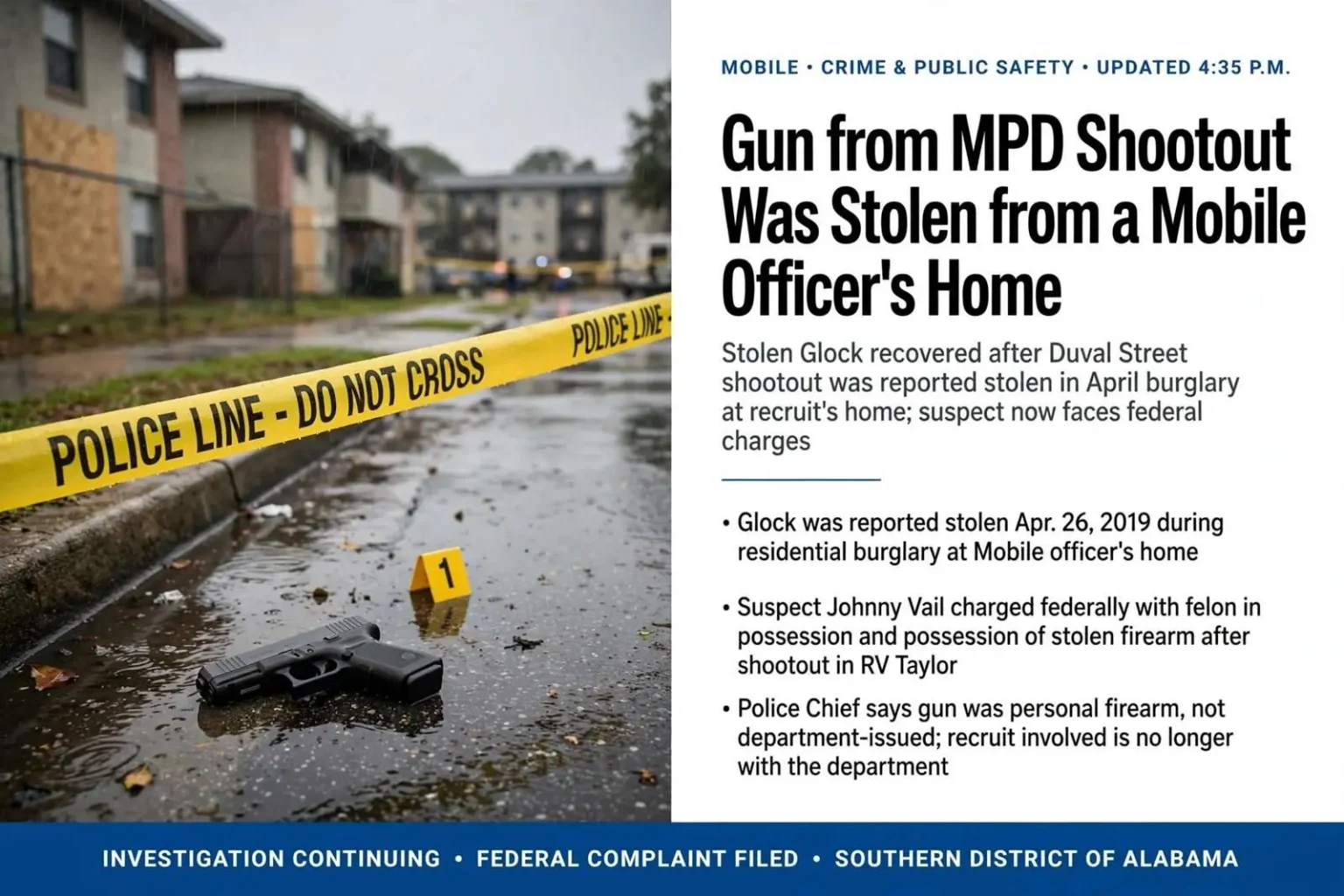
A gun recovered after a shootout with Mobile police was reported stolen from a Mobile police officer’s home in April, according to court documents.
UPDATE (4:35 p.m.): Chief Lawrence Battiste said the weapon was a personal firearm, not a service weapon, and had been stolen from the home of a recruit who is no longer with the department.
The connection between the stolen gun and the department raised immediate questions about how firearms stored in officers’ homes are secured — and about the wider problem of residential gun burglaries feeding the street market for weapons. Police leaders across the country have wrestled with the issue: officers are commonly armed at home, and a residential burglary can put a law enforcement weapon on the street as easily as any other gun. Battiste’s clarification drew the line between the two categories — department-issued service weapons, which follow strict accountability procedures, and the personal firearms officers keep at home, which are subject to the same theft risks as any civilian’s.
Court records identify the suspect as Johnny Vail, who was arrested in connection with the shootout and also faces federal gun charges — felon in possession of a firearm and possession of a stolen firearm.
The federal charges are a familiar pattern in gun cases in the Southern District of Alabama. When a suspect with a prior felony record is tied to a firearm, federal prosecutors frequently take the case under federal firearms statutes, which carry sentences that typically exceed what state charges alone would produce. Possession of a stolen firearm adds a second layer of exposure, and the combination — a convicted felon, a stolen gun, and a shooting at police — all but guarantees a federal prosecution alongside whatever state charges arise from the incident.
What the Complaint Says Happened
According to a federal complaint, an officer familiar with Vail as a drug dealer was with Andrew Lee Mitchell when police tried to stop Vail on Duval Street in the RV Taylor community. Mitchell allegedly fired a Springfield .40-caliber handgun at officers as they exited their vehicle; police returned fire, striking Mitchell twice and Vail at least once.
The RV Taylor community, a public housing neighborhood west of downtown Mobile, has seen concentrated attention from the department in recent years, and officers working the area know the streets and the players. That familiarity is what put an officer who recognized Vail in the passenger seat that day — local knowledge driving the stop that ended in gunfire. Duval Street runs through the heart of the community, a short block grid where an afternoon traffic stop can draw instant attention from every direction.
The shootout itself unfolded in seconds. As officers stepped from their vehicle, Mitchell allegedly opened fire with a Springfield .40-caliber handgun, and the officers answered with their own weapons. Mitchell was hit twice; Vail was struck at least once. In the chaos, Vail dropped a Glock as he ran into an abandoned apartment and surrendered about two hours later, according to the complaint.
The dropped Glock became the thread that unraveled the case. When officers ran the serial number, it came back stolen from a residential burglary of a Mobile police officer’s home on April 26, 2019 — the detail that transformed a shooting investigation into a story about how a weapon connected to the department itself ended up in a suspect’s hand during a shootout.
Stolen guns from residential burglaries are a persistent driver of violent crime statistics everywhere, and Mobile is no exception. Burglars target homes for firearms because they are valuable, untraceable in casual transactions, and easy to sell. When the burglarized home belongs to a police officer, the irony is sharp but the mechanics are the same: a gun left in a closet, a nightstand or a vehicle becomes inventory for the street market the moment a thief walks out with it. Law enforcement agencies across the country urge officers to secure personal weapons exactly as they urge the public to, and the department’s accounting of this case — a personal weapon, from a recruit’s home — put that guidance back in the spotlight.
He told police he had been given the gun in May 2018 after leaving prison, according to the complaint — a timeline that would mean the weapon had been out of its rightful owner’s hands and circulating for months before it surfaced in the shootout. Investigators will typically trace that path: who had the gun in the months between the April 26, 2019 burglary report and the day it appeared at the scene, and how it moved from a burglarized home to the waistband of a man running from police.
Vail’s Record and the Road Ahead
Vail had previously served prison time after pleading guilty to an obstruction of justice charge in 2017, and court records show he gave a fake name at arrest to avoid prosecution.
The false name is a small detail with a familiar shape. Identifying oneself under a fake name at arrest is a charge in its own right in many jurisdictions, and in this case it compounded a record that already included prison time. The pattern — a prior felony, a stolen firearm, a fake identity — is precisely the profile federal prosecutors build cases around, and the shootout on Duval Street converted those paper allegations into the most serious kind of new evidence: a recovered weapon tied by serial number to a burglary, fired in a confrontation that left two men shot.
Mitchell, struck twice in the exchange, faced his own reckoning once the shooting investigation concluded, with the federal complaint laying out the alleged sequence: a police stop, a Springfield .40-caliber opened on officers as they stepped from their vehicle, and the exchange of gunfire that left both men wounded and one Glock in the grass.
For the department, the episode landed at an uncomfortable intersection of two ongoing conversations: officer safety and gun accountability. Mobile police, like departments across Alabama, have worked for years on violent-crime reduction in the neighborhoods around downtown — RV Taylor among them — through a mix of focused enforcement, federal partnerships and community programs. A gun stolen from an officer’s own home turning up in a shootout in one of those neighborhoods is the kind of fact that circulates quickly, both inside the department and out, and Chief Battiste’s same-day clarification was aimed squarely at controlling the story: the weapon was personal property, not a service firearm, and the recruit involved was already gone from the department.
The case also illustrates why serial-number tracing matters. Every recovered gun at a crime scene gets checked against burglary reports through the national tracing system, and hits like this one — a match to a specific burglary, with a specific date — turn anonymous evidence into a documented chain of events. The April 26, 2019 burglary report, filed months before the shootout, sat in the system waiting for exactly this kind of match. When it came, it answered one question — where the gun came from — and opened a dozen more about everything in between.
The Wider Problem of Stolen Guns
Advocates and police leaders alike point to the same remedies for the stolen-gun pipeline: secure storage at home, serial-number documentation so stolen weapons can be traced, and prompt reporting of burglaries so the numbers enter the system before the guns disappear into casual sales. Mobile’s experience mirrors national data showing that a substantial share of crime guns were stolen from residences and vehicles, often months before they surface. Each trace like this one adds a data point to that picture — and, in this case, a family connection to the department itself that made the case personal for the officers working it.
The federal charges Vail faces — felon in possession and possession of a stolen firearm — carry sentencing guidelines that weigh his criminal history heavily, and the facts alleged in the complaint, including the shootout itself, will factor into how the case resolves. For the neighborhood where it happened, the case closed a circle that began with a burglary on the other side of town months earlier: a gun stolen from an officer’s home, passed hand to hand through the street market, and fired at police before the serial number told its story.
What remains in the public record is the sequence the court documents establish: a weapon reported stolen in a residential burglary on April 26, 2019; a police stop on Duval Street; alleged gunfire from a Springfield .40-caliber; two men wounded; a Glock dropped in a yard; a suspect surrendering two hours later under a false name; and a chief clarifying, within hours, whose home the gun had been stolen from. The investigation moves forward from there — into federal court, where the trace, the complaint and the charges now sit on the public record for the case to be argued over.