Handcuffed teen slips away from Spanish Fort police, captured nearly five hours later
A handcuffed 17-year-old accused of trying to steal shoes slipped away from Spanish Fort police and was captured nearly five hours later.
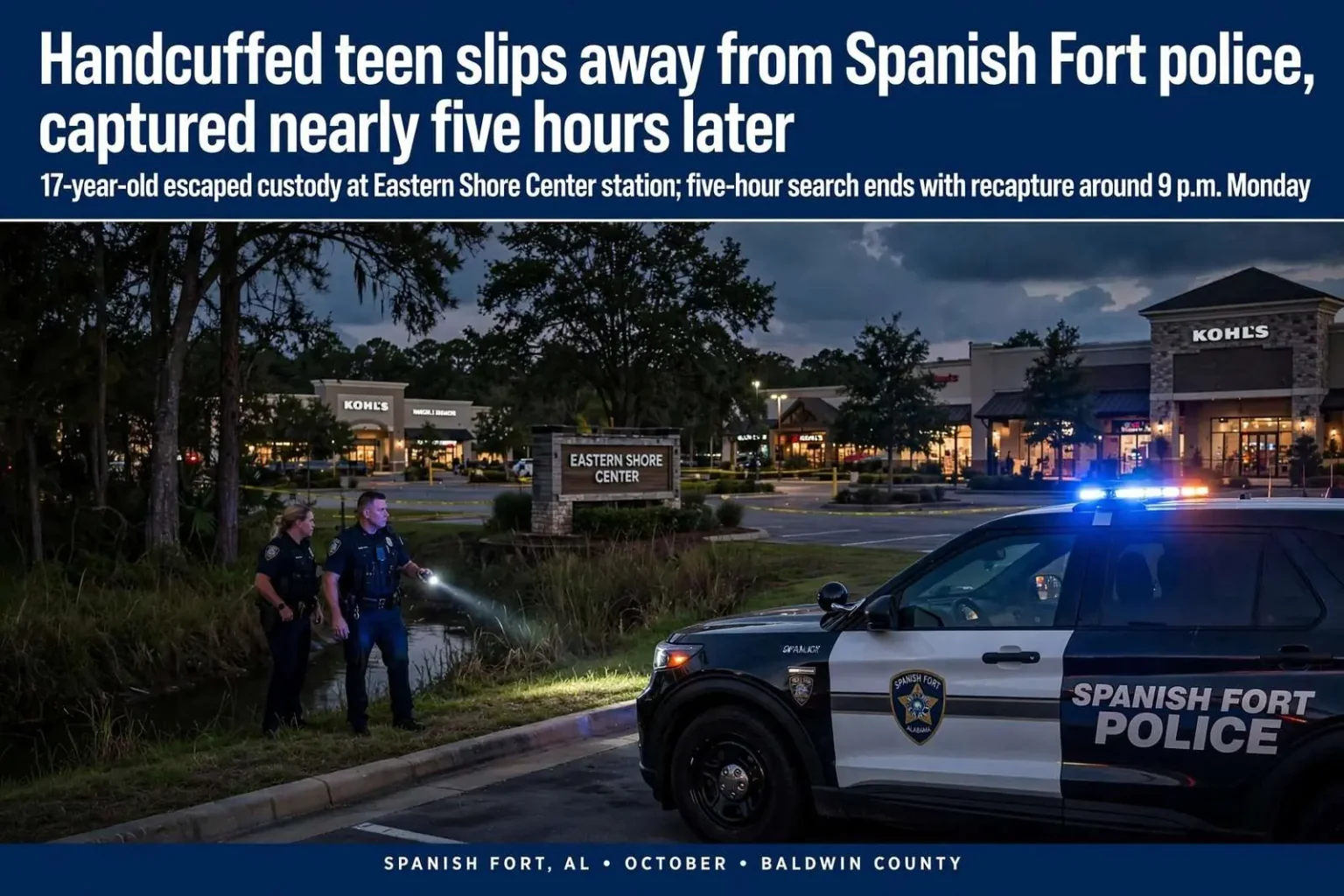
A teenager in handcuffs managed to break away from police custody in Spanish Fort and stayed on the run for nearly five hours before officers caught up with him. The escape, the search and the recapture unfolded across an October afternoon and evening in one of Baldwin County’s busiest retail corridors, and it ended with the 17-year-old back in custody around 9 p.m. Monday, according to the Spanish Fort Police Department.
The episode began around 4 p.m. Monday, when officers responded to the Kohl’s store at Spanish Fort Town Center, where the teenager was accused of trying to steal shoes. Retail theft calls are routine business for a police department serving a major shopping destination, but this one took an unusual turn: officers took the teen into custody and transported him, in handcuffs, to the police station at the Eastern Shore Center, the other major shopping complex in the city.
That is where, police said, he ran off. The 17-year-old, despite being handcuffed, managed to break away from officers at the station and disappear into the surrounding area, launching a search that would consume the rest of the afternoon and evening. The department said he evaded capture for close to five hours before officers finally took him back into custody around 9 p.m.
Spanish Fort and its retail corridors
Spanish Fort sits at the eastern edge of the Mobile Bay area, along the Interstate 10 corridor that carries travelers between Mobile and the beaches, and its retail development has grown with the traffic. Spanish Fort Town Center, the shopping complex where the attempted shoe theft occurred, anchors the city’s commercial activity along the highway, drawing shoppers from across Baldwin County and from Florida panhandle communities just across the state line.
The Eastern Shore Center, where the police station involved in the case is located, is the city’s other retail landmark, an open-air development designed around a village streetscape. The two shopping destinations, separated by a short drive across the city, define the geography of Spanish Fort policing: high-traffic retail environments where shoplifting calls, parking disputes and traffic issues make up the daily workload, alongside the residential neighborhoods that surround them.
The terrain between and around those developments shaped the search on the evening of the escape. Eastern Baldwin County’s mix of commercial parcels, wooded tracts, drainage corridors and residential streets offers a fleeing person both cover and movement, and a five-hour search in that landscape involves officers, tracking and patience rather than a simple sweep of a parking lot.
How a five-hour search unfolds
An escape from custody triggers an immediate and structured response. The department secures the area around the escape point, establishes where the person was last seen, and begins a expanding search that brings in additional officers as the hours pass. Descriptions are broadcast to neighboring agencies, since a fleeing teenager on foot near the Eastern Shore Center had any number of directions available to him.
The hours between roughly 4:30 p.m. and 9 p.m. Monday stretched across the most difficult conditions for a search: fading daylight, cooling evening, and a commercial area winding down toward closing time. Officers pursuing a 17-year-old on foot combine ground searches of the likely hiding places, from drainage ditches to tree lines to the edges of the shopping properties, with the slow work of checking reported sightings and keeping the perimeter wide enough that the fugitive cannot simply circle back.
The recapture around 9 p.m. closed the search the way departments prefer: with the subject in custody, no injuries reported, and the additional charges that an escape from custody brings. For the Spanish Fort Police Department, the evening demonstrated both the contingency of custody, a handcuffed suspect still ran, and the persistence required to end the incident on the department’s terms.
Custody, juveniles and what comes next
The case involved a juvenile, and that status shapes the legal aftermath in ways that differ from adult arrests. A 17-year-old accused of attempted retail theft faces the juvenile justice system, where proceedings are structured around rehabilitation as well as accountability, and where the records and procedures differ markedly from adult criminal court. The attempted theft charge he was taken into custody over, and any charge arising from the escape itself, route through that system.
Escaping custody is treated as a serious matter precisely because of what it sets in motion. A search consumes hours of officer time, closes down the routine work of a small department, and creates risk for everyone involved, the fugitive, the officers and the public. Juvenile suspects who flee custody typically face additional consequences within the juvenile system for the escape, layered on top of whatever brought them into custody in the first place.
For the department, the incident also illustrates the operational realities of policing a fast-growing city. Spanish Fort’s force is sized for a city of its population, but its retail corridors generate call volumes that belong to a much larger place, and an afternoon shoplifting call can consume an entire shift of manpower when it goes sideways, as this one did.
Retail theft and the mall economy
The attempted theft that started the case, shoes from a Kohl’s, belongs to the routine end of the crime spectrum, but routine does not mean insignificant. Retail theft is a constant across American shopping centers, and department stores and mall-based retailers lose inventory to it daily. Loss prevention staff are trained to observe, document and alert police rather than confront, which is how a suspected shoplifter ends up leaving a store in handcuffs.
Shopping destinations like Spanish Fort Town Center and the Eastern Shore Center occupy a central place in the city’s economy, generating sales tax revenue and employment, and their security needs are part of the partnership between retail operations and the police department. Calls from the stores are among the most common the city’s officers handle, and the response time from a store to a police substation in the same city is measured in minutes, as this case showed.
The irony of the location where the escape occurred, a police station in a shopping center, was not lost on observers of the case, but it reflects a practical arrangement: substation offices placed at high-traffic commercial locations give officers a base close to the calls they handle most often. On this Monday, the base itself became the scene.
The record of the day
The preserved account of the episode runs in a straight line through the day. Around 4 p.m. Monday, officers responded to Kohl’s at Spanish Fort Town Center, where the 17-year-old was accused of trying to steal shoes. Officers took him, handcuffed, to the Eastern Shore Center police station. There, police said, he broke away and ran, evading capture for close to five hours. Officers took him back into custody around 9 p.m. Monday, the Spanish Fort Police Department said.
Everything beyond that sequence, the details of how the teen slipped custody, the specific methods of the search, and the legal outcome in the juvenile system, lies outside the preserved account. The summary reports what the department stated and leaves the rest to the official record.
What the episode documents is a day in the life of a Gulf Coast suburban police department: a routine retail call, an unexpected escape, a five-hour search across commercial Spanish Fort, and a recapture that returned the case to its ordinary course. For the department and the city, the day ended where it should have, with a suspect in custody and no one hurt.
The Eastern Shore’s growth and its police work
Spanish Fort’s experience of the last two decades explains the setting of the case. The city has grown from a small community along the bay’s eastern shore into one of Baldwin County’s commercial centers, its population and its retail footprint both expanding with the wave of development that followed the Interstate 10 corridor toward the beaches. Growth of that kind brings tax base and amenities, and it brings the policing demands of a destination retail market to a department sized for a much smaller town.
The two shopping complexes at the center of this case are the visible products of that growth. Spanish Fort Town Center, at the interstate interchange, and the Eastern Shore Center, with its open-air village design, were built to capture the regional traffic that passes daily between Mobile, Pensacola and the Gulf beaches. Together they generate the kind of call load, thefts, wrecks, trespass reports, disputes, that defines suburban retail policing across the country.
Departments serving such markets learn to manage that load with substation presence, retail partnerships and rapid response. The police station at the Eastern Shore Center, the site of the escape in this case, is a product of that strategy, placing officers where the calls are concentrated. The episode showed both the value of that placement and its limits, since even a station cannot guarantee custody without attention.
Searching a commercial corridor
The geography of a five-hour search around the Eastern Shore Center deserves its own note. The area around the shopping development mixes parking fields, landscaped buffers, drainage ways, woodlands and connecting residential streets, and each of those environments presents different search problems. Commercial areas at evening closing time add another variable: crowds thinning, vehicles leaving, lighting shifting as storefronts go dark.
Officers managing such a search work the pattern methodically. Perimeter points are watched to keep the subject inside a shrinking area, sightings are checked and correlated, and likely hiding spots are cleared one by one. Neighboring agencies are notified so that the search can extend if the subject slips past the perimeter, and the search continues until the subject is found, because an escaped person in custody matters, handcuffed or not, cannot simply be left for the next shift.
The recapture near 9 p.m., close to five hours after the escape, represents the patient end of that process. Nothing about the department’s account suggests drama beyond the hours themselves: the search simply continued until it succeeded, and the 17-year-old was returned to the custody he had fled.
Lessons of the episode
Every escape from custody prompts the same internal review: how it happened, what could have prevented it, and what procedures change as a result. Handcuffed suspects do escape, more often than the public imagines, and departments respond with attention to transport practices, control of detainees at stations, and the balance between holding a juvenile securely and processing him quickly. The Spanish Fort case, whatever its internal findings, became a local example of that universal lesson.
For residents of Spanish Fort and the surrounding Eastern Shore communities, the episode was also a demonstration of their police department at work: responding to a mall call within minutes, absorbing a five-hour disruption, and closing the incident the same evening. Small-city departments earn their reputations on nights like that one, when an ordinary call becomes an all-hands event.
The preserved record of the day is brief because the facts were brief: an attempted shoe theft at Kohl’s around 4 p.m. Monday, a handcuffed 17-year-old driven to the Eastern Shore Center police station, an escape there, nearly five hours of evasion, and a recapture around 9 p.m. Monday as stated by the Spanish Fort Police Department. The rest, how the teen got loose and what became of the case afterward, belongs to the department and the juvenile court, not to the summary.