Hayley’s Bar Screens Walking Dead Season Premiere With ‘Michonne’s Pets’
Hayley's Bar on Dauphin Street marks the season premiere of The Walking Dead with a twist: the actors behind Michonne's pet zombies will attend.
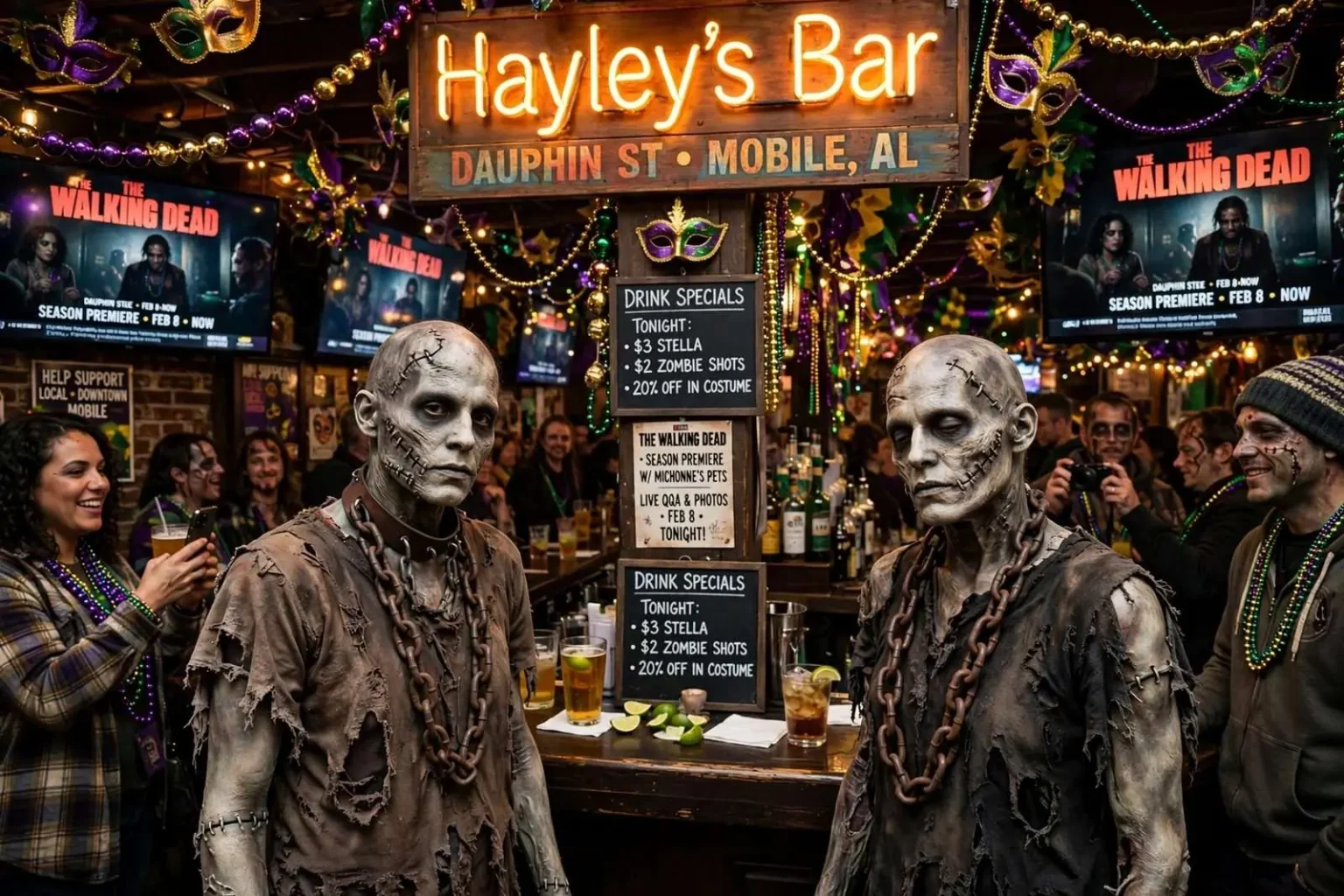
Hayley’s Bar on Dauphin Street marks the season premiere of The Walking Dead on Feb. 8 with a twist for Mobile fans: the actors who portray Michonne’s pet zombies will be on hand.
The two silent, armless horrors that trailed the samurai-swinging heroine through much of the series will mingle with patrons and pose for photos. The screening runs on the bar’s flat screens, and the actors may share behind-the-scenes stories from the hit show.
Drink specials include $3 Stella and $2 zombie shots, and anyone who arrives in zombie costume gets 20 percent off. It’s a natural fit for Mardi Gras season, when Dauphin Street already feels overrun with the undead. Supporting neighborhood bars like Hayley’s helps keep downtown Mobile’s entertainment district thriving.
Michonne’s Pets Come to Dauphin Street
For fans of The Walking Dead, few images from the series are as instantly recognizable as Michonne’s pets — the two walkers, jaws removed and arms cut away, led by chains at the side of the sword-wielding heroine as she moves through the show’s ravaged world. The actors who portray those silent, armless horrors on screen were set to appear in person at Hayley’s Bar for the show’s Feb. 8 season premiere, giving Mobile viewers a chance to stand next to the very creatures they had watched trail Michonne across television screens.
The arrangement is a curious one by design. On the show, the pets are mute, faceless presences — parts played, as walkers always are, by performers under layers of prosthetics and makeup who appear in credits but rarely speak. At Hayley’s, the two actors planned to mingle with patrons and pose for photos, turning television’s most unsettling bodyguards into the evening’s most photographed guests. And because they lived through the production, they could share behind-the-scenes stories from the hit show — how the prosthetics worked, what the set was like, and what it takes to spend a season walking in silence at the end of a chain.
For a neighborhood bar, booking an event of this kind is a coup. The Walking Dead was, by its third season, among the most-watched programs on American television, and its premiere nights functioned as de facto holidays for the show’s fanbase. Giving those fans a place to watch together — with the show’s own background players in the room — converts a night of ordinary television into an occasion worth leaving the house for.
The Screening Party Format
The premiere screening ran on the bar’s flat screens, with the room’s attention fixed on the season’s opening episode as it aired. Watch parties have become a staple of bar programming for appointment television, and the formula’s appeal is simple: a show is better with a crowd, the crowd needs a place, and the bar supplies drinks, screens and seating to both. For a premiere as anticipated as The Walking Dead’s, the crowd arrives pre-committed — the bar’s job is mostly to give them somewhere to cheer and gasp together.
The extras in attendance elevated the format beyond the usual watch party. A screening becomes a fan event when someone connected to the production is in the room, and two actors from the series — even performers whose characters never speak — carried the kind of authenticity that fan conventions trade on. Patrons could ask questions between acts, hear how particular scenes were shot, and get a photograph with two of television’s most famous silent walkers without traveling to a convention hall or paying an admission fee beyond the price of a drink.
The drink specials did their part to build the theme. Stella was priced at $3, zombie shots at $2, and anyone who arrived in zombie costume received 20 percent off — an invitation that ensured at least a scattering of the bar’s patrons would look the part, and that the photographs with Michonne’s pets would feature a supporting cast of homemade undead.
Zombies in Mardi Gras Season
The timing placed the premiere party squarely inside Mardi Gras season — and on Dauphin Street, that made it less a theme night than a matter of degree. Mobile’s carnival season fills downtown with parades, masked societies, moon pies and late nights through the weeks before Fat Tuesday, and the street’s normal weekend crowd already carries a ghoulish edge: face paint, costumes, glitter and the walking weary. Adding a pair of professional zombies to the mix, the thinking went, hardly changed the population’s character.
That overlap is part of what made the event work. Mardi Gras season has already conditioned downtown Mobile to accept spectacle on a weeknight, and the premiere party rode along with it. A bar that could put costumed patrons, television walkers and drink specials in the same room during carnival — the busiest stretch of the downtown calendar — had found a way to stand out on a street where every venue is competing for the same celebratory traffic.
The zombie-mardi connection runs deeper than convenience, too. Both traditions are about costume and transformation — about a night when the ordinary crowd becomes something stranger. A Walking Dead premiere during carnival season let patrons be both fan and reveler at once, arriving in zombie makeup that would have been equally at home in either context.
Neighborhood Bars and the Downtown Economy
Underneath the fun sat a commercial point worth making plainly: supporting neighborhood bars like Hayley’s helps keep downtown Mobile’s entertainment district thriving. The Dauphin Street corridor’s mix of bars, music venues and restaurants functions as an ecosystem, and its health depends on each venue finding reasons for people to come downtown on nights when no parade is rolling. Themed events — a premiere screening, a costume night, a visit from television performers — are how smaller neighborhood bars compete with larger operations for that traffic.
The economics of the evening reflected that strategy. Drink specials priced at $3 for Stella and $2 for zombie shots trade margin for volume, getting patrons through the door with the promise of a night worth attending. The 20 percent discount for costumed arrivals converts the crowd itself into decoration and promotion — costumed zombies spilling onto the sidewalk outside a Dauphin Street bar are their own advertisement, visible to everyone else deciding where to spend the evening.
For the fanbase, the equation is equally favorable. Premiere night at a bar with the show’s background actors in residence offers what no living room can: a crowd, a theme, a photo opportunity and a story to tell afterward. Events like this one succeed because both sides gain something concrete — the bar gains a packed room, the fans gain a memory — and downtown Mobile gains one more reason to keep its entertainment district busy in the stretch between carnival weekends.
The Walking Dead’s Cultural Grip
The fact that a Mobile neighborhood bar could build a full evening around two background performers says much about the show’s cultural grip at the time. The Walking Dead had grown from a comic book adaptation into a phenomenon that filled convention halls and drove premiere-night parties in cities far larger than Mobile. Its walkers had become costume staples, and Michonne, introduced with her chained pets in the show’s second season, had quickly become one of its most iconic characters.
The pets themselves occupy a specific place in that iconography. Silent, armless and jawless, they exist on screen as an idea as much as characters — a walking shield of walkers that lets Michonne move through the undead world unnoticed. The concept required actors willing to spend long production days in full prosthetic disguise, moving at the end of chains. At Hayley’s, those same performers finally got to break the silence, telling the stories behind the show.
For one February night during Mardi Gras, then, Dauphin Street had it all: a season premiere on the screens, $3 Stella and $2 zombie shots at the bar, discounts for the costumed, and two of television’s most famous walkers posing with patrons between episodes. It was a reminder that the undead, in downtown Mobile, were already a seasonal tradition — the premiere party just made it official.
Premiere events like the one at Hayley’s also demonstrate how television fandom has become a local, social activity again. Appointment viewing survived the streaming era precisely because events like this give it a venue: a date, a place, a themed drink and a room of people reacting to the same moments. The Feb. 8 screening on the bar’s flat screens turned an episode everyone could have watched alone into a night no one present would forget — and gave downtown Mobile’s undead season one more evening of genuine star power, zombie makeup and all.
And that, in the end, was the point of the whole evening. A premiere is only a television schedule until someone gives it a room, a drink special and a reason to dress up. Hayley’s gave the season’s opening episode all three, and Dauphin Street — already deep in its carnival stretch of costumes and crowds — was the natural place for it.