‘He’s One of Our Neighbors Now’: Saraland Residents Embrace Their Local Black Bear
A black bear has become a regular sight in a growing Saraland neighborhood off Celeste Road, raiding trash cans and charming residents.
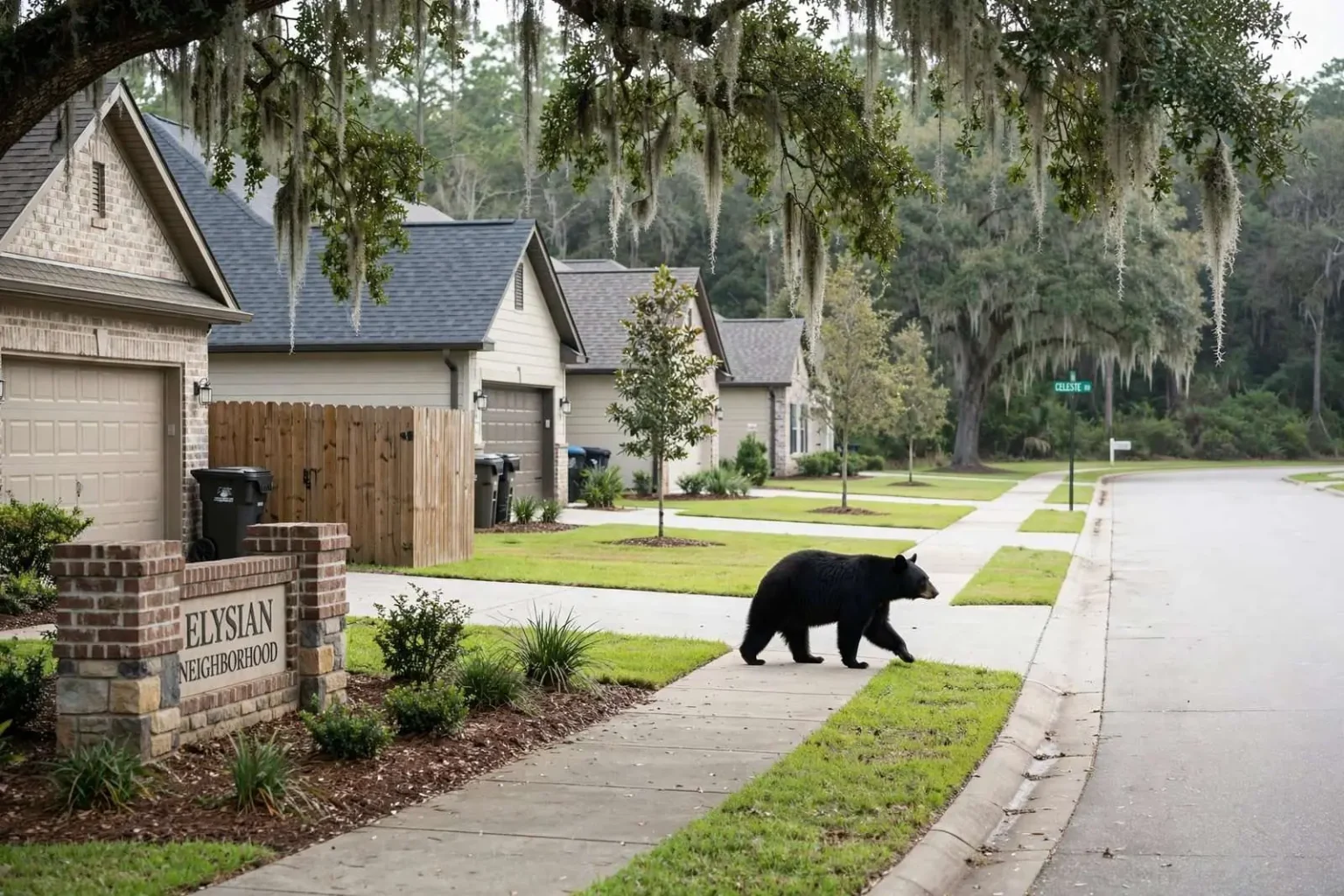
In a fast-growing Saraland neighborhood off Celeste Road, one particular black bear has become something of a local celebrity. Residents of the Elysian Neighborhood say the animal wanders in regularly from surrounding woodlands, strolling sidewalks and popping out of tree lines on either side of the subdivision — a routine that has turned one of Alabama’s most elusive wild animals into a fixture of daily life on the northern edge of Mobile County.
“He will come from the wooded area over here or the wooded area over there — he doesn’t have a preference,” resident Deanna Nezat said. The bear’s comings and goings have become neighborhood news, passed along in group messages and front-yard conversations, with residents comparing sightings and noting which tree line he emerged from on a given morning.
Neighbors charmed, not frightened
Rather than frightening neighbors, the visits have mostly charmed them. Melissa Flowers, who has lived in the neighborhood five years, said her family spotted their first bear within a year of moving in. “He is one of our neighbors now,” Flowers said. “We want to protect him; we know that they’re getting thrown out of the place they live with all the neighborhoods coming up.” Her children agree — they say catching a glimpse of the bear every once in a while is pretty “cool.”
The sentiment captures an unusual moment of coexistence in a fast-growing suburb. Black bears are shy by nature and generally avoid people, and the Elysian Neighborhood’s regular visitor has done nothing to change that reputation: no aggressive encounters, no injuries — just a large, wary animal moving through a landscape that used to be his alone, passing through subdivisions that did not exist a decade ago.
A messy houseguest
The bear does have one habit residents could do without: trash raiding. Nezat said the animal has gotten into her garbage two or three times and will dig through cans right at the road. Neighbors now make sure to store their cans somewhere the bear can’t rummage through them — in garages or behind closed fences until pickup morning — an adjustment that has become routine along the streets he favors.
The trash raids are more than a nuisance story. Wildlife managers consistently identify garbage as the leading attractant that draws bears into neighborhoods and keeps them coming back, because an easy meal outweighs the animal’s natural caution. A bear that learns to feed from cans can become a permanent neighborhood fixture, with consequences for both the bear and the community, which is why the Elysian residents’ habit of securing their cans is exactly the behavior state biologists hope to see.
Alabama’s bears
Alabama is home only to black bears, and an estimated 300 of them roam the southwest region of the state. That population is centered in the mobile-bay region’s remaining forests and wetlands — the vast bottomland tracts of the Mobile-Tensaw delta and the woodlands of Mobile, Baldwin, Washington and Clarke counties — where bears find the mast, cover and travel corridors they need. The species is protected in Alabama, and the southwest population represents one of the state’s most significant wildlife recovery stories after decades in which bears were rarely seen at all.
Saraland sits squarely at the edge of that habitat. The city’s growth corridors along and north of Celeste Road push subdivisions into the wooded tracts bears use as travel routes and home range, and encounters like the Elysian Neighborhood’s regular visitor are the visible result of that meeting edge.
Growth meets habitat
Saraland is one of the fastest-growing cities in the Mobile area, and its expansion off Celeste Road and into the northern reaches of the county is part of a larger wave of residential development pushing out from the metro area. Every new subdivision converts woodland into lawns, and while that growth brings schools, roads and tax base, it also narrows the corridors bears and other wildlife use to move between larger tracts of habitat.
Wildlife biologists describe the result as a steady increase in the interface between bears and people. Bears are territorial travelers with home ranges measured in square miles, and a subdivision built across a travel route does not remove the route — it just populates it. The Elysian Neighborhood’s celebrity bear, wandering in from the woodlands on either side of the subdivision, is following a path his kind has likely used for years, through a landscape that changed around him.
What wildlife officials advise
As cities like Saraland expand into former woodland, wildlife officials say encounters like these are likely to continue — and residents are encouraged to secure attractants and give the animals plenty of space. The guidance is consistent across bear country: never feed a bear, intentionally or otherwise; keep garbage in secure containers or enclosed storage; remove pet food and birdseed that draws visits; and clean grills after use. A bear that finds no food reward in a neighborhood has little reason to keep coming back.
Officials also emphasize the proper response to a sighting. Black bears are rarely aggressive toward people, and a bear that notices humans will typically leave on its own. Residents who see one are advised to give it room, keep pets inside or leashed, and report significant sightings or problem behavior to state wildlife authorities rather than taking matters into their own hands — bears are a protected species in Alabama, and harming one carries serious legal consequences.
Living alongside the neighborhood bear
For now, the Elysian Neighborhood’s arrangement with its famous visitor is working the way wildlife managers would script it. Residents keep their cans out of reach, give the bear his space, and enjoy the sightings — and the bear continues his rounds without incident. The children who think a glimpse of him is “cool” are growing up in one of the few parts of Alabama where a black bear is a familiar neighbor rather than a rumor from the delta.
The longer story the neighborhood tells is about adaptation on both sides of the property line. As Saraland grows north and west, its newest residents are learning the habits of its oldest ones — securing attractants, respecting space, and accepting that the woodlands they built beside were never empty. State biologists watching the southwest Alabama bear population grow expect more neighborhoods to learn the same curriculum, one trash can at a time, and the Elysian experience suggests the lesson can take: people and bears, sharing the same streets, with the bears still wild and the people still charmed.
Black bears return to southwest Alabama
The bears now moving through Saraland’s outskirts are part of a population that nearly vanished from Alabama and has slowly rebuilt itself. Black bears were once found across the state, but habitat loss and unregulated killing reduced them to a remnant by the mid-twentieth century. The survivors in southwest Alabama persisted in the great bottomland forests of the Mobile-Tensaw delta, and over recent decades that population has grown and spread, with bears documented more frequently each year in the surrounding counties.
State biologists have followed the growth through sighting reports, camera surveys and genetic studies that paint a picture of a small but expanding population — distinct from the better-known bear populations in Georgia, Florida and Louisiana, and increasingly important in its own right. Female bears with cubs documented in southwest Alabama signaled that the population was reproducing locally rather than merely sending wandering males across state lines, a milestone in the species’ recovery in the state.
The Mobile-Tensaw connection
The delta north of Mobile Bay — tens of thousands of acres of swamps, oxbows and bottomland hardwood forest — is the engine of the region’s bear population. Its dense cover and abundant food supply support bears largely out of human sight, and its waterways and ridgelines serve as the corridors along which young bears disperse to find territory of their own. Saraland’s northern growth area sits near the western edge of that system, which is why a bear emerging from a tree line behind a new subdivision is not a mystery but a map: the subdivision was built on the edge of bear country.
Development pressure around the delta has made corridor conservation a growing concern for wildlife agencies. Bears need connected habitat to maintain genetic diversity and expand their range, and every subdivision that cuts across a travel route increases the odds of the kind of neighborhood encounters Saraland residents have grown used to — along with road strikes, which are among the leading causes of bear mortality in the region.
Reporting sightings matters
State wildlife officials ask residents who see bears to report the sightings, and the reports do real work: they help biologists map where bears are moving, identify which corridors matter most, and target education to the neighborhoods where encounters are rising. A well-documented sighting — location, time, what the bear was doing, whether it appeared healthy — adds a data point to a population that scientists are still learning to count.
The Elysian Neighborhood’s experience offers a template for how that relationship can work. Sightings are shared openly, attractants are managed, and the community’s attitude toward its bear is protective rather than hostile. If southwest Alabama’s bear population continues to grow as biologists expect, more subdivisions off Celeste Road and beyond will have their own celebrity bears before long — and the neighborhoods that welcome them with secured trash cans and a little distance will be the ones where the story stays as pleasant as it has been in Saraland.