Historic Buildings Along St. Francis, St. Louis Streets Reborn as Downtown Mobile Apartments
Two historic downtown Mobile buildings along St. Francis and St. Louis streets are being converted into more than 50 new apartments, with developers leaning on state historic tax credits to fund the renovations.
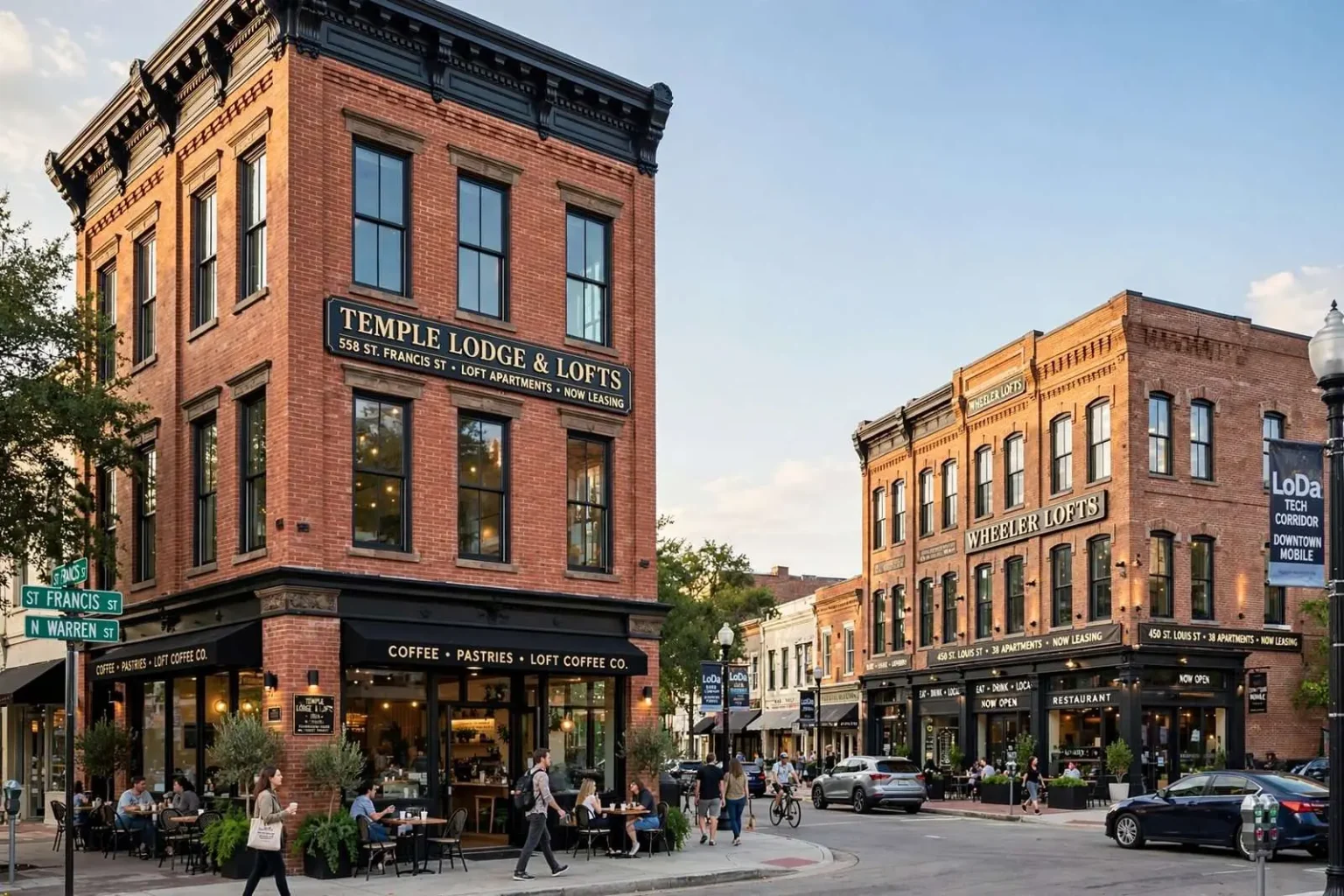
A wave of new apartment construction is transforming two historic blocks of downtown Mobile, as developers convert century-old commercial buildings along St. Francis and St. Louis streets into loft-style residences aimed at young professionals and empty nesters drawn to the city’s growing Central Business District. The two projects, Temple Lodge and Lofts at 558 St. Francis St. and Wheeler Lofts at 450 St. Louis St., will together add more than 50 apartments to a downtown corridor that has increasingly become a hub for entertainment, technology firms and street-level retail. Both sites sit within walking distance of established downtown landmarks and the emerging LoDa technology corridor, and both lean heavily on Alabama’s historic tax credit program to make the renovations financially viable.
At Temple Lodge and Lofts, brothers John and William Peebles of NAI Mobile recently hosted a preview open house for the property, a renovation project nearing 90 percent completion at the corner of St. Francis and North Warren streets.
The building dates to roughly 1850 and later served for 120 years, from 1890 to 2010, as the home of an African-American Masonic lodge — a history the Peebles brothers say is reflected directly in the project’s name. “The space was the home for an African-American Masonic lodge dating from 1890 to 2010, and the naming of the mixed-use property is in reference to this 120-year occupancy,” said John Peebles, managing partner with NAI Mobile.
NAI Mobile worked exclusively with local investment partners, a first for the firm, who put roughly $2.5 million into repurposing the building over the past two years. The finished apartments will feature high ceilings, exposed brick and timber intended to preserve what William Peebles described as an authentic 19th-century feel.
Of the property’s 10 studio units, eight already have lease agreements in progress ahead of the official opening. Douglas Kearley served as the local architect on the project, and ServisFirst Bank provided the loan capital.
The ground floor of the main building includes about 5,000 square feet of commercial space. A Dallas-based coffee shop is expected to take the highly visible corner space at St. Francis and Warren streets, with the remaining commercial square footage reportedly under discussion with an out-of-town advertising agency.
Across the street, five newly built Temple Lodge Townhomes are about 80 percent finished. Each three-level townhome includes a ground-floor parking garage, a second-floor kitchen and living area, and third-floor bedrooms, with roughly 500 square feet per level. Covered parking adjacent to the townhome lot will also be available to tenants of the main Temple Lodge building across the street.
Three blocks east, at the corner anchoring the city’s LoDa technology corridor, the Wheeler Lofts project is bringing a similarly historic property back into active use.
The roughly 53,000-square-foot complex has been in the same family for generations. Bestor Ward’s great-uncle purchased the main section of the block in 1933, and Ward has since acquired the surrounding parcels, most recently an 1800s-era horse stable situated perpendicular to the main building. The Wheeler name traces back to the Wheeler Motor Co., which briefly operated on the site from 1927 to 1932.
Construction crews are currently active on the site, with Rob Middleton of Mobile-based Rob Middleton Construction handling parking lot work and David Middleton of Point Clear-based SCC Group overseeing project management. Ward said he expects the complex to open by January 2019, with leasing set to begin in September 2018 if construction stays on schedule.
Ward traced the idea for converting his family’s commercial property into mixed-use apartments back roughly a dozen years, to a trip to New Orleans he took with Downtown Mobile Alliance President and CEO Elizabeth Stevens. The project broke ground two years ago.
Ward credited Alabama’s state and federal historic tax credit programs with making the renovation financially possible, saying the credits contributed more than $1 million toward defraying construction costs. “It would not have happened without the Alabama historic tax credits existing,” Ward said.
When finished, Wheeler Lofts will include 38 apartments, each with a window view, along with four parking lots capable of holding up to 75 vehicles combined. The main Wheeler Building footprint covers about 45,500 square feet, split between roughly 6,000 square feet of retail and restaurant space and 39,500 square feet of residential space, housing 34 one- and two-bedroom units divided evenly between the two layouts.
The adjacent 1800s-era horse stable adds another 7,500 square feet, with 4,000 square feet set aside for offices and 3,500 square feet split among four loft-style apartments. Three of those lofts will be one-bedroom units, while the fourth — a 1,400-square-foot, three-bedroom unit on the second floor — has already been leased.
Because of requirements tied to the historic tax credits, none of the Wheeler Lofts units will be available for purchase; all will be offered as rentals. Ward said pricing will run about $1.60 per square foot across the property, translating to roughly $1,400 a month for one-bedroom units and more than $1,700 a month for two-bedroom units.
How the Historic Tax Credits Work
Alabama’s historic rehabilitation tax credit, enacted in 2013, gives developers a state credit worth 25 percent of qualified rehabilitation costs on certified historic buildings. It can be combined with the 20 percent federal historic tax credit. The work must meet preservation standards reviewed by the Alabama Historical Commission and the National Park Service.
The federal credit is available only for income-producing buildings, and it can be recaptured if the property is sold within five years of being placed in service. That is why projects financed this way, like Wheeler Lofts, are typically offered as rentals rather than sold as condominiums.