How Mobile-Area Families and Businesses Reinvented Daily Life During the Early Days of COVID-19
As COVID-19 forced schools to close and daily life to slow down, Mobile-area families found new routines for exercise, learning and connection, while local businesses like Calagaz Printing and Perdido Vineyards retooled production to help meet the demand for protective equipment and hand sanitizer.
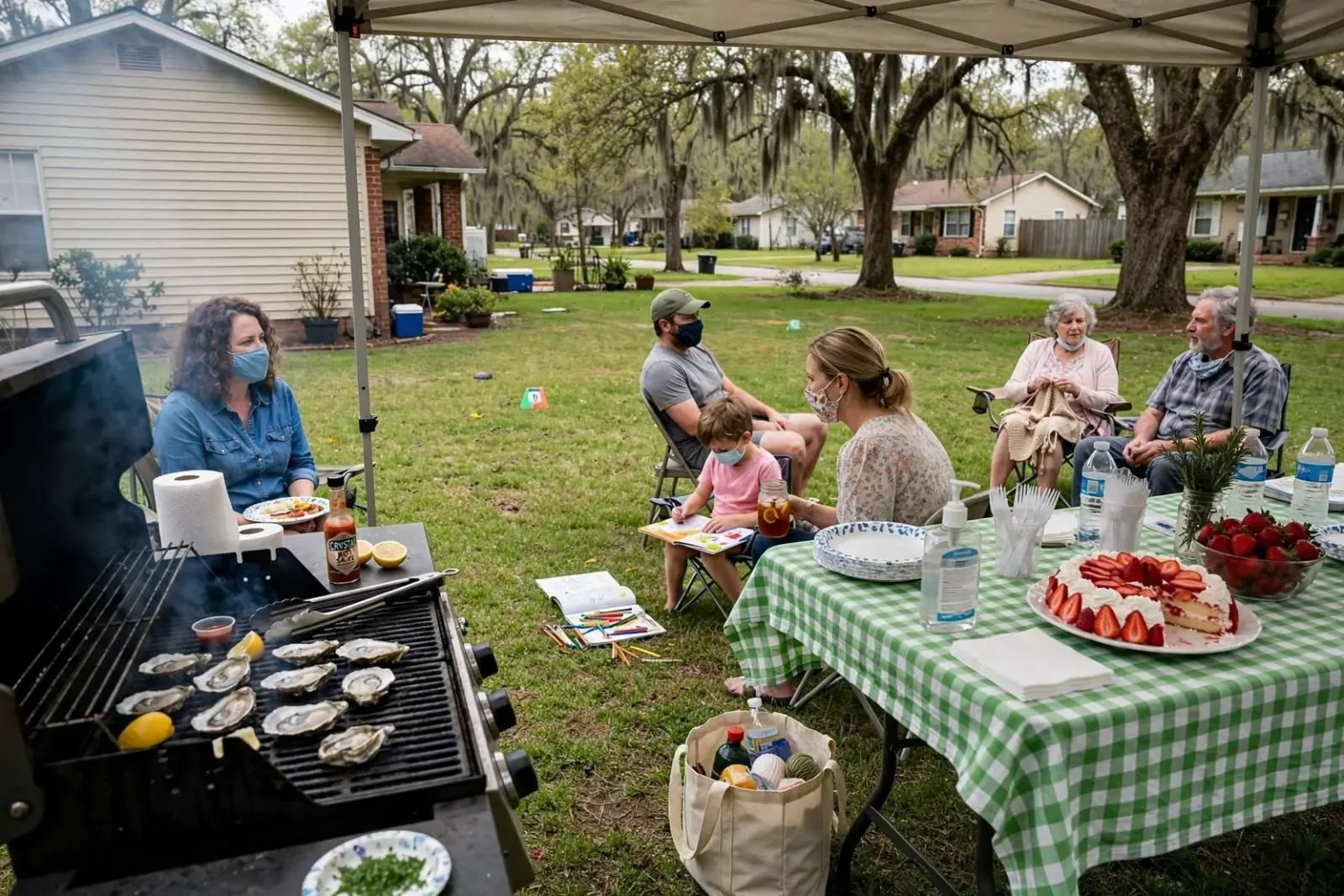
Oysters sizzled on the grill and a strawberry dessert was spread across a folding table under a backyard tent on Le Moyne Place in Mobile last month, but the scene looked nothing like the neighborhood’s usual spring get-togethers. Families sat six feet apart in small clusters, trading conversation across the yard rather than mingling shoulder to shoulder, as residents up and down the street found new ways to gather safely during the COVID-19 outbreak.
“It’s physical distancing, not social distancing,” said Sheila Morris, who has lived on the street for years and helped organize the outdoor gathering. “We’re physically separated. We have it set up with each family, each group physically six feet separated, and we get to enjoy each other’s company, we get to enjoy really good food, and we get to protect each other, because it’s all about taking care of each other.”
The neighborhood typically holds block parties to mark spring, the Fourth of July or Christmas, but this one looked different, Morris said. In a normal year, neighbors would drift freely between houses and sit close together on porches and lawn chairs. This time, everyone stayed put in their own distanced pods.
“There would be a lot more people in and out of houses,” Morris said. “We would just enjoy each other’s company a little differently. It’s not what we’re used to, but it still felt good to be together, even from a distance.”
How the Region Adjusted to Distancing
Across Mobile and Baldwin counties, residents have spent the past several weeks reworking daily routines as public health officials have urged people to stay home and limit close contact to slow the spread of the coronavirus. Both the World Health Organization and the Centers for Disease Control and Prevention have identified distancing as one of the most effective tools available for reducing transmission while hospitals and testing capacity ramp up.
Data-tracking firm Unacast has used anonymized cell phone location data to build a scoreboard grading how well different areas are adhering to distancing guidelines, assigning letter grades based on the drop in average distance traveled compared with normal patterns. Alabama as a whole earned a “D,” reflecting a 10 to 20 percent decrease in travel, while Mobile and Baldwin counties scored slightly better with a “C” average, showing a 20 to 30 percent decline.
Finding New Ways to Stay Connected
For some residents, the new routines have meant finding substitutes for social outlets that used to happen in person. Judy Prickett, who normally spends part of her day at a nearby senior center, has instead taken to walking laps around Medal of Honor Park.
“It’s new for me right now,” Prickett said of her park visits. “I was going to the senior center to work out. I can’t go to the senior center now.” She said she misses seeing friends there but has kept up her workout routine with online exercise videos, and she has stayed connected with a longtime friend, Nancy Hanna, through a book club the two now hold entirely by phone.
“I’ve found it pretty satisfying after I hang up,” Hanna said of the calls. “We talk for about an hour, and after I hang up I really feel like I’ve been with the others.” Prickett added that the slower pace has given her more time for hobbies, including knitting projects she had let slide before the outbreak. “This to me is like guilt-free knitting time,” she said. “I’m getting a lot of stuff knitted.”
Morris, meanwhile, has been working from home for roughly three weeks, leaving the house mainly for grocery runs and a daily walk around the neighborhood. City leaders have moved to formalize some of those informal precautions. Mobile Mayor Sandy Stimpson announced restrictions on crowd sizes at grocery stores and other essential businesses, and said police could ask groups of more than 10 people to disperse.
Schools Shift to At-Home Learning
Schools have seen some of the most dramatic disruptions to daily routines. When Gov. Kay Ivey ordered all Alabama K-12 schools closed in mid-March, families across the region had little time to prepare for a sudden shift to learning at home, forcing parents to take on teaching duties on top of their usual responsibilities.
Lauren McClinton, a fourth-grade public school teacher in Mobile’s Chateauguay neighborhood, put her own training to work keeping children in her community engaged even before formal remote instruction began. She distributed a nature scavenger hunt through neighbors’ mailboxes, sending children outside to find items like rocks and leaves as a way to stay active and connected to the outdoors. McClinton has since signed up for Google Classroom to prepare for teaching her own students online, while trying to keep her own children’s days balanced between lessons and play.
Jane Hale, whose twins attend St. Paul’s Episcopal School and whose youngest is in preschool, said the adjustment took some getting used to. “I was nervous,” Hale said. “Even though I’m a professional, I don’t have an education degree. I was a little scared at first, but we all started to get into a rhythm after about the first full week. They didn’t just throw us out there — they gave us a few days to get used to everything.”
Hale, a physical therapist whose caseload has shrunk since non-emergency medical procedures were postponed to preserve hospital capacity, has taken on more of the day-to-day teaching responsibilities while her husband continues working full time. “Whenever we finish breakfast, we sit down with our computers, usually around 8 or 8:30, and then we’re done around 11 if we work straight through their assignments,” she said. She credited St. Paul’s online learning system, which includes video conferences with teachers and classmates as well as virtual parent-teacher check-ins, with making the transition more manageable.
Jennifer Marley, whose two sons attend UMS-Wright Preparatory School, said her family’s shift to at-home learning went smoothly in part because her boys, ages 13 and 16, are old enough to manage their own schedules. That has been especially helpful since Marley and her husband are both teachers at Williamson High School and were preparing to lead their own online classes for other local students.
“It has made my job a great deal easier because the kids have been in class from 8 to 3 every day on the computer, and they’ve got alarms set so they know when to switch periods,” Marley said. “Everything’s been so well organized, and that’s made it easier for me to focus on my students at Williamson.” She said the bigger challenge has simply been keeping two teenage boys fed throughout the day, and she expects the household’s schedule to get more complicated once Williamson students begin their own at-home instruction, with both parents teaching classes under the same roof as their sons attend theirs.
One Family’s Homeschool Routine
Not every family’s homeschool routine has been so structured. Tricia Butts, whose four children range in age from 2 to 6, has effectively been running a one-room schoolhouse since the outbreak began. Her oldest, a first grader at Mary B. Austin Elementary, is the only one of the four considered “school aged,” but with the younger three no longer attending their church daycare program, all four have become classmates under one roof.
Butts said she spends time most weeknights putting together a lesson plan for the next day, since skipping that step tends to lead to disorder. “Some of the things I’m doing with the little kids is like using construction paper and cutting patterns with scissors, coloring or working with glue — basic little preschool things,” she said. “With my oldest, the school has actually sent out a packet, and we’ve been working through those worksheets together each day, but I’ve also been trying to supplement that with some more interactive things as well.”
Those supplemental lessons have often grown out of whatever the family stumbles across outdoors. After finding a dead bee one morning, the children spent part of a lesson drawing and labeling bee anatomy. A bird’s nest spotted on a neighborhood walk turned into a lesson about nesting behavior, complete with the kids’ own attempts at building nests. Butts said moments like those have become unexpected bright spots. “I probably never would have taken the time to point out nests to my kids before all of this, and just talk about them and spring and the newness of life,” she said. “I’ve been able to kind of learn with my kids in a way, and that’s really been one of the joys.”
Faith has also become part of the family’s daily curriculum, with afternoon lessons often built around Bible study. “One of the things that’s very important to me as a parent is helping them grow in their faith,” Butts said. “So I’ve tried to see how I can pull school activities out of that, whether it’s copying scriptures to practice handwriting or just analyzing and observing God’s creation in the real world and then learning about it.”
Butts acknowledged the arrangement hasn’t been without its difficulties. One of her children has special needs and has lost access to services that were available before the outbreak, and she said she recognizes her family is fortunate to have the financial stability and flexibility that allows her to stay home during the week. She said other parents navigating the same sudden shift shouldn’t feel pressure to have it all figured out. “It’s OK if some of us can’t do our jobs, keep these kids alive and teach them perfectly day in and day out,” Butts said. “Everybody is just trying to do the best that we can as we figure this out together.”
Local Businesses Retool to Meet New Demand
The pandemic has also pushed some local businesses to retool their operations. Calagaz Printing in Mobile lost the bulk of its menu-printing business within days as restaurants closed dining rooms, but rather than lay off staff, the company shifted toward manufacturing face shields for medical workers. An employee at the print shop cobbled together a prototype using office supplies, and Calagaz began producing shields using clear synthetic paper sourced from a supplier.
“We’ll be able to make 24,000 in about a week or so,” said Joe Calagaz, who bought up available supplies of the clear material once the shift proved viable. He said the company is aiming for a scale that could meaningfully affect the regional shortage of protective equipment. “Us providing 50, 100 or even 300 shields won’t significantly impact the problem,” he said. “I would say 200,000 face shields could impact the problem.” Gulf Packaging in Bay Minette has been producing the boxes used to ship the shields, a partnership that Calagaz said has helped keep all 17 of his employees on payroll during a period when the shop’s usual work all but disappeared. “First and foremost, it’s given us something to do other than clean and cross-train,” he said. “It gives me a way to cover payroll and get through this.”
In Baldwin County, Perdido Vineyards has begun taking orders for hand sanitizer while the winery waits on a shipment of raw materials, according to Marketing Director Sherri Clay. The winery is following World Health Organization guidelines to produce sanitizer with 80 percent alcohol content. “We want to supply first responders, care facilities and then the public,” Clay said, adding that the winery has already secured ingredients and orders for four batches. Once supplies arrive, Perdido Vineyards plans to begin production with a 66-gallon batch.
University of South Alabama associate professor of psychology Dr. Phillip Smith said some of the habits residents have picked up during the outbreak may outlast the pandemic itself. “I think people will do some things differently for sure,” Smith said. “I’ve seen a lot more people biking during this time. I hope that continues.” He pointed to simple gestures, like using video calls to reconnect with friends who had fallen out of touch, as changes that could stick around once restrictions ease. “We take it for granted, but social connectedness and relationships are so important for well-being,” Smith said. “I wonder if this will make us appreciate that.”
Morris said she doesn’t want to work from home forever — “it’s harder than people think it is,” she said — but believes she’ll carry some lessons from this period into life after the pandemic, particularly a renewed attentiveness to neighbors. “There are other aspects, like the daily walk and taking care of and checking on our older neighbors and making sure that they have what they need,” she said. “We were already a close-knit neighborhood. We’re even closer now.”