How Mobile County’s Environmental Enforcement Department Tackles Illegal Dumping and Litter
Mobile County's Environmental Enforcement Department investigates illegal dumping and litter complaints, issues citations under county and state law, and maintains more than 1,000 miles of county rights of way.
Illegal dumping and roadside litter remain persistent problems in unincorporated parts of Mobile County, and the county’s Environmental Enforcement Department is the agency tasked with responding. Its primary responsibility is enforcing the Mobile County Junk Control Ordinance and Alabama’s state litter laws across areas of the county that fall outside city limits.
The distinction matters more in Mobile County than in many places. The county covers more than 1,200 square miles along Mobile Bay and the Gulf Coast, stretching from the bayous of the south up through the timberlands and rural communities of the north, and much of that territory lies outside the police jurisdictions of Mobile, Prichard, Saraland, Satsuma, Citronelle and the county’s other municipalities. When a truckload of construction debris is left at the end of a county road or a trash pile appears at a rural crossroads, it is the county — not a city code office — that gets the call.
The department operates largely on a complaint-driven model, responding to reports from residents who allege a violation of the ordinances, laws and regulations it administers. When a complaint comes in, Environmental Enforcement Officers investigate to determine whether a violation has actually occurred, and the department says it works to resolve citizen complaints in a timely manner. That structure means the department’s reach depends in large part on residents picking up the phone: a dump site hidden off a sparsely traveled road may go unaddressed until someone reports it.
Investigating Dumping Complaints and Issuing Citations
Environmental Enforcement Officers investigate complaints regarding illegal dumping of junk and garbage on both commercial and residential properties throughout unincorporated Mobile County. When officers confirm a violation, they have the authority to enforce and issue state and civil citations under the Mobile County Junk Control Ordinance and Alabama’s litter laws.
Some investigations extend well beyond a citation. Cases can lead to prosecution by the District Attorney’s office, and when that happens, it becomes the responsibility of the Environmental Enforcement Officers involved to testify in court about their findings. That court-facing role underscores that the department’s work isn’t limited to issuing paperwork — officers are expected to build cases that can hold up as evidence when violations rise to the level of prosecution.
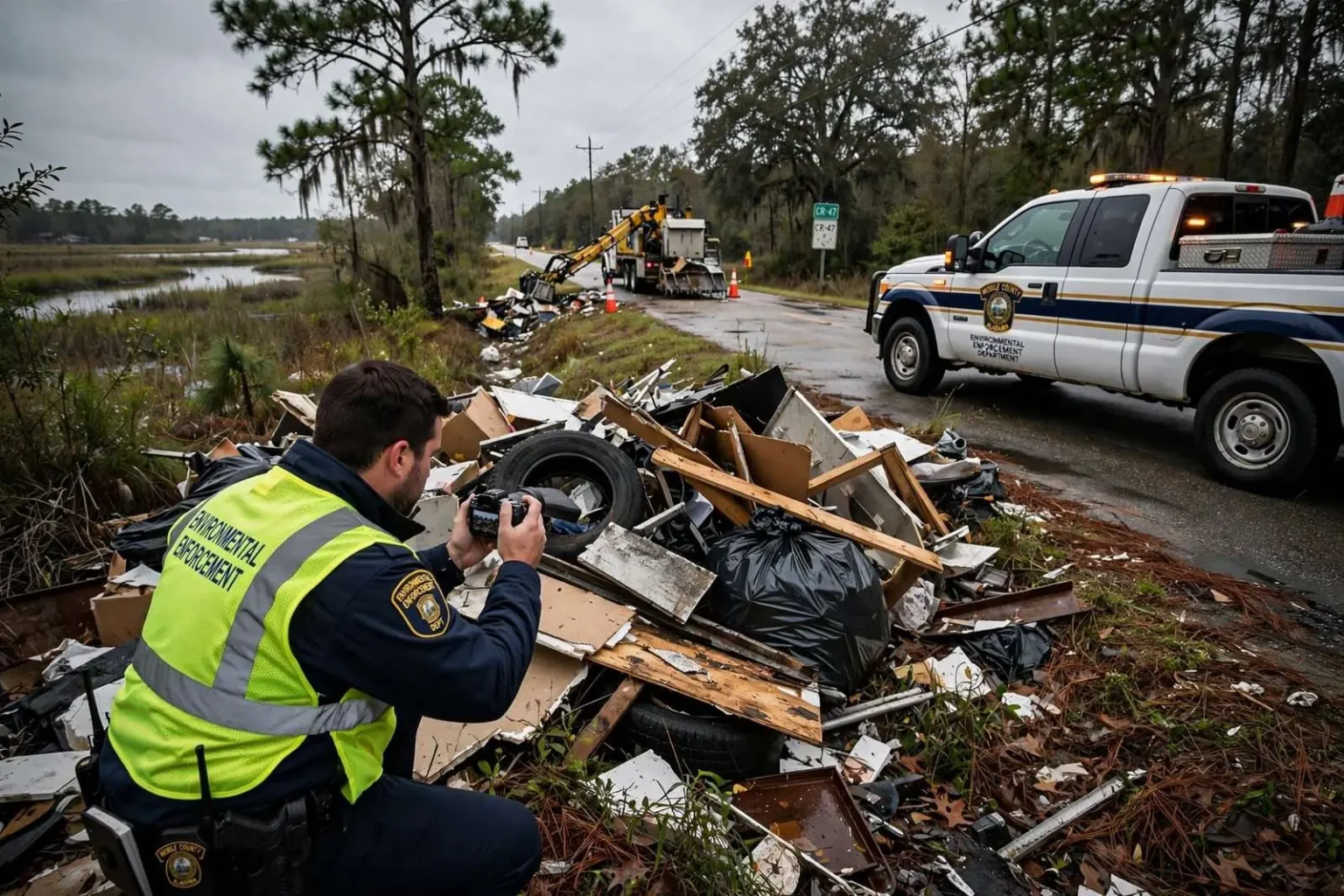
In practice, that means documentation from the first visit on. Photographing the site, identifying where the material came from and tracing it back to the party responsible are all parts of an investigation that may eventually be tested before a judge. Large-scale dumping cases can involve commercial operators looking to avoid disposal fees, and proving who left what where often determines whether a case ends in a fine, a cleanup order or a courtroom.
Beyond Litter: Animal Removal and a Dedicated Litter Crew
The department’s responsibilities also extend to matters that might not immediately come to mind when thinking about environmental enforcement. Officers remove deceased dogs, cats, coyotes, deer and other wild game from county rights of way, while also asking pet owners and livestock owners to take responsibility for removing their own deceased animals from those same rights of way when possible.
It is unglamorous work, but on a road network where deer strikes are common and stray animals remain a chronic issue in rural areas, the service protects public health and keeps rights of way passable. The department’s role here reflects the broader reality of county government: in unincorporated Mobile County, there is no municipal animal control or public works department to absorb these calls, so they fall to the agency already patrolling the county’s roads.
To keep county roadways clear of litter more broadly, the department operates a litter crew equipped with a mechanical Litter Picker, which is used to maintain more than 1,000 miles of county rights of way. Given the scale of Mobile County’s unincorporated road network, mechanized equipment like this plays a significant role in making litter cleanup efforts feasible across such a large area.
A crew working by hand could cover only a fraction of that mileage in any given week, particularly along fast-moving rural highways where litter accumulates fastest. The mechanical picker allows the department to cycle through its coverage area on a rotating basis, and it complements the state’s traditional response to roadside litter — inmate cleanup details operated through the county and the Alabama Department of Corrections — by handling the routine maintenance that keeps drainage ditches clear and roadsides presentable.
The Legal Framework Behind Enforcement
The department’s enforcement work is grounded in a handful of specific ordinances and laws: the Mobile County Junk Control Ordinance, the Mobile County Process and Procedure Ordinance, and Alabama’s Section 13A-7-29, which addresses criminal littering. Together, these provide the legal basis officers rely on when investigating complaints and issuing citations.
The state statute, part of Alabama’s criminal code, makes it a violation to deposit litter on public or private property, and it gives counties the hook they need to pursue cases that a purely local ordinance might not reach. The county ordinances, for their part, define what constitutes junk on property in unincorporated areas and establish the process by which violations are noticed, appealed and enforced. Residents who receive a citation have a defined process available to them, and officers are required to follow it, which is where the Process and Procedure Ordinance comes into play.
The patchwork is a familiar feature of Alabama local government. Municipalities enforce their own codes inside city limits, while counties depend on general-purpose ordinances that apply only outside them. That division means the same illegal dump can fall under two different enforcement regimes depending on which side of an invisible corporate-limits line it sits, and it explains why departments like Mobile County’s exist at all: somebody has to be responsible for the territory no city covers.
Community Outreach and Prevention
Enforcement isn’t the department’s only focus, however. Environmental Enforcement also works with schools and community action groups to raise awareness about the health and environmental concerns tied to illegal littering on county rights of ways and waterways, as well as the accumulation of litter on private properties.
The environmental stakes are real in a county drained by Mobile Bay, the Mobile River, the Tensaw Delta and their tributaries. Litter dumped on a roadside does not stay there: rain carries it into ditches, creeks and bayous, and eventually into the bay, where plastic and other debris threaten the waterways that define the region’s ecology and economy. Preventing a dump site is cheaper by every measure than cleaning one up.
Officers regularly attend community meetings to hear residents’ concerns about environmental issues, and the department participates in outreach efforts such as Operation Clean Sweep and Love Your Community, along with other anti-litter initiatives aimed at reducing dumping before it happens.
Those programs work both ways. They give neighborhood associations, church groups and civic clubs a framework for organizing cleanups in their own areas, and they give the department a channel for educating residents about what can be dumped legally, where household waste is supposed to go and how to report violations they see. In a complaint-driven system, an informed public is the department’s most valuable asset.
Hours and Emergency Response
The Environmental Enforcement Department’s regular hours run Monday through Thursday, from 6 a.m. until 4:30 p.m., and the office is closed on designated county, state and federal holidays. The four-day schedule is a common arrangement among Alabama county operations and concentrates the department’s fieldwork into long daytime shifts.
Outside those hours, an Environmental Enforcement Officer remains on stand-by duty to respond to emergency calls, though those after-hours calls must be designated by a law enforcement department before an officer is dispatched. The requirement reflects the department’s place in the county’s emergency framework: when deputies, volunteer fire departments or other responders encounter a situation involving dumped hazardous material, a blocked roadway or a scene that needs environmental attention overnight, they can bring in an environmental officer rather than waiting for the next business day.
For residents dealing with illegal dumping or litter concerns on county rights of way, the department’s complaint-driven process offers a direct path to having violations investigated, and, where warranted, enforced through citations or prosecution. The message the department emphasizes to the public is straightforward: report what you see. Every dump site that gets reported is a site that can be investigated, and every case built against a dumper raises the cost of treating the county’s roadsides as a free landfill.
For the unincorporated communities that make up so much of Mobile County’s land area — from the fishing villages along the bay to the farming and timber communities of the north — the department is the front line for keeping public property clean, and its mix of enforcement, outreach and mechanical cleanup reflects the practical reality that no single approach solves a problem as stubborn as illegal dumping.