How to check for sex offenders in your neighborhood before Halloween trick-or-treating
As Halloween approaches, Mobile-area parents can check state sex offender registries to see who lives near their trick-or-treat routes.
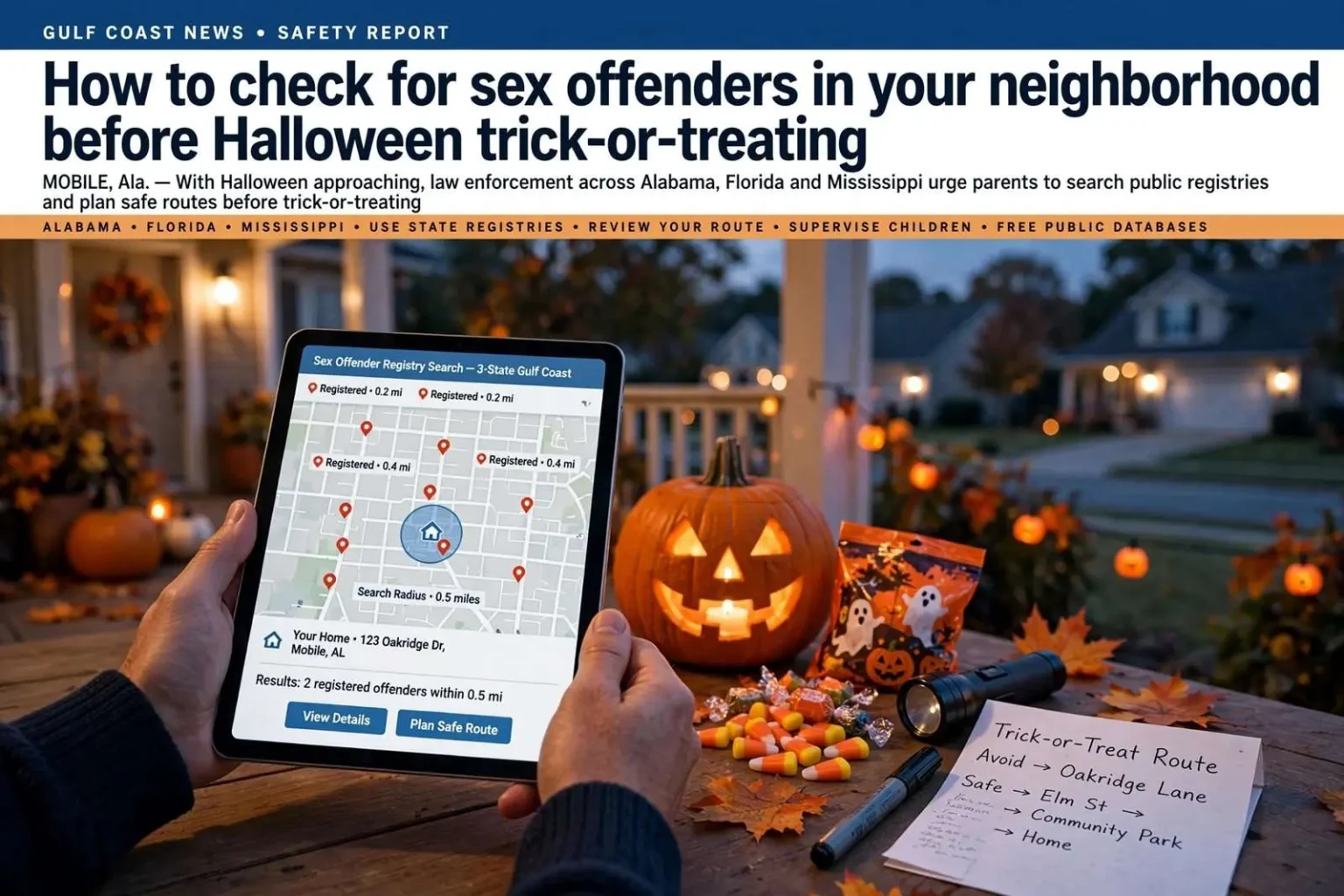
MOBILE, Ala. — With thousands of registered sex offenders living across Alabama, Florida and Mississippi, law enforcement agencies are reminding parents to take precautions as Halloween approaches. The reminder arrives every year with the holiday, and it comes with a plain message for Gulf Coast families: the single most effective step is checking your own neighborhood before the trick-or-treat routes are drawn up.
Many agencies warn — and in some cases prohibit — registered sex offenders from taking part in Halloween activities involving children. But authorities cannot station an officer outside every offender’s home, and enforcement of the holiday’s unwritten rules is uneven at best. In Alabama, it remains legal for a registered sex offender to participate in Halloween. That leaves much of the responsibility with parents.
Why the reminder comes every year
Halloween is the one night of the year when millions of children walk unfamiliar streets after dark, knock on strangers’ doors and accept candy from anyone who answers. Police departments, sheriff’s offices and state agencies along the Gulf Coast use the weeks before the holiday to remind parents of that reality and to point them toward the public tools that exist for checking on a neighborhood. The warnings are not tied to any single incident; they reflect the general logic of the holiday itself — a mass movement of children through residential areas at dusk.
The scale of the regional registry is part of the picture. A map of offenders within a 100-mile radius of Mobile shows a dense picture, spanning the Alabama cities of Mobile, Prichard, Saraland, Daphne and Fairhope, the Florida Panhandle communities of Pensacola and its suburbs, and the Mississippi Gulf Coast counties to the west. Every jurisdiction in that circle keeps its own list, but all three states make their registries searchable by the public.
What the registries let you do
State sex offender registries in Alabama, Florida and Mississippi allow residents to search by name, address or neighborhood to see whether any offenders live nearby. A parent who enters a home address can pull up the offenders registered within a chosen radius, complete with photographs, addresses, conviction information and the terms of each registration. The registries are maintained by state agencies — the Alabama Law Enforcement Agency on the Alabama side, the Florida Department of Law Enforcement in Florida, and the Mississippi Department of Public Safety in Mississippi — and each is updated as offenders register new addresses or report moves.
The registries are public record by design. They exist so that residents, especially parents, can make informed decisions about where their children go and whom they interact with. Law enforcement agencies in all three states treat the weeks before Halloween as the peak season for registry lookups, and they encourage families not to stop at a general awareness — the specific address list for your own street is what matters on trick-or-treat night.
The limits of enforcement
The reminder that authorities cannot station an officer outside every offender’s home is not an excuse; it is an honest accounting of what police can and cannot do on a holiday that sends children to every door in the city at once. Patrols are concentrated where calls are, and no department in the region has the manpower to monitor each registered offender’s doorstep for an evening. Some jurisdictions handle the gap with published ordinances or conditions that restrict offenders from Halloween activities involving children, and agencies in some places conduct compliance checks around the holiday to verify addresses. But the base rule in Alabama stands: participation in Halloween itself remains legal for a registered sex offender, and the state does not impose a blanket holiday prohibition.
That legal reality is why the annual message leans so heavily on parental planning rather than police action. The agencies issuing the reminders — municipal departments, county sheriff’s offices and state registries across the three-state region — frame the registries, route planning and supervision as the tools that actually change outcomes on the night itself.
Planning the route
Law enforcement encourages parents to review the registries, plan trick-or-treat routes in advance and accompany children throughout the evening. The advice stacks up in order: check the addresses along the neighborhood first, draw a route that avoids any home of concern, and keep children with an adult from the first door to the last. The route-planning step turns a registry lookup into an actual decision — parents who know which houses to skip can steer a group past them without drama, and older children given a boundary map are far easier to keep on track.
The standard Halloween safety advice applies alongside the registry checks: travel in groups, carry flashlights or glow sticks, stay on sidewalks and porches, inspect candy before it is eaten, and set a firm return time. Communities across the Mobile area supplement the night with organized alternatives — trunk-or-treat events at churches and schools, mall and downtown trick-or-treat hours — that give families a supervised option in a single location.
A regional habit worth keeping
The annual pre-Halloween reminder from Gulf Coast law enforcement has become as much a part of the season as the candy itself, and the tools it points to are free and take minutes to use. Whether the search turns up an offender on your street or none at all, the lookup is worth the time — it is the difference between assuming a neighborhood is safe and knowing who is registered where you plan to walk.
Families heading out this Halloween across Mobile, Baldwin County, the Florida Panhandle and the Mississippi Coast can find each state’s registry online, searchable by name, address or neighborhood. Check the route, walk with the kids and treat the registries as what they are meant to be: public information put to practical use on the one night of the year when the whole neighborhood comes to the door.
How the registries work
Each of the three states operated under the federal framework that requires convicted sex offenders to register with law enforcement and keep their addresses current, with registration terms that vary by offense and by state. The public-facing registries are the visible end of that system: a searchable database where a resident can look up a name, an address or an entire neighborhood and see who is registered within a radius. Entries typically include the offender’s photograph, physical description, home address, the offense of conviction and compliance status, though the detail available varies with state law.
The registries are updated as offenders report changes, and they carry the usual limits of any public database — addresses reflect what has been reported, and compliance varies. That is one more reason agencies pair the registry advice with the supervision advice: the registry tells parents where registered offenders are listed as living, and adult accompaniment covers the ground the database cannot.
Who issues the reminders
The annual warnings come from across the law-enforcement landscape of the Gulf Coast — municipal police departments in Mobile and the surrounding suburbs, county sheriff’s offices in Alabama, Florida and Mississippi, and the state agencies that maintain the registries themselves. The message is coordinated in spirit rather than by any single office, and it reaches parents through news releases, social media posts and the school communications that circulate in the weeks before the holiday.
The consistent core of the message is the same from every agency: Halloween puts children on the streets after dark, thousands of registered offenders live within the region’s 100-mile radius, the law in Alabama does not bar offenders from participating, and the practical protections are parental. Review the registries, plan the route in advance and accompany the children all evening.
Getting the word out
The reach of the annual reminder depends on parents seeing it, and agencies use every channel available in the weeks before the holiday. News releases go to local media, posts go up on department social media accounts, and in many communities the school systems and neighborhood associations pass the registry information along through their own networks. Community meetings and National Night Out-style events in October often fold the registry message into broader talks on child safety.
The repeated emphasis on the tools’ ease of use is deliberate. Agencies know that the families most likely to benefit from a registry check are often the ones least likely to know the databases exist, and that a lookup postponed until the night of the holiday is a lookup that never happens. The message is built to be actionable on the day a parent reads it: open the state registry, enter the home address, look at the radius, plan accordingly.
The takeaway for Mobile-area families
None of the advice requires anything unusual — just ten minutes with the state registry and a conversation with the kids before the costumes go on. Parents who make the registry check an annual habit, the way checking the weather forecast is, approach trick-or-treat night with actual knowledge of their own streets rather than assumptions about them.
The registries for Alabama, Florida and Mississippi are maintained by each state’s law-enforcement agency and are searchable by name, address or neighborhood at any time of year. As Halloween approaches, law enforcement across the Mobile area encourages every household with trick-or-treaters to use them — and to remember that the officers issuing the reminders will spend the night patrolling, while the most important supervision happens one porch at a time, with a parent standing beside the candy bag.