How to Watch a Mobile Mardi Gras Parade Like a Local
As Mobile's Mardi Gras parade season kicks off, longtime parade-goers share where to park, where to stand and how to time your night for the best experience on the parade route.
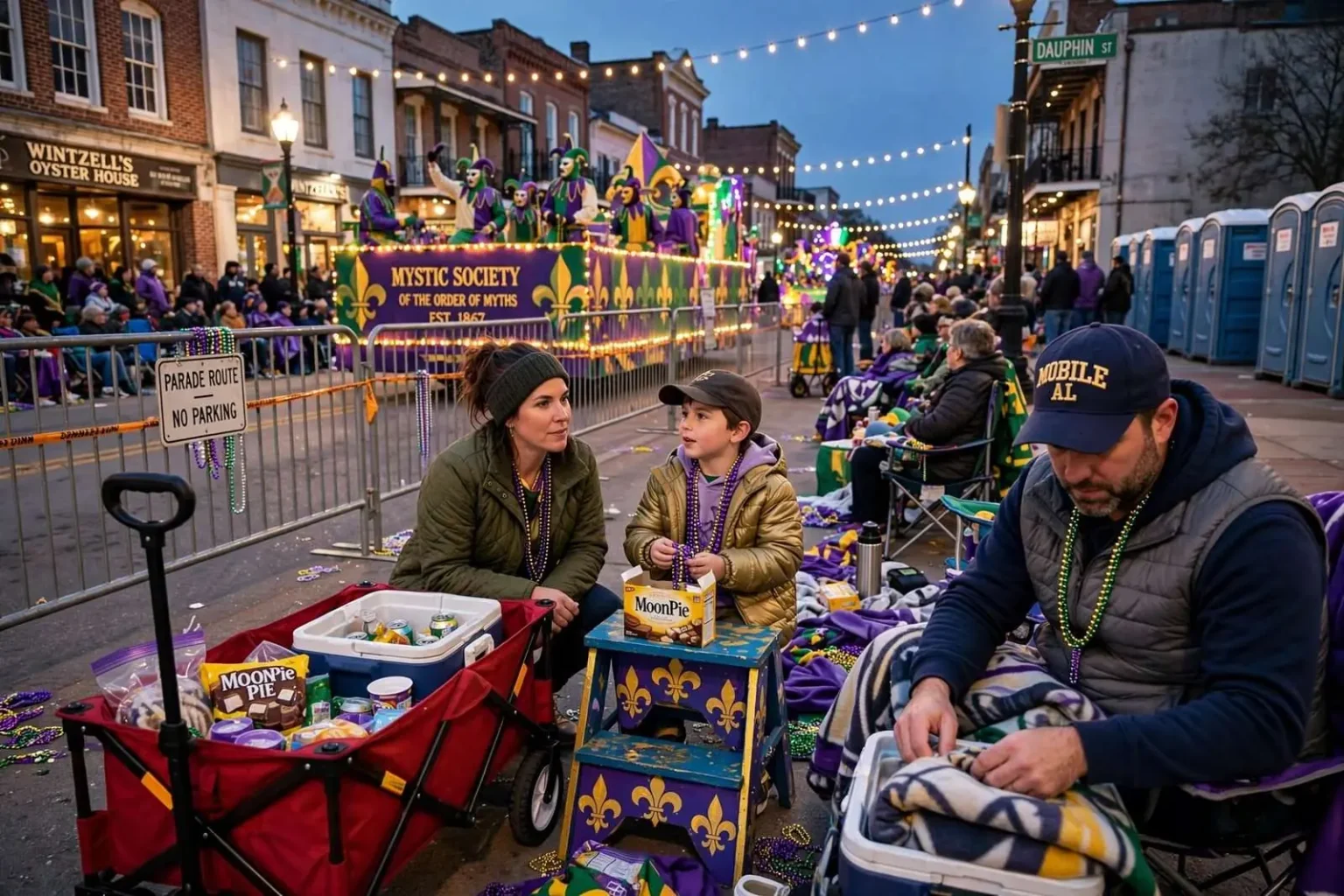
Mobile’s Mardi Gras season is back, and with it comes the yearly ritual of picking a parade route, finding a parking spot and figuring out exactly where along the barricades to plant a lawn chair for the night. For newcomers and out-of-towners, the run-up to a parade can look like organized chaos: streets close to traffic, sidewalks fill with coolers and wagons, and marching bands and masked riders known as maskers begin working their way through downtown as the sun goes down. Veterans treat that choreography as a solved problem — and knowing how they solve it is the difference between a memorable night and a miserable one.
Mobile has held Mardi Gras celebrations since the 1700s and is widely credited as the birthplace of Carnival celebrations in the United States, predating the more widely known festivities in New Orleans. The city’s first organized Carnival observance dates to the earliest years of the French colonial settlement, and the tradition has rolled continuously — through wars, depressions and hurricanes — ever since. New Orleans’ festivities took root generations later, and Mobile’s claim to priority is a matter of documented civic pride here, argued with dates that predate its neighbor across the state line.
Each winter, dozens of local mystic societies, many of which have paraded for generations, roll floats through downtown and the surrounding neighborhoods, throwing beads, MoonPies, doubloons and other trinkets to crowds lining the route. The societies are the institutional backbone of the season — private organizations, some tracing lineages back more than a century and a half, that design themes, build floats, stage balls and maintain the parade calendar from late winter through Fat Tuesday. The MoonPie, the marshmallow-and-chocolate snack invented in Chattanooga but adopted as Mobile’s signature throw, has become so identified with the city’s celebration that the region hosts an annual festival in its honor.
The season’s scale surprises first-time visitors. This is not a single-parade event but a months-long calendar: parades roll on weeknights and weekends across downtown, the streets around it and the neighboring communities, building toward the final crescendo of Fat Tuesday. Locals speak of the season as a second social calendar, complete with its own etiquette, its own equipment — ladders, wagons, coolers — and its own geography of good spots and bad ones.
The Three P’s
Veteran parade-goers say the most important decision of the night has nothing to do with costumes or throws: it is choosing where to stand. Long-time Mobilians describe it as balancing three essential needs, sometimes called the three P’s: parking, pottying and partaking — meaning a plan for where to leave the car, where to find a restroom or portable toilet, and where to grab a drink or snack before and after the floats roll by.
The formulation sounds lighthearted, but it encodes hard-learned logistics. Parade closures turn downtown’s street grid into a maze after the first float rolls, so a car parked outside the cordons can become an hours-long hike away once the route seals. Restrooms follow the same logic: portable toilets along the route can draw long lines once a parade is underway, and the wait compounds as the crowds thicken. Food and drink close the loop, because the hours around a parade — the tailgating that precedes it and the decompression that follows — are as much a part of the night as the floats themselves.
Families with young children often look for stretches of the route with fewer crowds and easier sightlines, while groups looking for a livelier atmosphere tend to cluster around the bars and restaurants near the center of downtown. Either way, planning ahead for restrooms is critical, since portable toilets along the route can draw long lines once a parade is underway. Experienced families stake out the same blocks year after year, arriving hours early to claim sidewalk frontage near facilities and exits, and treating the parade less as a spectacle to watch than as an evening to manage.
Equipment is part of the local craft. Standard issue includes folding chairs or blankets, a cooler packed with food and drinks, wagons or rolling coolers to haul it all, and — for the youngest celebrants — the step ladders with built-in seats that Mobile families famously build and decorate for each season, giving small children a safe perch above the crowd line. None of it is improvised; it is stored between seasons and rolled out again each February, a household infrastructure as predictable as holiday decorations.
Parking Like a Local
One popular strategy is to park in the Oakleigh Garden District, a historic neighborhood just south of downtown that typically offers more available street parking than the blocks directly on the parade route. From there, spectators can walk to the intersections along the route’s southern end — arriving with the perspective of a short, predictable walk rather than a desperate circling of downtown blocks in the final minutes before streets close.
The Oakleigh approach illustrates the broader parking calculus. Downtown’s garages and surface lots fill early on parade nights, and street parking inside the cordons disappears by late afternoon; the neighborhoods ringing the route — Oakleigh, De Tonti Square, Church Street East — offer the pragmatic alternative of residential street parking and a ten-minute walk. Locals caution visitors about one detail: residential permit rules and private driveways are enforced, so the strategy works best when visitors respect the neighborhood norms that make residents willing to host parade traffic every year.
Timing matters as much as location. Parade-night veterans arrive in midafternoon, well before the first barricade goes up, to establish their spot and set out their furniture; arriving at dusk means choosing from what remains, which is usually the worst sightlines behind the tallest crowds. The rhythm is the inverse of most event-going: the early arrivals are not chasing proximity to a stage but real estate along a curb, and the best frontage is claimed the way picnic tables are — with physical occupation, hours ahead.
Reading the Route
Choosing among the route’s segments means understanding how each behaves. The central downtown blocks — around the Dauphin Street corridor and the densest bar-and-restaurant strip — draw the biggest, rowdiest crowds, where the throws fly thickest and the partying runs latest. The blocks nearer the route’s edges and its passes through adjacent neighborhoods draw families, sitting groups with room to spread blankets and let children range to catch falling beads. Maskers themselves tend to throw more generously to the children in the crowd — riders work the family stretches with extra care, aiming MoonPies and plush throws at small hands on ladder seats.
Veterans also read the route against the season’s calendar. Weeknight parades draw lighter crowds than the weekend showcases, making them the family-favored nights; the final weekend and Fat Tuesday itself draw the region’s full surge, when every strategy above — early arrival, neighborhood parking, restroom planning — shifts from optional to essential. The societies’ parade order, published each season, lets regulars plan which nights they will commit to and which they will skip, a scheduling discipline that newcomers rarely appreciate until they find themselves downtown on the wrong night without a plan.
Weather is the wild card the Gulf Coast adds to every calculation. February in Mobile can deliver either spring-like evenings or cold, driving rain, and a season’s worth of planning rides on the forecast for any given night. Locals build their kit for both — tarps and ponchos alongside the lawn chairs — and the societies roll regardless unless conditions turn dangerous, which makes the prepared spectator’s advantage clear in any given downpour.
Etiquette of the Barricades
Mardi Gras crowds develop their own norms, and visitors who learn them fit in quickly. Territory along the curb is respected once established — a blanket or chair line is honored, and jumping someone’s claimed frontage invites the kind of neighborhood friction that persists across seasons. Throws are caught, not fought over; local children learn early to position under the flying beads and let the adults stand back. Riders on the floats — the maskers — are addressed politely and thanked, because the societies’ members are neighbors: the woman throwing beads from the float is as likely to be your child’s teacher as a stranger.
Cleanup completes the local rhythm. Parade nights end with streets littered in beads, cups and MoonPie wrappers, and the city’s crews sweep through before morning; celebrants who bag their own trash before leaving are the ones welcomed back to the same spots the following season. The unwritten compact between spectators and neighborhoods — take the fun, leave the curb clean — is what keeps the annual migration sustainable in the residential blocks around downtown.
Safety follows from the same habits. Children on ladders are watched by design, with an adult stationed behind every perch; coolers are kept clear of the barricade line; and the crowd’s dense center is treated as adult territory while families hold the edges. Mobile’s parade tradition has run for generations on exactly this self-managed order, and police presence supplements rather than substitutes for it.
Why It Matters How You Watch
The practical craft of parade-watching is also how the tradition transmits itself. Mobile’s Mardi Gras survives not merely because mystic societies build floats, but because each generation of families passes down the knowledge of where to park, where to stand and how to spend the night — knowledge that turns a cold evening on a crowded street into the event children remember for a lifetime. Visitors who absorb the three P’s and the Oakleigh parking strategy are, in effect, being initiated into that chain.
For the city, the season is an economic engine as much as a cultural one: restaurants, hotels, costume shops and float builders all ride the calendar’s surge, and the visitors who come for a parade night frequently return for the season. The locals’ strategies — spread across neighborhoods rather than concentrated downtown — spread that benefit into the districts around the route as well, from the Oakleigh area’s porches to the businesses along the approaches.
The parades roll for weeks before the season’s climax, and every night offers the same fundamental choice the veterans describe: arrive late and improvise, or plan the three P’s and own your evening. Mobile’s celebration has survived three centuries on the strength of families who chose the second option, season after season, and taught the next crowd how to do the same.