Hurricane Sally leaves dozens displaced at Forest Creek Apartments
Dozens of families were forced from Forest Creek Apartments in Warrington after Hurricane Sally, with many given only days to leave.
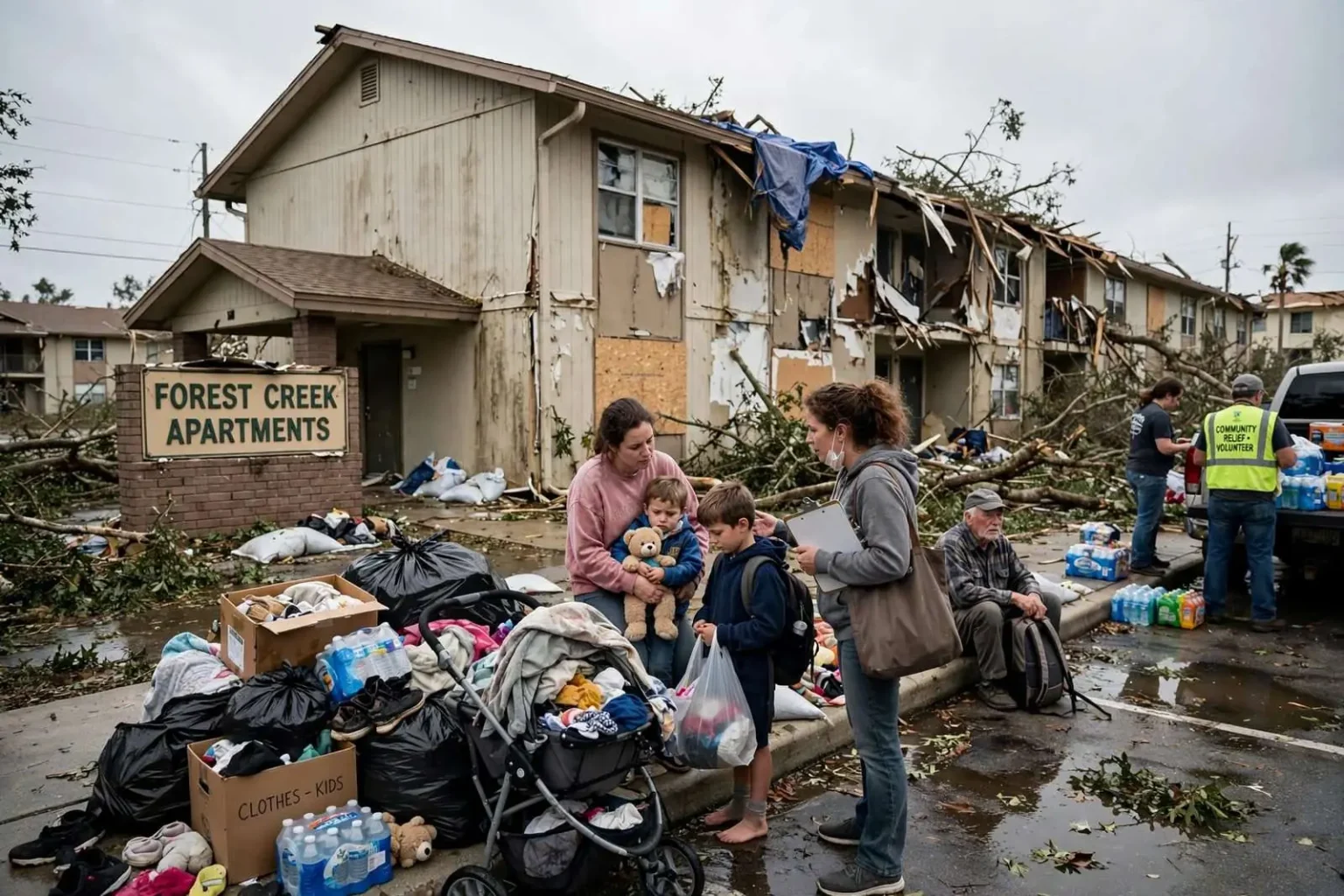
Nearly two weeks after Hurricane Sally, dozens of families have been forced from their homes at Forest Creek Apartments in Warrington, Florida — a displacement crisis unfolding inside the Pensacola-area community as the storm’s damage collided with what tenants describe as a hasty push out of the storm-damaged complex.
Community advocate Laura Merritt, whose daughter and grandchildren live at the complex, said tenants were given just two to three days to leave and feared retaliation from the property owner if they spoke out. The warning window left families with the job of finding new housing, salvaging belongings and arranging school and work routines in a region still reeling from the hurricane itself.
“This just breaks my heart to listen to the kids cry, for tenants to come to me and tell me they’re hungry,” Merritt said. “They don’t have any shoes. They don’t have anywhere to go. They lost everything.”
Merritt has worked with community organizations to help more than 100 people from the complex, many of whom are now in hotels or staying elsewhere — a rescue operation run out of volunteer networks while the residents themselves navigated an uncertain path between a damaged apartment complex and wherever they could land next.
Warrington and the storm that hit it
Hurricane Sally made landfall in September 2020 as a slow-moving Category 2 storm near the Alabama-Florida line, and its pace — rather than its peak wind — did much of the damage. Crawling across the coast, Sally dropped extraordinary rainfall on the Pensacola metropolitan area, flooding neighborhoods, washing out roads and leaving thousands of homes and apartments damaged across Escambia County.
Warrington, the community just west of Pensacola near Naval Air Station Pensacola, took its share. The neighborhood’s housing stock includes a large share of older rental properties, home to working families, military-connected households and retirees — populations with the least financial cushion for a disaster and the fewest options when a landlord decides a building is no longer habitable.
That is the position Forest Creek residents found themselves in nearly two weeks after landfall: apartments damaged by the storm, a landlord setting a departure timeline measured in days, and a rental market suddenly compressed by a hurricane that had damaged housing across the entire county at once. Every displaced family in the region was searching for the same scarce resource — a place to live.
The advocate at the center
Merritt’s connection to Forest Creek was personal — her daughter and grandchildren lived there — and her account of the displacement carried the detail that secondhand reports miss. Tenants facing two to three days to vacate a storm-damaged home are not making a planned move; they are deciding, in a window too short for anything deliberate, what to save and where to go.
Her description of what she encountered — children crying, tenants telling her they were hungry, families without shoes and without anywhere to go — described a community losing everything at the exact moment the broader region was least able to absorb it. The hurricane had strained every shelter, hotel and charitable resource in the county; residents pushed out of Forest Creek entered that strained system at the bottom of the queue.
Working with community organizations, Merritt helped more than 100 people from the complex, many now in hotels or staying with others. The number describes the scale of the displacement and the response both: what property records would count as dozens of households was, in human terms, more than 100 people — children, parents, grandparents — whose housing security ended not with the storm but with the days that followed it.
The commissioner’s rebuke
District 2 Escambia County Commissioner Doug Underhill said the residents deserve better. “Those citizens have rights and none of that should be happening,” Underhill said, adding that the property had a history of problems and that the county had even tried to buy it.
The commissioner’s account reframed Forest Creek from a storm casualty into a longstanding problem that the hurricane had pushed past its breaking point. A property with a documented history of issues — one the county had considered purchasing outright — was now displacing dozens of families two weeks after the storm, and the county’s own past effort to intervene gave Underhill’s criticism the weight of direct involvement rather than distant commentary.
Underhill called Forest Creek “a continual embarrassment” and urged the owner to address conditions as displaced families searched for stable housing. The phrase put the county government on record about the property, and the urging carried the implicit threat that follows such statements: a complex already under scrutiny now stood at the center of a displacement crisis with dozens of witnesses.
His reference to residents’ rights pointed at the legal protections that exist precisely for this situation — tenants displaced from damaged housing are not supposed to be left to fend for themselves on a landlord’s timetable, whatever the storm’s damage. How those rights were being honored at Forest Creek, two weeks after Sally, was the question the commissioner’s comments put in front of the county.
Disaster displacement and the housing squeeze
The Forest Creek situation illustrated a pattern that repeats after every major Gulf Coast hurricane: the storm damages housing, and the displacement that follows is driven as much by property decisions as by wind and water. A damaged apartment complex presents its owner with a choice — repair and retain tenants, or clear the property — and the tenants’ futures hang on that decision, made without their voice.
The math after Sally made the choice harsher. Escambia County’s rental market could not absorb a sudden influx of displaced families; hotels were filled with storm victims and insurance adjusters; and families with limited means had few places to turn. Tenants given two to three days to leave entered a market with no slack in it, which is how more than 100 people from a single complex ended up dependent on advocates and community organizations to find them hotel rooms and temporary shelter.
The fear of retaliation Merritt described added a final layer. Tenants who depend on a landlord for housing — and who may be owed deposits or relief under lease and disaster law — are often the least able to speak publicly about their treatment, and the advocate’s account suggested that Forest Creek families understood exactly what speaking out might cost them.
What comes next for the families
Two weeks after the storm, the situation at Forest Creek remained unresolved: dozens of families out of their homes, more than 100 people placed in hotels or with relatives through volunteer efforts, a commissioner publicly demanding the owner address conditions, and no announced plan for what would happen to the complex or the tenants it had housed.
The longer-term question — whether Forest Creek would be repaired, sold or emptied for redevelopment — would determine whether any of the displaced families ever returned. For the moment, the immediate work belonged to people like Merritt and the community organizations backing her: keeping more than 100 newly homeless neighbors fed, clothed and sheltered in a county still digging out from the same hurricane that had upended their lives.
The episode at Warrington’s Forest Creek Apartments became, in the weeks after Sally, a test case of what disaster recovery looks like for renters — the Gulf Coast’s most vulnerable residents, whose homes can vanish in a landlord’s two-day notice and whose recovery depends on whatever the community’s advocates can organize before the region’s attention moves on.
Sally’s slow-motion damage across the coast
Understanding the Forest Creek crisis requires understanding what kind of storm Sally was. Forecasters had watched the system wobble through the Gulf for days before it came ashore, and its slow forward speed turned a Category 2 hurricane into a flooding catastrophe. Rainfall totals across the Pensacola area reached extraordinary levels, dropping on neighborhoods for the better part of two days, while the storm’s prolonged winds drove water into structures and toppled trees across thousands of properties.
Escambia County’s damage assessment ran to billions of dollars, and the housing stock absorbed a disproportionate share: apartments and older homes flooded by rainfall, roofs torn away by wind, and entire complexes left uninhabitable while their residents waited to learn their fate. Two weeks after landfall — the point at which the Forest Creek story broke — the county was still in its emergency phase, with power restored unevenly and debris removal barely underway.
Into that strained landscape came the situation at Forest Creek: dozens of families displaced not directly by the storm’s first hours, but by the decisions made afterward about whether they could stay. The distinction matters for how the community understood the episode — Sally damaged the apartments, but the two-to-three-day departure notice was a human choice made in the storm’s aftermath.
The county’s history with the property
Underhill’s disclosure that the county had even tried to buy Forest Creek revealed how long the property had been on the government’s radar. A county that attempts to purchase an apartment complex is a county that has concluded, through repeated code enforcement, complaints or inspections, that the property’s problems run deeper than ordinary management lapses.
That history gave the post-Sally displacement a bitter context. The residents now scrambling for housing were living in a complex the county itself had flagged as troubled — “a continual embarrassment,” in the commissioner’s words — meaning the disaster did not create the conditions at Forest Creek so much as expose them. A building with a history of problems was also a building least prepared to shelter its residents through a hurricane’s aftermath.
The commissioner’s demand that the owner address conditions carried that history into the present. With families displaced, advocates organized, and the county’s own record of engagement with the property on the record, Forest Creek had become a public test of whether a problematic complex would be held to account when its residents needed it most.
Volunteers filling the gap
The response that kept more than 100 displaced Forest Creek residents housed in the storm’s aftermath came from the same network of community organizations that mobilizes after every Gulf Coast disaster — churches, nonprofits and volunteer advocates who find hotel rooms, collect clothing and make sure children eat while the formal recovery machinery grinds through its assessments.
Merritt’s work illustrated both the strength and the fragility of that safety net. Its strength is speed and trust: a local advocate with family ties to the complex could reach tenants that institutions never hear from, especially tenants afraid of retaliation for drawing attention to their situation. Its fragility is endurance: hotels are a temporary answer, volunteer networks are not funded indefinitely, and the families displaced from Forest Creek needed permanent housing in a market the hurricane had thrown into chaos.
Nearly two weeks after Sally made landfall, that was the state of the crisis at Warrington’s Forest Creek Apartments — dozens of families out, more than 100 people sheltered through volunteer effort, a county commissioner publicly demanding accountability from the owner, and the community’s most vulnerable residents waiting to learn whether the phrase “temporary” would turn out to mean days, months or never going home at all.