I-10 Mobile River Bridge Project Shows Visible Signs of Progress as Financing Nears Finish Line
Construction staging has begun on the $3.2 billion I-10 Mobile River Bridge project, with ALDOT officials saying financing details and a construction start could come this fall.
At $3.2 billion, the Interstate 10 Mobile River Bridge and Bayway project ranks among the largest infrastructure undertakings in Alabama history. For nearly three decades, it existed mostly behind the scenes — in studies, meetings, press releases and negotiations in Montgomery and Washington, D.C. — with little visible sign that construction was actually near.
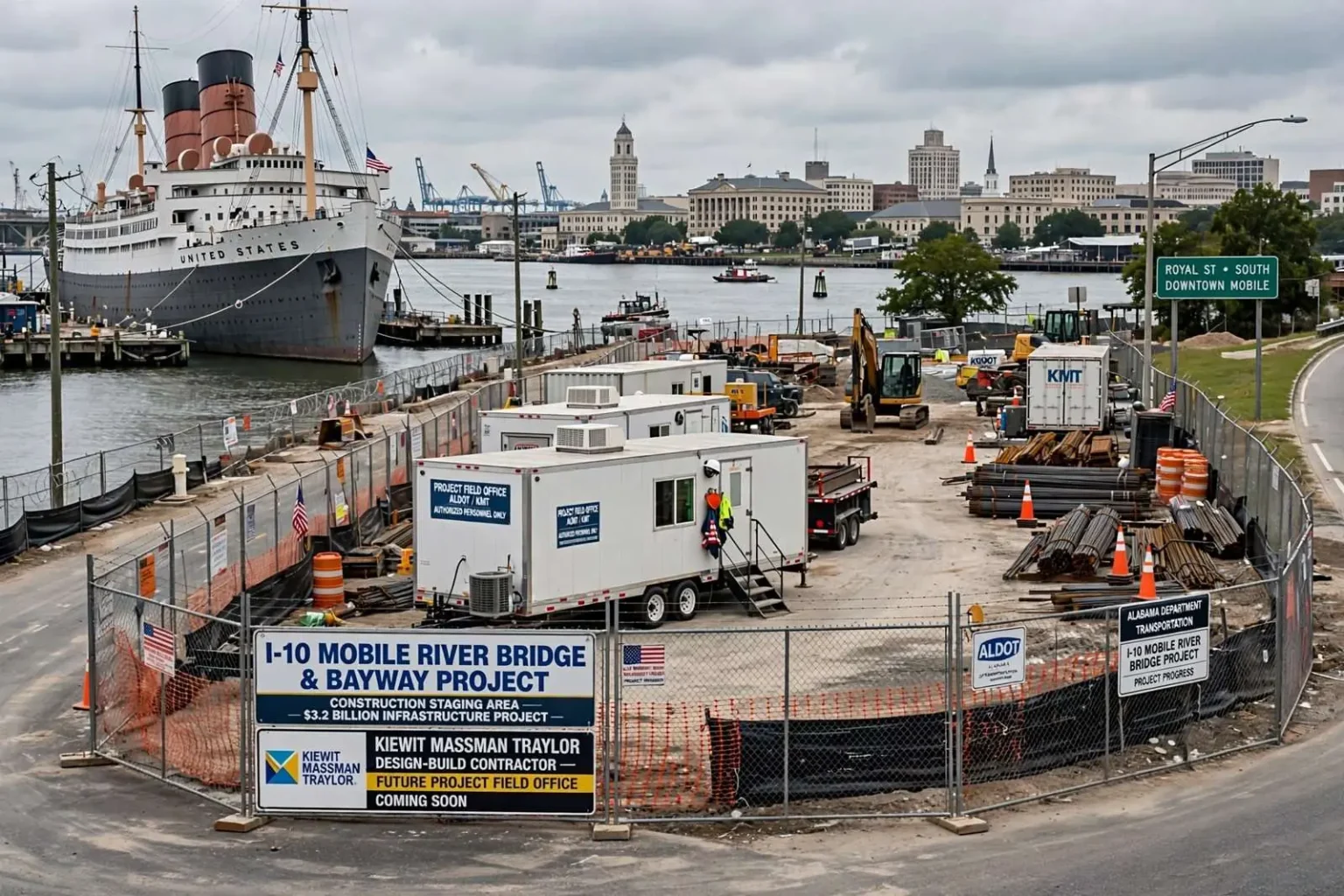
That is beginning to change. The project’s design-build team and lead contractor, Kiewit Massman Traylor, has established a construction staging area along Royal Street south of downtown Mobile, near where the historic ocean liner SS United States is currently berthed. A large fenced-in site and trailer are already visible, along with signage identifying the property’s future use by the contractor. While the site remains quiet for now, it could soon become an active staging ground for a project that may officially enter construction by October.
Edwin Perry, project manager for the Alabama Department of Transportation, told members of the Mobile Area Metropolitan Planning Organization’s policy committee Wednesday that one of the most noticeable changes in the coming weeks will be the addition of a field office within the project area.
“We’re looking to move forward with the project,” Perry said moments after the Mobile MPO approved a resolution adding the project — now divided into two phases — to its short-term Transportation Improvement Program. The Eastern Shore MPO in Baldwin County approved a similar measure at its meeting last month.
“Being able to have that field office ready just allows for the contractor to have his personnel ready to go and for our personnel to be ready to go,” Perry said. “Without having that already set up, you just have to wait.”
Financing Details Expected by Mid-September
The project has long been defined by delays, but Perry said major developments in finalizing its financing are expected by mid-September. A Transportation Infrastructure Finance and Innovation Act, or TIFIA, loan that will cover up to 49% of the project’s cost is expected to be finalized in the coming weeks.
The final toll plan, which will generate revenue to repay the loan debt, is also expected to receive approval from the U.S. Department of Transportation around the same time. Under the plan unveiled last month, motorists with an ALGO Pass will pay $3 each way to use the new bridge and the restriped Bayway. Those without a pass will pay $7.70 each way. A federal pilot program called the Interstate System Reconstruction and Rehabilitation Pilot Program allows the tolling plan to move forward, with toll revenue going directly toward repaying loans associated with the project’s first phase.
What the Project Includes
The current version of the project has drawn strong support from local and state leaders in Mobile and Baldwin counties since it was unveiled. The first phase, included in the overall $3.2 billion cost, calls for construction of a 215-foot-tall cable-stayed bridge over the Mobile River beginning near I-10 and Virginia Street in Mobile. The bridge would reconnect with the existing Bayway near the Tensaw River interchange, which would then be restriped from two lanes to three lanes in each direction, extending east to the U.S. 98 exit in Daphne. Baldwin County officials are also working with ALDOT to extend the additional lane farther east toward the Alabama State Route 181 interchange and eventually toward the Baldwin Beach Express exit near Buc-ee’s.
Unlike an earlier proposal that was scrapped in 2019 after an anti-toll movement pushed back against a public-private financing arrangement that included a controversial $6 one-way toll and would have imposed tolls on existing infrastructure, including the Wallace Tunnel, the current project has faced relatively little public opposition. “It’s drastically different,” Perry said. “We are excited to be here and to be able to work with the MPO to get to this point.”
Construction on the bridge and restriping of the Bayway are expected to take about five years. Afterward, ALDOT plans to pursue a second phase that would demolish the existing Bayway and replace it with a new structure connected to the new bridge. No cost estimate has been released for that phase, but ALDOT has said the complete project would have exceeded $5 billion if built all at once — a price that officials say would have made the project far more difficult to finance and advance.
What a TIFIA Loan Is
The Transportation Infrastructure Finance and Innovation Act program, administered by the U.S. Department of Transportation’s Build America Bureau, provides federal loans and other credit assistance for large surface transportation projects. The loans are repaid from a dedicated revenue source, which in this case is the toll revenue from the new bridge and the Bayway.