I-10 Widening Project in Mobile County Adds Third Lane in Each Direction
ALDOT has completed a $24.8 million widening of I-10 in Mobile County, adding a third travel lane in each direction along a five-mile stretch that carries about 65,000 vehicles a day.
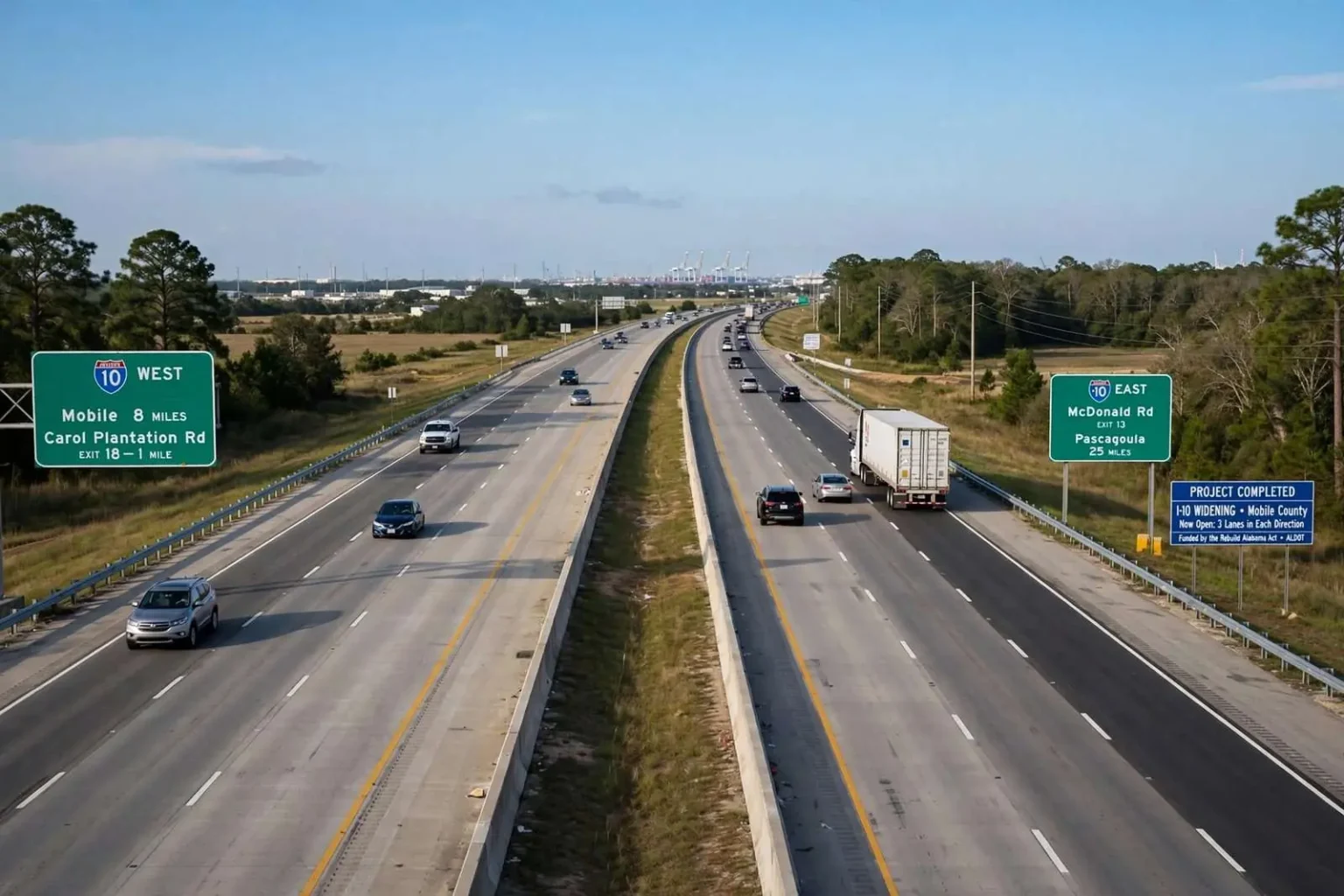
A major widening project on Interstate 10 in Mobile County has wrapped up, giving drivers a third travel lane in each direction along one of the region’s busiest stretches of interstate. The Alabama Department of Transportation (ALDOT) says the newly completed work is already easing congestion for the tens of thousands of vehicles that travel the corridor every day. The completion turns one of the county’s most persistent commute bottlenecks into a six-lane stretch of highway, a change drivers will notice the first time they pass through it in rush-hour traffic.
The project added a third lane to roughly five miles of I-10 in both the eastbound and westbound directions, between Carol Plantation Road and McDonald Road. With the new lanes in place, that section of interstate now carries six total lanes of traffic, up from four. The corridor sits in the rapidly growing western part of Mobile County, where residential development along the interstate has pushed commuter volumes upward year after year, and where a four-lane cross-section had become an aging mismatch for the traffic it was asked to carry.
A Response to Heavy Daily Traffic
The stretch of I-10 between Carol Plantation Road and McDonald Road is one of the more heavily traveled sections of interstate in Mobile County, seeing an estimated 65,000 vehicles a day. That volume of traffic, moving through what had been a four-lane bottleneck, made the corridor a natural target for expansion as ALDOT works to keep pace with growth across the region. When two lanes in each direction must absorb 65,000 vehicles, a single stalled car or fender-bender turns the interstate into a parking lot, and the daily rhythm of merges and lane changes resets the whole flow.
By adding a third lane in each direction, the project is designed to give drivers more room to merge, pass slower-moving vehicles and maintain a steadier flow of traffic, particularly during the morning and afternoon commute. The third lane also creates the buffer that lets entering traffic from on-ramps blend into the stream without forcing through-travelers to brake. ALDOT officials say the extra capacity should translate into shorter, more predictable travel times for the commuters, commercial trucks and visitors who rely on the interstate to move through Mobile County.
Commercial traffic has a particular stake in the improvement. The corridor carries freight trucks serving the Port of Mobile, the industrial plants along the river and the distribution centers scattered across west Mobile County, and trucks accelerate and change lanes more slowly than cars. Additional through-lanes separate some of that traffic from the passenger-car stream, reducing the friction that made the old four-lane section so punishing at peak hours.
Funded Through the Rebuild Alabama Act
The $24.8 million project was funded through the Rebuild Alabama Act, the state’s program dedicated to repairing and modernizing Alabama’s roads and bridges. Since it was signed into law, the act has directed funding toward a range of infrastructure upgrades across the state, and the I-10 widening in Mobile County represents one of the more significant investments to reach the region under the program. The law tied new revenue to transportation work of exactly this kind — capacity and preservation projects that had spent years waiting in line behind the state’s shrinking construction budget.
“This project represents a critical investment in our transportation infrastructure,” said James Gordon, an ALDOT Southwest Region spokesperson. “The widened I-10 will enhance connectivity, promote economic growth, and improve quality of life.” The statement captures the three arguments ALDOT has made for projects like this one across the region: a smoother-moving interstate links communities and job centers, supports the commercial activity that depends on predictable freight movement, and gives residents back time they used to lose sitting in traffic.
For the neighborhoods between Carol Plantation Road and McDonald Road, the completion is visible in more than the pavement. Widening projects of this kind involve rebuilding shoulders, drainage and bridge structures along the corridor, and the finished product includes the modernized cross-section — wider lanes, improved merge geometry and updated markings — that comes with contemporary interstate construction. The new lanes opened to traffic as soon as the project wrapped, with no additional phases left to complete on this section.
What It Means for Mobile County
Interstate 10 is the primary east-west corridor connecting Mobile County to the rest of the Gulf Coast, carrying everything from daily commuter traffic to freight moving between Louisiana, Mississippi, Alabama and Florida. Delays or bottlenecks along the route can ripple outward, affecting commercial trucking schedules as well as everyday commutes for residents who live and work on opposite ends of the county. A driver stuck between Carol Plantation Road and McDonald Road might be commuting from Pascagoula to a Mobile hospital, hauling a load from the port toward Florida, or simply crossing town — the corridor does not distinguish.
ALDOT has framed the completed widening as part of a broader commitment to safer, more efficient travel for Alabama residents, visitors and the businesses and industries that depend on the state’s highway network. Congestion is a safety problem as well as a convenience problem: dense, stop-and-start traffic produces rear-end collisions and merge accidents at rates that thinner flows do not. Adding capacity on a corridor carrying 65,000 vehicles a day is expected to reduce both the number of conflict points and the severity of the crashes that do occur.
Wider interstates with additional through-lanes generally also give emergency responders and maintenance crews more room to operate without fully blocking traffic, an added safety benefit for a corridor that sees such consistently high volume. A lane can be closed to an incident response while the remaining lanes carry the through-traffic, which is not possible on a four-lane section where every closure eliminates half the roadway’s capacity. That operational flexibility compounds the capacity gains every day the interstate runs.
With the new lanes now open to traffic, ALDOT says the completed project reflects its ongoing effort to modernize key stretches of Alabama’s interstate system to match current and future demand. Traffic volumes that overwhelmed the corridor’s old design were not a surprise — they followed decades of residential growth in west Mobile County and steady expansion of port-related freight — and the widening brings the highway’s capacity up to the level the corridor has in practice already been asked to carry. Future demand projections informed the design the same way.
Drivers along the Carol Plantation Road to McDonald Road stretch of I-10 should now find three lanes available in each direction for the first time. The change rewrites the daily experience of one of the county’s most-traveled commutes: the merge points that once compressed four lanes of traffic into a crawl now have an additional lane to absorb them, and the peak-hour queue that defined the corridor should shrink as the new capacity distributes the load.
The completed section also fits into the larger picture of I-10’s role in the Gulf Coast economy. The interstate threads through Mobile County carrying tourists, commuters and some of the heaviest freight volumes in the Southeast, and every improved segment strengthens the connections among the port, the county’s industrial employers and the growing residential areas west of the city. Investments of the scale of this $24.8 million project — and the Rebuild Alabama Act funding that made it possible — will continue to shape how well the corridor handles the growth still ahead for the region.
For now, the work is done and the benefits are immediate. ALDOT officials point to the finished five-mile widening as evidence of what dedicated transportation funding can deliver in a county that has long pressed for relief on its busiest roads. Drivers passing between Carol Plantation Road and McDonald Road this week will find the third lane open in both directions — the most visible sign of a project meant to keep one of the Gulf Coast’s key corridors moving for years to come.
The funding mechanism behind the project deserves attention from drivers who will use the new lanes. The Rebuild Alabama Act dedicates revenue specifically to road and bridge work through a transparent process that lets local governments and ALDOT districts compete for dollars based on need. In Mobile County, that has meant a steady drumbeat of projects — resurfacing, intersection rebuilds and capacity work like this five-mile widening — moving from the state’s waiting list into construction. The act’s role in the I-10 project is why state officials have described it as one of the more significant regional investments delivered under the program.
Construction on a corridor carrying 65,000 vehicles a day also had to be staged around the traffic it was widening, with lane shifts and nighttime work phasing the buildout while keeping both directions of I-10 open. Completing that work without extended closure of the interstate was itself part of the project’s engineering challenge, and the wrap-up means drivers will no longer encounter the construction zones that shaped their commutes while the lanes were being added.
The project’s completion also hands the corridor’s neighboring communities a predictable baseline for their own planning. Developers along the Carol Plantation Road and McDonald Road interchanges, school systems routing buses across the interstate and emergency planners modeling evacuation routes all factor highway capacity into their decisions. A six-lane section where four lanes stood for decades changes those calculations in concrete ways, from the size of retail sites that pencil out near the interchanges to the time it takes to move residents out of the path of a Gulf storm.