Improved Delta Port Boat Launch in Coden Set to Reopen Friday
The Delta Port boat launch in southern Mobile County reopens Friday after upgrades funded by fishing license revenue and federal Sport Fish Restoration Program dollars.
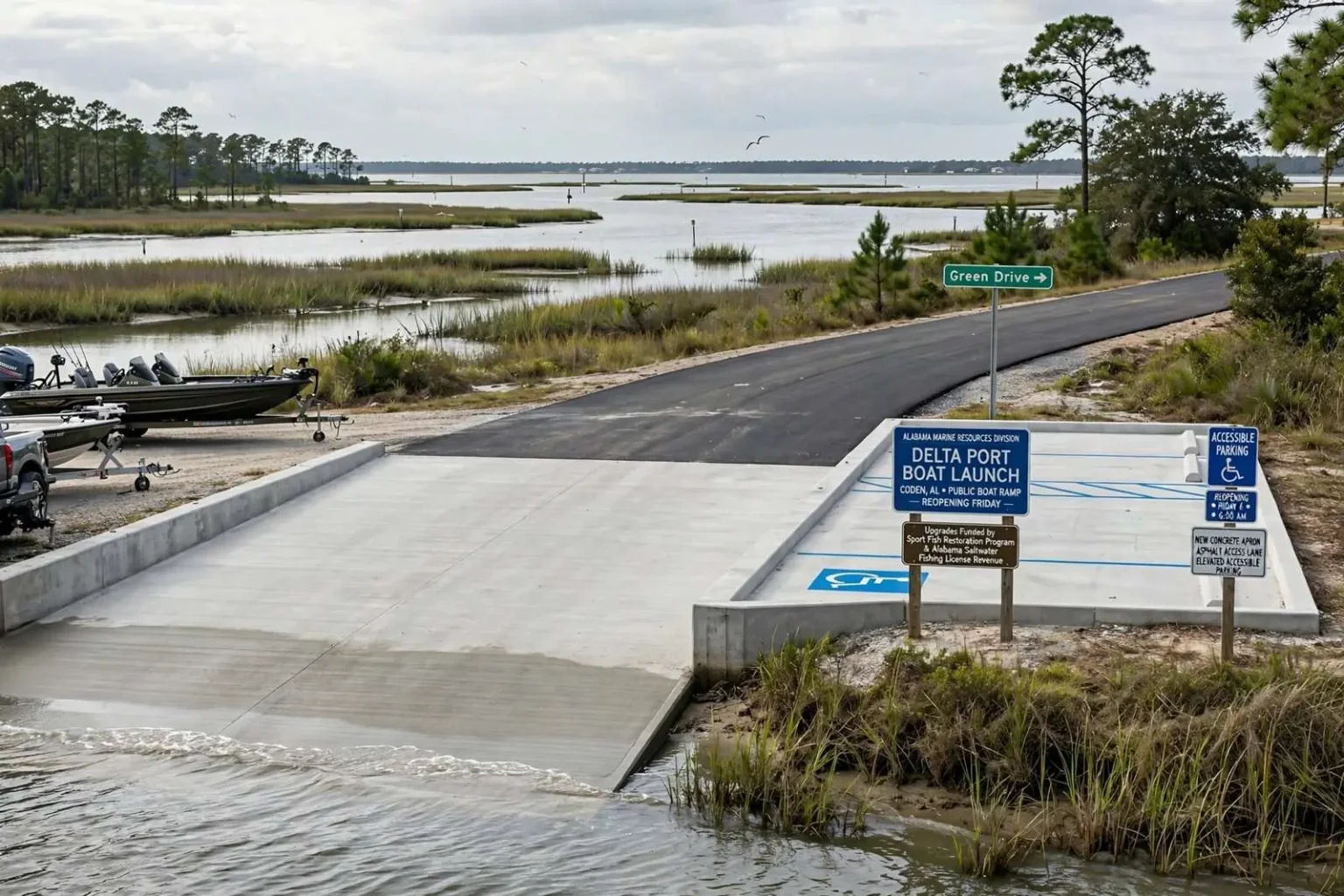
CODEN, Ala. — Boaters in southern Mobile County will soon have access to an upgraded launch site, as the Delta Port boat launch is scheduled to reopen Friday following a round of infrastructure improvements, according to officials with the Alabama Marine Resources Division. The reopening returns one of the area’s most heavily used public ramps to service just as boaters continue to work the waterways that make the southern end of the county a destination for anglers across the Gulf Coast region.
The project focused on making the popular access point more durable and easier to use. Crews extended the concrete apron in front of the boat ramp, built a new asphalt lane connecting the expanded concrete area to Green Drive, and raised the elevation of the site’s handicap-accessible parking space. Each of the three improvements addresses a specific complaint familiar to regular users of coastal ramps: the apron that takes the daily abuse of trailers and tides, the connector lane that channels traffic on and off the site, and the parking space that lets anglers with disabilities reach the water.
Marine Resources officials said the upgrades were designed with long-term maintenance in mind. By reinforcing the ramp area and improving how water drains from the property, the changes are expected to reduce pothole formation that has plagued similar coastal access points after years of heavy use and tidal exposure. Water is the enemy of a coastal ramp — standing water undermines the base material beneath the pavement, tide cycles work the edges of the concrete, and the combined traffic of trailers and weather opens cracks that become potholes within a few seasons.
How the project was funded
The improvements were paid for using a combination of Sport Fish Restoration Program funds and revenue collected from Alabama saltwater fishing license sales. The funding mix means the people who use the resource paid for its improvement — a principle that has governed American fisheries financing for decades and one that state officials point to when justifying license fees.
The Sport Fish Restoration Program is a federal cost-share initiative that channels excise taxes on fishing equipment and motorboat fuel back into state fisheries and boating access projects. Anglers pay the tax on rods, reels, tackle and trolling motors, and boaters pay it at the fuel dock; the federal government returns the money to the states through a formula based on license sales and land area, and state agencies compete for the funds with project proposals like the Delta Port upgrade. The program has financed boat ramps, fishing piers, hatcheries and habitat work across Alabama for generations, quietly building the public infrastructure that private marinas and launch fees alone would never supply.
License revenue is generated directly from anglers who fish Alabama’s coastal waters. Saltwater fishing licenses fund the Marine Resources Division’s work — artificial reefs, fisheries monitoring, enforcement support and access projects — and their inclusion in this project’s financing underscores the connection between what anglers pay and what they get back. Officials have long made that case when encouraging compliance: every license sold strengthens the state’s claim on federal matching funds and builds the account that pays for the next ramp improvement.
Delta Port has long served as a launch point for recreational anglers and boaters heading into the Mobile-Tensaw Delta and surrounding waterways in south Mobile County. The ramp’s location puts boaters within easy reach of some of the most varied fishing on the Gulf Coast — the brackish lower Delta where bass, bream and redfish overlap, the marsh edges and bayous that hold speckled trout and flounder, and the open waters of Mobile Bay just a run to the south. For the communities around Coden and Bayou La Batre, the site is a daily portal to that water, used by everything from weekend families to working guides and tournament anglers.
Public boat ramps like Delta Port are a key part of the region’s outdoor recreation economy, giving residents and visitors alike access to some of Alabama’s most productive fishing grounds. Recreational fishing along the Alabama Gulf Coast supports bait shops, marinas, guides, tackle dealers and the restaurants and lodging that serve visiting anglers, and every link in that chain begins at a launch. When a ramp closes for construction, the displacement shows up quickly — nearby ramps fill earlier in the morning, launch lines grow longer, and boaters from inland counties think twice about making the trip.
The engineering choices behind the project reflect lessons learned from decades of coastal ramp maintenance across the region. Extending the concrete apron gives trailers a wider landing zone and moves the transition from pavement to water farther from the soft ground at the ramp’s edge. The raised elevation of the accessible parking space lifts it above the high-water events that periodically flood low-lying sites in southern Mobile County, keeping it usable after storms and extreme tides. And the asphalt connector to Green Drive separates arriving and departing traffic from the ramp itself, easing the congestion that builds on summer weekends when every lane is in demand.
What it means for local boaters
Officials did not indicate any changes to launch fees or hours of operation once the site reopens Friday. For regular users, that means the improvements arrive as pure convenience — the same access, at the same cost, on a surface that should hold up far better through the seasons of heavy use that wore down the old one.
The reopening also matters for the rhythm of the fishing calendar. South Mobile County’s waterways produce year-round, but the heaviest traffic runs through the warm months, when speckled trout move into the bays, redfish school along the marshes, and the lower Delta’s bass fishery draws tournaments and weekend anglers alike. A reliable ramp at Delta Port keeps that traffic distributed across the region’s access points, easing pressure on the launches at Bayou La Batre and the Causeway and spreading the economic activity that visiting anglers bring.
Coastal access has become an increasing concern across Alabama as development narrows the public’s reach to the water. Working waterfronts give way to private docks, land prices push marinas out of reach of the average boater, and the public ramps that remain — like Delta Port — carry a larger share of the traffic every year. Investments in those sites, funded by the excise taxes and license fees that anglers themselves pay, are how the state keeps its promise that the resource belongs to everyone, not just to those with waterfront property. The crews’ work at Coden will be measured in the seasons of launches that follow — trailers on fresh concrete, the accessible space above the tide line, and the first boats of a Friday morning easing down the ramp and out into the Delta.
The Alabama Marine Resources Division, which administered the project, manages the state’s saltwater fisheries and the public infrastructure that supports them. The division’s work spans artificial reef construction in the Gulf, fisheries data collection, oyster bed management and the network of coastal boating access sites that this project exemplifies. Its projects are funded, as Delta Port’s was, by the combination of federal Sport Fish Restoration dollars and state license revenue — a structure that ties the division’s budget directly to the health and popularity of the fishery it manages.
For boaters planning their first trip back after the reopening, the practical changes are straightforward. The extended apron offers more room to stage trailers on busy mornings, the new asphalt lane off Green Drive smooths the entry and exit that used to bottleneck the site, and the raised accessible parking space restores full use of the ramp to anglers who need it. Nothing about fees, hours or the ramp’s operation changes — officials confirmed no such adjustments are planned — so the site returns to its familiar routine on a better foundation.
The Delta Port project is a small investment by the standards of state infrastructure budgets, but its beneficiaries are measured in the thousands of anglers and boaters who launch there every year. Public ramps are among the most heavily used and least visible pieces of coastal recreation infrastructure: they cost little to visit, they demand constant maintenance, and when they close, the loss is felt within a single weekend. The work at Coden — new concrete, new asphalt, a raised parking space and better drainage — buys the site years of additional service life and, in the process, protects the access that makes south Mobile County’s waterways a public resource rather than a private one.
The funding structure behind the work is worth noting for what it says about who pays and who benefits. The excise taxes collected on fishing tackle and motorboat fuel flow to Washington and are returned to state agencies by formula, meaning an angler in Coden who buys a new reel or fills a fuel tank is directly financing the ramp that reel and that tank will be used from. License dollars work the same way close to home: every saltwater license sold in Alabama strengthens the state’s federal matching formula and fills the account that Marine Resources draws on for projects exactly like this one. Boaters who renew their licenses each year are, in a very literal sense, buying their own infrastructure.