Independent Feature Film Shooting in Mobile Seeks Volunteer Crew Members
Alabama filmmaker Chris Hilleke brought his debut indie feature film to Mobile, seeking local volunteers for the micro-budget murder mystery production.
MOBILE, Ala. — An ambitious micro-budget feature film with a title as long as its premise is unusual began production in Mobile in December 2010, and its makers were looking for local volunteers to help pull it off. “Mister Henry Walnut Badger and the Death Thereof,” the debut feature from Alabama filmmaker Chris Hilleke, is a murder-mystery-ghost story that follows a faked death gone badly wrong, and the production put out a call for crew members from all departments to join the shoot.
The film’s plot unfolds across two worlds — the world of the living and the world of the dead — filtered through the perspective of a troubled artist named Arthur, who struggles with multiple-personality disorder. The story’s blend of mystery and the supernatural, told through the eyes of a character whose grip on reality is unstable, gives the picture a tone Hilleke described as somewhere between a ghost story and a psychological puzzle, with the faked death at its center spinning consequences in both realms.
The lead role of Arthur is played by Mobile actor William Masters. In keeping with the project’s grassroots character, the supporting cast and crew are drawn entirely from the Mobile area — a deliberate choice by a director who wanted the production to be a genuinely local effort from top to bottom.
An experienced filmmaker’s labor of love
Hilleke, who hails from Birmingham, is a veteran cinematographer with more than 15 years of experience spanning corporate productions, commercials, documentaries and motion pictures. Along the way he has written, directed, shot and edited his own award-winning short films, both fictional and documentary, building the reel that made a feature possible.
Despite that background, “Mister Henry Walnut Badger and the Death Thereof” is his first feature, and he described the project as a labor of love rather than a commercial venture. Micro-budget filmmaking of this kind runs on enthusiasm as much as money, and Hilleke said he hoped the production would offer participants rewarding hands-on filmmaking experience — the kind of on-set education that film schools charge tuition to approximate.
For Mobile’s small but active community of actors, videographers and craftspeople, the pitch was straightforward: a chance to work on a real feature, in their own city, alongside an experienced cinematographer, without needing prior professional credits to get in the door.
Volunteer orientation at Serdas Cafe
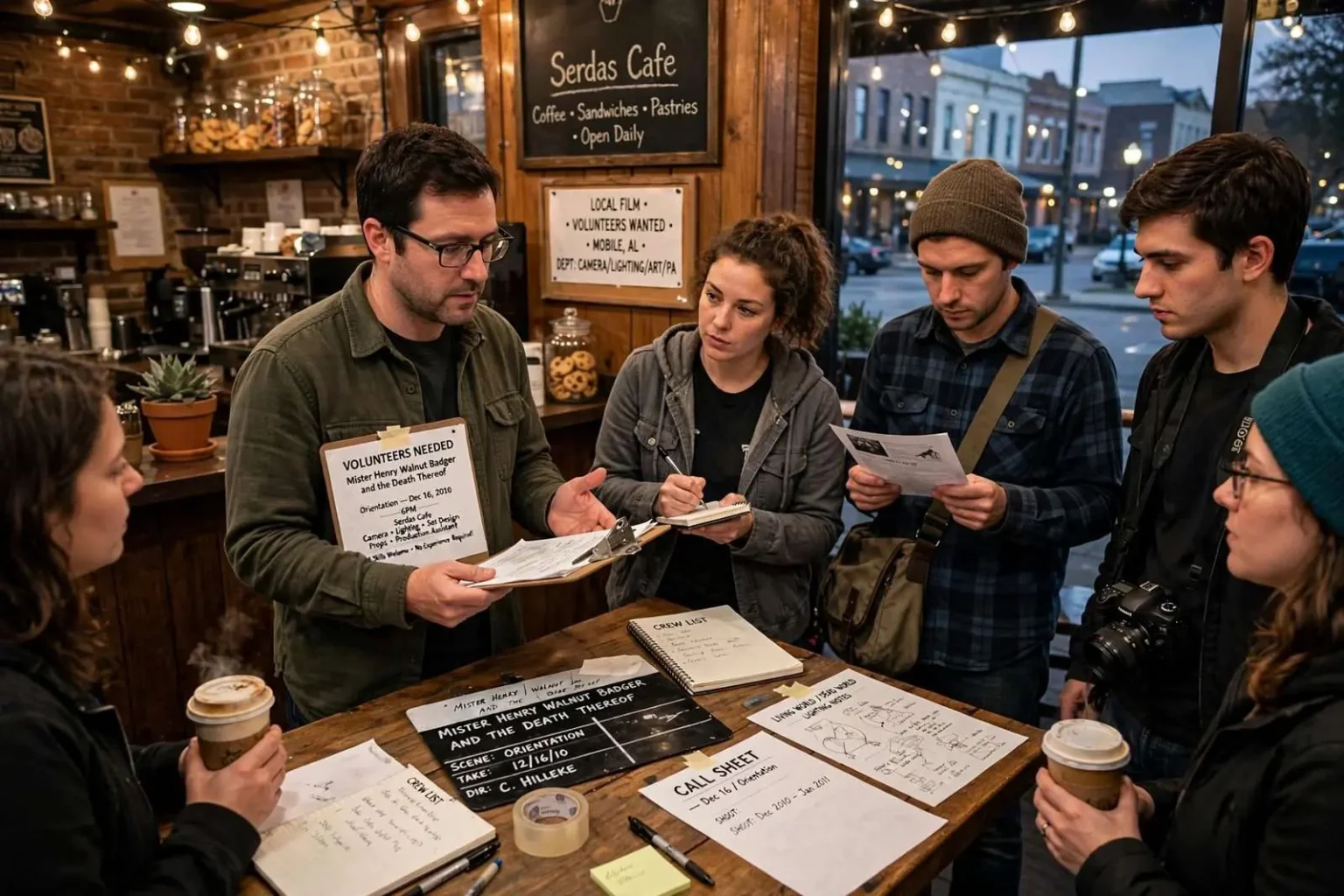
The production held an orientation session for prospective volunteers at Serdas Cafe in Mobile on December 16, 2010. The gathering gave Hilleke and his department heads a chance to walk interested volunteers through the shoot’s schedule, explain what each department would do, and match newcomers to roles based on interest and experience.
Volunteers were needed in all departments, from camera and lighting to set design and production assistance. On a micro-budget shoot, those divisions blur — volunteers who sign up to help with sets often end up gripping lights, running props or standing in for actors during lighting setup — and Hilleke made clear that willingness mattered more than a resume.
A shooting schedule through mid-January
The shoot was scheduled to run through the middle of January 2011, giving the production roughly six weeks to capture everything the dual-world story required. That timeline is typical of micro-budget features, which shoot nights and weekends around volunteers’ day jobs rather than on a compressed professional schedule.
The project maintained a presence on Facebook, where interested supporters could follow production updates by searching for the film’s full title. The page served as the production’s public face — posting behind-the-scenes photographs, casting notes and calls for help — a distribution strategy that was becoming standard practice for independent filmmakers of the era.
How micro-budget features get made
Productions like “Mister Henry Walnut Badger and the Death Thereof” occupy a distinct corner of the film industry. Without studio backing, the budget covers essentials — equipment rental, materials, food for the crew — while labor comes from volunteers who work for experience, screen credit and the plain fun of making a movie. Meals, screen credit and a finished film to show for it are the traditional currency, and everyone on set knows the terms going in.
What volunteers get in return can be substantial. A first feature puts newcomers inside a working set where they can watch how scenes are blocked, how lighting is shaped, how sound is captured and how a director keeps a schedule moving. For aspiring cinematographers, editors and production designers, a few weeks on a micro-budget shoot often teaches more than a semester of coursework, because the small crew means fewer people between the volunteer and the actual work.
The arrangement benefits the filmmaker as well. A crew drawn entirely from one city solves the perennial indie problem of housing and travel costs, and local volunteers bring local knowledge — who owns a building that could be a location, where to find props, which diner will feed twenty people at midnight without complaint.
Why Mobile attracts independent film
Mobile has long served as a working location for film and television production on the Gulf Coast. The city offers a compact downtown with historic architecture, riverfront and bay settings, antebellum neighborhoods, industrial corridors and quiet residential streets within a short drive of one another — a range of looks that lets a low-budget production stand in for many places without leaving the city limits. Its deep-water port, railway lines and tree-lined squares have doubled for settings across the South and beyond in productions both large and small.
For a ghost story that moves between the world of the living and the world of the dead, that variety is more than a convenience. Atmospheric locations — old buildings, water, night streets — do narrative work in a supernatural mystery that would otherwise have to be bought with effects, and Mobile’s stock of period architecture gives a filmmaker those textures for the cost of a location agreement.
The city also benefits from a modest pool of working actors and technical crew, supplemented by students and community theater performers willing to take a chance on an unusual script. A lead actor like William Masters, based in Mobile, anchors a production that would otherwise have to import its cast.
The grind and the payoff of a first feature
Veterans of micro-budget productions describe a familiar arc. The first week is energized and chaotic as the crew learns each other’s rhythms. Somewhere in the middle, with the schedule sagging and the weather uncooperative, the production tests everyone’s commitment. The final stretch, when the remaining scenes are compressed into whatever days the volunteers can still offer, demands the kind of stubbornness that only a labor of love supplies.
Hilleke’s background as a cinematographer who has shot, written, directed and edited his own work gives him a realistic grasp of that arc. A filmmaker who has carried a project through every stage understands what a six-week volunteer shoot can and cannot do, and budgets the schedule accordingly. His 15 years across corporate, commercial, documentary and narrative work mean the production’s technical foundation rests on someone who has solved those problems before.
Following the production
For residents who missed the December orientation, the Facebook page remained the production’s open door — the place where new volunteer needs, schedule changes and progress updates appeared as the shoot moved forward. Productions of this size rarely turn away late-arriving help, particularly in departments like set design and production assistance where demand is constant.
The film joins a long line of projects that have treated Mobile as both a backdrop and a production base, and its makers framed it the way most first features are framed: not as a guaranteed commercial proposition, but as a story worth telling and an experience worth having. Whether “Mister Henry Walnut Badger and the Death Thereof” went on to festival screens or simply became the defining adventure of a Mobile winter for its volunteers, the production’s model — local crew, local cast, local locations, built on volunteer energy — is the same one that has launched countless independent films before it.
Inside the story’s dual worlds
The premise at the heart of “Mister Henry Walnut Badger and the Death Thereof” gives the production its unusual shape. A faked death gone wrong is a classic mystery engine on its own, but the film filters the fallout through a protagonist whose grip on a single identity is unreliable. Arthur, a troubled artist with multiple-personality disorder, experiences the story’s events as they ripple between the living and the dead, which allows the film to keep its audience guessing about what is literally happening and what is happening only inside a fractured mind.
Scripts that move between worlds place unusual demands on a small crew. Scenes set on each side of the divide need distinct visual treatments — different lighting schemes, color temperatures, camera movements and sound design — and a micro-budget production has to create those distinctions with ingenuity rather than money. For a cinematographer like Hilleke, that is the kind of problem that makes a first feature worth shooting; the dual-world structure turns every technical choice into a storytelling one.
For the cast, the setup offers meaty material as well. A lead character with multiple personalities gives an actor several roles in one, and William Masters’ performance carries the audience’s orientation through the story’s shifts — the film works only as well as his ability to keep viewers oriented while everything around Arthur dissolves.
What volunteers actually did on set
The call for volunteers in “all departments” was not an exaggeration. On a production of this scale, the camera department needs assistants to pull focus, slate shots and manage media; the lighting team needs hands to run cable, set stands and shape fixtures; the art department needs builders, painters and prop wranglers; and production assistance — the catch-all for everything from coordinating extras to running food — never has enough hands.
Shoots of this kind also lean on volunteers for the unglamorous logistics that consume so much of any production day: moving equipment between locations, keeping the schedule posted, managing parking and neighborhood relations at exterior shoots, and feeding the crew. Experienced filmmakers are generally candid about the fact that the majority of production work is logistics, not art, and that the volunteers who master logistics are the ones crews remember and rehire.
The orientation at Serdas Cafe was where those matches got made. Department heads described their needs, volunteers described their interests and availability, and the production filled its remaining gaps. For a shoot stretching into January, early alignment mattered — a volunteer who understood the schedule and the expectations in December was far more valuable in week five than a late addition.
A snapshot of Gulf Coast filmmaking
The production belongs to a moment when digital cameras and online social networking lowered the cost of entry for first-time feature filmmakers across the country. A cinematographer with 15 years of professional experience could now own or rent the core of a camera package, recruit a volunteer crew through a Facebook page, and shoot a feature in the city where he could find free help and cheap locations. The economic math that once made a first feature a decade-long savings project had shifted, and cities like Mobile — with willing locations, local talent and no permit burden of a major market — became natural hosts.
The volunteer orientation model likewise became a fixture of regional filmmaking. Cafe meetings, community bulletin boards and social media groups served as the casting calls for crew, and productions that treated volunteers well found the same faces returning for the next project, building the experienced local crew base that every film community needs to grow.
For Mobile, each production of this kind leaves something behind: residents with real set experience, location owners who have hosted a shoot, and a small strengthening of the professional network that bigger productions draw on when they come to town. That is the quiet return on a labor of love like Hilleke’s — even before the footage is cut, the city’s filmmaking capacity has grown by the number of volunteers who spent a December evening at Serdas Cafe learning what a production schedule looks like.