Independent Music Collective Opens Season with Australian Bluesman C.W. Stoneking
The Independent Music Collective at South Alabama opens its 2016-17 season Sept. 17 with Australian blues artist C.W. Stoneking at Satori Coffee House.
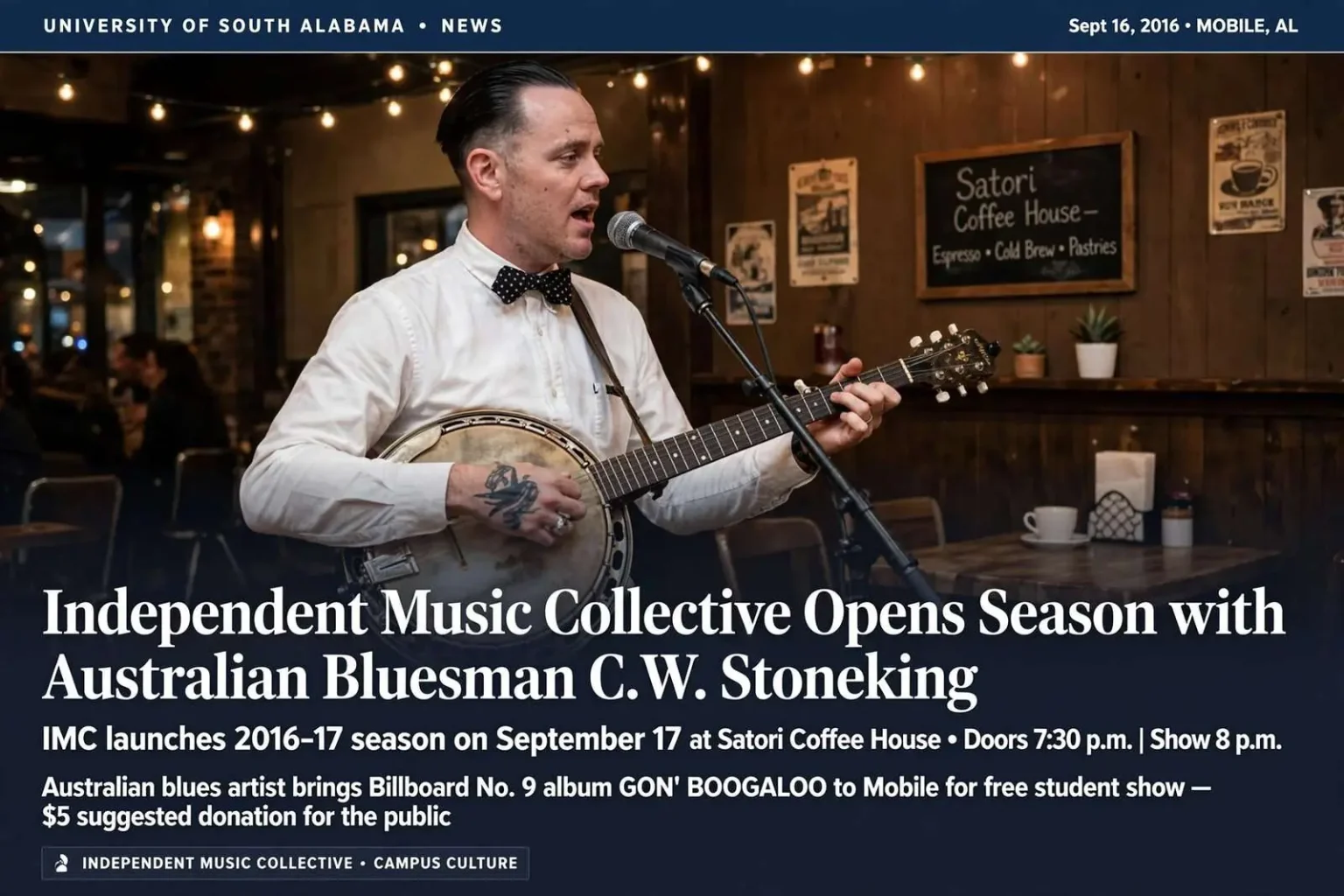
The Independent Music Collective at the University of South Alabama opens its 2016-17 season on September 17 with Australian blues artist C.W. Stoneking. Doors at the Satori Coffee House open at 7:30 p.m., with the show starting at 8 p.m. Admission is free for USA students with a suggested $5 donation for others.
Stoneking’s latest release, GON’ BOOGALOO, sits at No. 9 on the Billboard Blues Albums chart. The Village Voice has called him “the hottest — and most enigmatic — blues artist in Australia,” while NPR says he “will make you want to get up and dance.”
The booking gives Mobile listeners a chance at something genuinely scarce. Stoneking, born in Katherine in the remote Northern Territory of Australia, rarely tours the United States, making this a limited opportunity for local listeners. For a Saturday night in September, the arrival of an internationally reviewed blues artist in a Mobile coffee house is the kind of pairing that defines the Independent Music Collective’s approach to its season lineup.
Stoneking’s music defies the easy assumption that blues belongs to one place and one era. Drawing on pre-war country blues, jug band music, gospel and calypso, he writes and performs songs that sound as if they drifted out of a 1920s Mississippi Delta recording session — until the wink in the lyrics and the unmistakable Australian baritone reveal a wholly original artist. His records layer ukulele, banjo, brass and ragged choirs of backing voices into productions that feel simultaneously antique and playful, and his live reputation rests on shows that blend music with storytelling between and during songs.
The Season Opener
Opening a season is a statement of intent for any concert series, and the IMC’s choice of Stoneking signals the organization’s taste for artists who exist outside the mainstream touring circuit. The 2016-17 season that begins September 17 will continue through the academic year, but the opener sets the tone: music with genuine chart momentum — GON’ BOOGALOO at No. 9 on the Billboard Blues Albums chart — presented in a room of a few dozen people rather than a theater of a few hundred.
Satori Coffee House, the venue on the USA campus area, has long served as the IMC’s home for that reason. The room rewards the kind of performance Stoneking delivers: intimate, conversational, dependent on audience connection rather than production. Coffee house shows strip away the barriers between artist and audience, and for an artist whose work draws on the front-porch intimacy of early blues, the setting is not a compromise but the point.
The pricing is part of the same philosophy. Free admission for University of South Alabama students with a valid ID keeps the series accessible to the campus community, while the suggested five-dollar donation for the general public supports the organization’s work in bringing independent talent to Mobile. Nobody is turned away over the suggested donation — the model depends on goodwill and modest contributions rather than ticket revenue.
The Artist and His Record
GON’ BOOGALOO, the album carrying Stoneking up the Billboard blues chart at the time of the show, continued a distinctive body of work that had already earned him attention far beyond Australia. His earlier recordings had won awards and reviewers’ praise at home, and his American appearances — infrequent as they were — had built a small but devoted following among listeners who championed his synthesis of vintage styles with contemporary wit.
The Village Voice’s description of Stoneking as “the hottest — and most enigmatic — blues artist in Australia” captures the paradox that follows his career: an artist working almost entirely within pre-war American musical forms, arriving from the other side of the world, and outperforming much of the American blues establishment at its own game. NPR’s simpler assessment — that he “will make you want to get up and dance” — points to the other half of his appeal. For all the antique surface of the music, Stoneking’s shows groove, and audiences used to reverent acoustic blues performances are often surprised to find themselves moving.
Katherine, the Northern Territory town where Stoneking was born, sits in Australia’s tropical top end, a place about as far from the Mississippi Delta as geography allows. His path to the blues ran through obsessions with old 78s and the music of the 1920s and 1930s, absorbed deeply enough that his original songs stand naturally beside the tradition rather than imitating it from outside. That authenticity, filtered through his own background and humor, is what reviewers mean by “enigmatic.”
The IMC’s Role in Mobile’s Music Scene
The Independent Music Collective, a campus organization that brings independent talent to Mobile in cooperation with Satori Coffee House, has built a reputation for intimate, well-received performances. Its seasons typically string together a lineup of touring artists across the fall and spring, giving the city a steady schedule of shows that fill the gap between campus events and the bars and theaters of the broader Mobile music scene.
Student-run concert organizations occupy an important niche in American college towns. They operate on slim budgets and volunteer labor, they book on taste rather than market research, and they consistently land artists years before those artists outgrow small rooms. For USA students, the IMC’s shows mean seeing nationally reviewed performers at no charge, steps from class; for the wider community, they mean a $5 suggested donation buys an evening with a Billboard-charting artist in one of Mobile’s most intimate venues.
The September 17 season opener fit that record precisely: a rarely touring international artist with fresh acclaim, a beloved coffee house room, doors at 7:30 p.m. and music at 8. For Mobile listeners, the advice in the advance coverage amounted to a simple warning — opportunities like this one, with an artist who rarely crosses the Pacific, do not come around twice in the same season.
What the Audience Could Expect
Concertgoers arriving at Satori Coffee House by the 7:30 p.m. door time would find the practical details of a coffee house show: limited seating that rewards early arrival, the room’s modest stage close enough to the audience that the performance feels shared rather than staged, and an atmosphere closer to a large living room than a concert hall. Shows of this size generally run without opening spectacle — the artist walks out, tunes, talks, and begins.
Stoneking’s live format at the time of the GON’ BOOGALOO tour favored that intimacy. Audiences could expect the baritone storytelling that threads through his records, songs drawn from across his catalog, and the crowd work that has made his reputation as a performer who entertains between the verses as thoroughly as during them. For listeners whose only exposure was the recordings, the live show typically adds the dimension that reviewers write about most: the sense of an artist completely in command of a room.
The blues-chart context also gave the night a particular character. An artist at No. 9 on the Billboard Blues Albums chart playing a coffee house for a five-dollar suggested donation represents the kind of value and access that rarely coexist, and Mobile audiences who took the chance in September 2016 witnessed the kind of performance that usually required a trip to New Orleans or Atlanta — or a ticket costing several times the donation.
Coffee Houses and the College Concert Tradition
The venue choice deserves its own attention in this record. Coffee houses have served as incubators for folk, blues and independent music in American college towns since the folk revival of the 1950s and 1960s, when small rooms and small audiences shaped the listening culture that still surrounds acoustic music. The tradition prizes exactly what Satori offered the IMC: a quiet, attentive room, decent coffee, and no barriers between performer and audience.
For the University of South Alabama community, organizations like the IMC form part of the campus’s cultural infrastructure alongside its museums, theaters and lecture series. A student organization that books touring artists does more than entertain; it builds the habits of live music attendance that sustain scenes for decades afterward. Many of the region’s long-running concert series and festivals trace their origins to similar campus groups, run by students who learned booking, promotion and production by doing them.
The 2016-17 season that opened on September 17 with C.W. Stoneking continued that lineage in Mobile. An Australian bluesman from Katherine, ranked on the American blues chart, playing the opening set of a student-run season in a coffee house on University Boulevard: the pairing captures the IMC’s particular promise. As the advance coverage made plain, Stoneking’s rare American tours meant the night was not to be repeated soon — and for those who filled the room that Saturday, the season began with exactly the kind of discovery the organization exists to deliver.