
Independent Music Collective opens season with Tim Easton at Satori
South Alabama's Independent Music Collective opens its 2014-15 season with a free Tim Easton recording session Sept. 5 at Satori Coffee House.
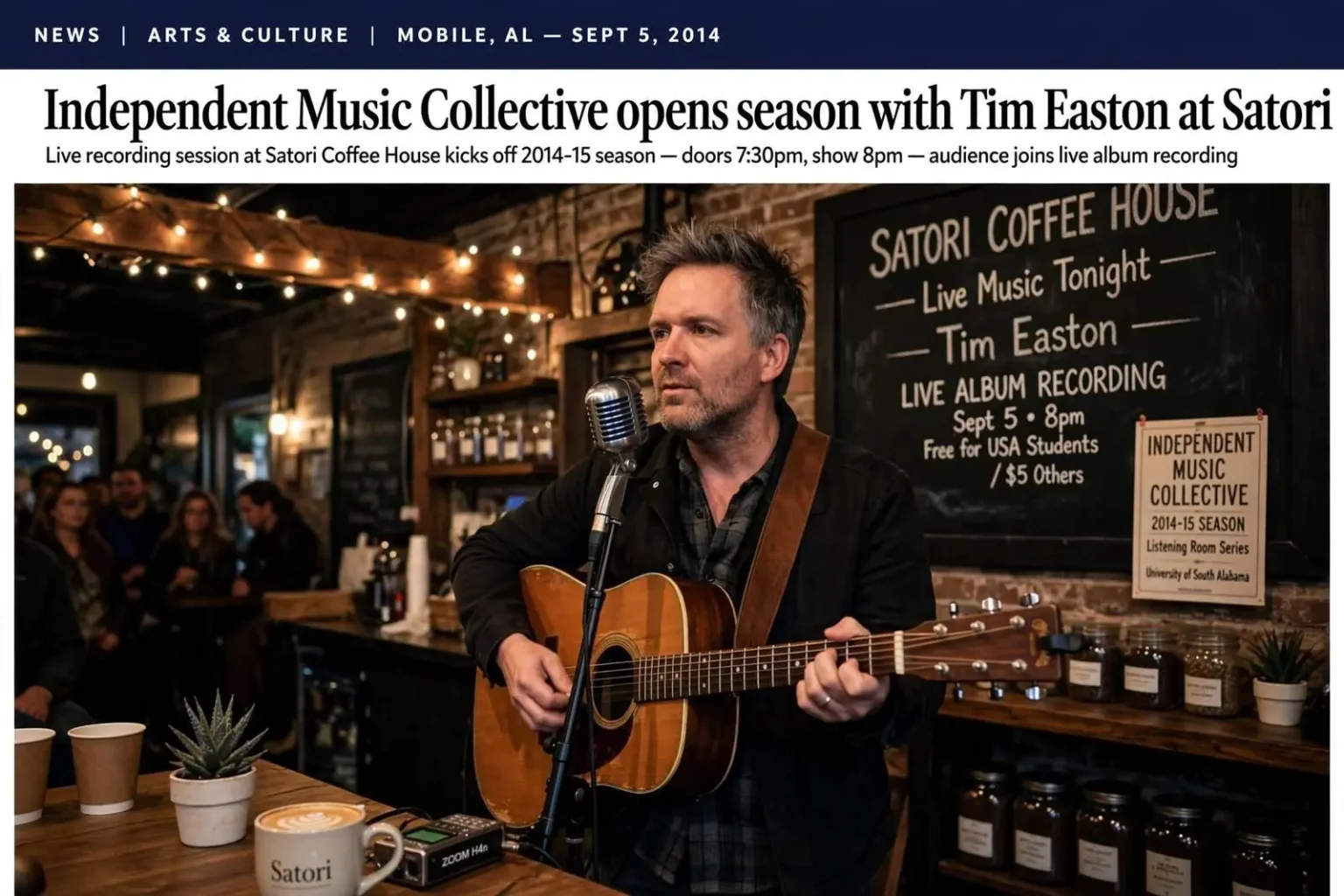
The Independent Music Collective at the University of South Alabama will open its 2014-15 concert season with a special Tim Easton recording session on Friday, Sept. 5, at Satori Coffee House in Mobile. The show doubles as a live album session, giving the college-town coffee house audience a chance to appear on a professional recording while the collective launches a new year of programming.
Doors open at 7:30 p.m. and the show begins at 8 p.m. There is no opening act, and admission is free for USA students and $5 for everyone else. The stripped-down arrangement — one artist, one room, no filler — reflects the listening-room philosophy that has made the collective’s Satori shows a fixture of Mobile’s acoustic music calendar.
A live recording for a forthcoming album
Easton will record tracks during the performance for an official live album tentatively planned for late 2014 or early 2015. It is the second taping of the project. The first took place in March 2014, after Easton — who called Satori “one of the friendlier listening room type joints I’ve come across” when the collective first brought him to Mobile in 2013 — asked to host several recorded shows.
That request says something about both the artist and the venue. Touring songwriters play hundreds of rooms over a career, and the ones they remember are those where the audience actually listens. Satori, a coffee house on Old Shell Road near the USA campus, has built its reputation on exactly that: quiet tables, good coffee and a room where a singer and a story can hold the crowd’s attention without amplification doing the work.
Recording a live album across multiple nights gives an artist options. Different shows yield different performances, different song selections and different crowd moments, and the best takes from each can be assembled into a record that captures a performer at ease in a room he trusts. For Mobile audiences, the Sept. 5 show is a chance to be part of that process rather than just hear the result.
A roots-music veteran returns
Easton broke onto the Americana scene in 1998 with Special 20 and went on to a deal with New West Records. His 2001 release, The Truth About Us, featured members of Wilco and the Jayhawks — a pairing that announced Easton as a songwriter whose company matched his ambitions.
In the years since, Easton has built a catalog admired across the Americana and alt-country worlds, releasing records while crisscrossing the country and Europe on tour. He continues to collaborate with roots musicians, most recently as part of the Americana supergroup Easton Stagger Phillips, whose records and tours have kept him on the road between solo projects.
His songwriting has earned comparisons to the great traveling troubadours — direct, image-rich verses, choruses that stick, and a voice that carries the dust of the highway. The live setting at Satori suits that style; without a band to hide behind, the songs stand or fall on their own, and Easton’s have stood the test of hundreds of rooms.
The collective’s 2013 booking introduced Easton to Mobile audiences, and his return for a second engagement — and then a third and fourth, as the recording project grew — speaks to the relationship that formed. Artists return to venues where they are treated well and heard well, and Satori has managed both.
Charlie Parr follows in October
The collective has also announced its second show of the season: Charlie Parr live at Satori on Saturday, Oct. 18, the acclaimed country-blues musician’s first Mobile appearance in three years. Parr’s return gives the season an early one-two punch of nationally respected Americana talent.
Parr, a Minnesota-based guitarist and songwriter, has spent years building a devoted following with his raw, driving take on country blues — twelve-string guitar, resonator, and a voice that sounds like it came up through the same Mississippi Delta his heroes did. His performances are known for their intensity, marathon sets and total absorption in the music, qualities that translate perfectly to a listening room the size of Satori’s.
For Mobile fans, the October date closes a three-year gap. Parr last played the city in 2011, and the opportunity to see him in an intimate room — rather than a festival stage or a noisy bar — is the kind of booking that has become the Independent Music Collective’s signature.
What the Independent Music Collective does
The Independent Music Collective works with USA faculty, staff, alumni and the broader community to enrich Mobile’s live music scene. The organization’s model is simple: bring respected touring songwriters to an intimate venue, keep tickets affordable, and let the students and residents of Mobile hear artists they might otherwise have to drive to New Orleans, Birmingham or Nashville to see.
The collective’s partnership with Satori has been central to that work. The coffee house’s location near the USA campus puts touring acts in front of students, while its listening-room culture draws the wider community — musicians, music writers and fans who value a quiet room. Shows there routinely feature artists who fill larger halls elsewhere, but who prefer the close connection a small room provides.
Free admission for USA students with a $5 cover for everyone else keeps the series accessible. The modest door charge helps pay the artists, and the low-key pricing reflects the collective’s mission rather than a commercial calculus. Over its seasons of programming, the collective has become part of the pipeline that connects national Americana tours to the Gulf Coast.
The season ahead
The Easton session and the Parr date bookend a fall that promises more announcements as the 2014-15 season takes shape. The collective’s seasons typically mix returning favorites with first-time visitors, and the opening lineup — an established Americana songwriter mid-recording project, followed by one of the country’s most respected bluesmen — sets a high bar.
For Easton’s Sept. 5 show, early arrival is the practical advice: a room the size of Satori’s fills quickly for a free-to-students show with a national act, and the recording session adds an extra reason for fans to claim a seat. Doors at 7:30 p.m., music at 8 p.m., and no opening act means the main event starts on time.
For anyone who has wondered what a live album sounds like as it is being made, the answer is: like a Friday night in a good room, with the songs, the between-song banter and the applause all on tape. Mobile’s coffee house audience will supply that soundtrack, and the record that follows will carry the city’s name in its credits.
Satori and Mobile’s listening rooms
Every music city of any size is defined in part by its listening rooms — the cafes, bookstores and small halls where the audience comes to hear the songs rather than talk over them. Mobile has a handful, and Satori Coffee House has long been counted among the best. The room near the USA campus hosts open nights, local singer-songwriters and the Independent Music Collective’s touring guests, all in a space designed for coffee and conversation but suited by temperament to quiet, focused performance.
Easton’s quoted description of Satori as “one of the friendlier listening room type joints” he had come across circulated among touring musicians, and word of mouth like that is how small venues land big artists. A recommendation from a respected traveling songwriter carries more weight with his peers than any advertisement could, and it is part of why the collective’s Mobile dates attracted an artist of Easton’s pedigree for a multi-show recording project.
The economics of such rooms are fragile — small capacity, modest covers, coffee instead of bar sales — but they occupy an outsized place in the careers of working songwriters. A successful listening-room show pays an artist fairly, builds an audience that buys records, and gives the performer something harder to find on festival stages: attention.
A college town’s music culture
The University of South Alabama’s presence gives Mobile a student population that can sustain regular acoustic programming, and the Independent Music Collective sits at the intersection of campus and city. By making shows free for students and affordable for everyone, the collective ensures the room’s audience is a mix — undergraduates discovering songwriters for the first time, alumni back for a favorite act, and the local musicians and fans who never stopped coming out.
That mix matters for the acts as much as the audience. Touring artists remember rooms where young crowds show up, and Mobile’s place on the Southeastern circuit — between New Orleans and Pensacola, an easy drive from the Florida panhandle and the wider Gulf Coast — depends on venues demonstrating that the city turns out for original music.
The collective’s work with USA faculty, staff and alumni also ties the series to the university’s arts culture, giving students exposure to working musicians whose careers demonstrate what the craft looks like up close. For a student who has only heard Americana through headphones, a front-row seat to a live album session is an education of a different kind.
Marking the calendar
With the season opener set for Sept. 5 and Charlie Parr due Oct. 18, the Independent Music Collective’s 2014-15 calendar is taking form. Details on additional dates will follow as they are announced, and the collective’s shows have a way of selling out the room’s limited seats — particularly recording sessions and first appearances in years.
The through-line of the programming is respect: for the songs, for the room, and for the audience that keeps both alive. As Easton settles in at Satori to capture another night of tracks for his live album, Mobile once again plays host to the kind of intimate, serious music-making that big cities take for granted — and that this city, thanks to a coffee house and a collective of volunteers, gets to call its own.