Infirmary Health Launches Appointment-Only COVID-19 Testing Sites in Baldwin County
Infirmary Health has opened three appointment-only COVID-19 testing sites in Baldwin County, directing residents with symptoms to call a nurse hotline before receiving a testing time and location.
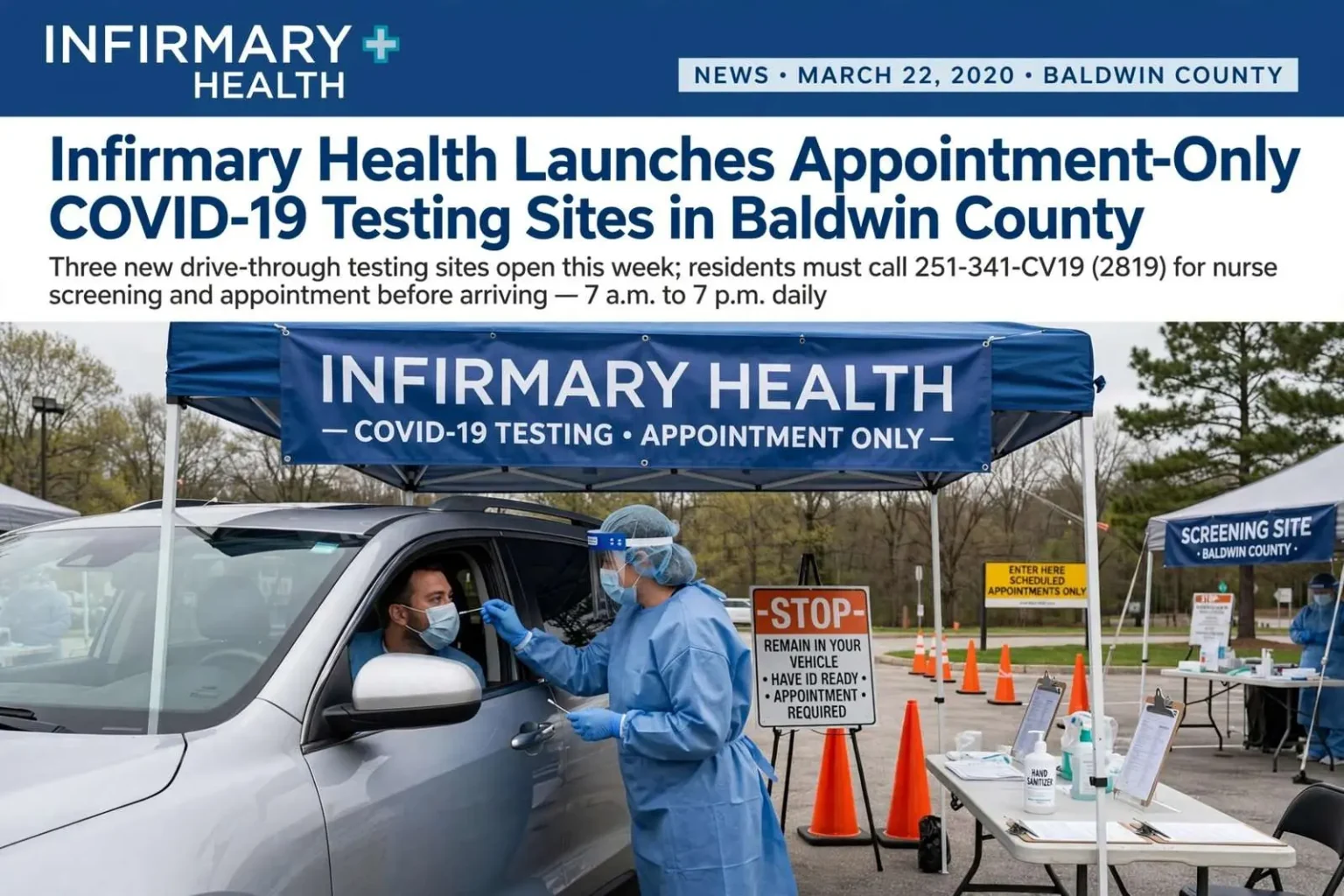
Infirmary Health has opened three appointment-only COVID-19 testing sites in Baldwin County this week, giving area residents a structured way to get screened for the coronavirus as case counts continue to climb across the Gulf Coast. The launch puts the region’s largest health system at the center of the local response to a pandemic that was, by the week of March 22, reshaping daily life in every Alabama county.
Rather than allowing walk-up testing, the health system is directing anyone who suspects they may be infected to call a dedicated hotline first. The design reflects an early-pandemic reality that health officials across the country were confronting simultaneously: testing capacity, protective equipment and staff time were all scarce resources, and an unmanaged line of symptomatic patients could exhaust them in a day.
Residents who believe they are showing common symptoms of the virus, including fever, fatigue and a persistent dry cough, are asked to dial 251-341-CV19 (2819) to speak directly with a registered nurse before any testing appointment is scheduled. Putting a nurse on the first call, rather than a scheduler, means medical judgment enters the process at step one and patients whose symptoms point elsewhere — flu, strep, allergies — can be redirected to appropriate care.
The screening hotline is staffed from 7 a.m. to 7 p.m. daily from March 22 through March 27, according to Infirmary Health. The twelve-hour window covers the hours when most residents can realistically call, including early morning before work and evening after it, and the daily staffing schedule gives the system flexibility to extend or adjust operations as the situation develops.
Callers are asked a series of questions to determine whether their symptoms and potential exposure history meet criteria set by the Centers for Disease Control and Prevention for testing. In the pandemic’s early weeks, those criteria prioritized patients with symptoms who had known exposure to a confirmed case, had traveled to affected areas, or required hospitalization — protocols designed to concentrate limited tests where they mattered most.
Who qualifies for an appointment
Testing appointments are available to residents of both Baldwin and Mobile counties who are at least 18 years old and can present a valid photo ID. Opening the sites to both counties recognizes the way the two sides of Mobile Bay function as a single community — thousands of residents cross the bay daily for work, medical care and family — and prevents a confusing dividing line between two health systems’ catchment areas.
Officials say the age and identification requirements are meant to keep the process orderly as demand for testing continues to grow statewide. Verifying identity at scheduling prevents duplicate appointments, and the age threshold gives the early sites a defined patient population while pediatric testing pathways — which required different supplies and procedures — were being developed.
Clearing the hotline was the only path to an appointment, and officials were blunt about what they wanted residents to avoid: showing up unannounced at hospital emergency rooms, clinics or the testing sites themselves. Uncoordinated arrivals threaten the staff and patients inside those facilities, consume protective equipment, and slow the screening process for everyone — the opposite of what a county trying to contain an outbreak needs.
Patients who are cleared for testing under CDC guidelines will be given a specific appointment time and testing location rather than reporting to a general site. The approach eliminates waiting rooms entirely, and it allows the health system to pace the flow of patients through each site to match the daily capacity of staff and supplies.
The sites represent one of the largest testing operations assembled on the Eastern Shore to that point in the pandemic, and they arrived as hospitals nationwide were still learning how the disease moved through communities. Every appointment kept a potential case out of a waiting room, and every nurse on the hotline kept a worried caller out of an emergency department — small efficiencies that multiplied across thousands of calls.
The appointment-only model is designed to limit crowding, protect medical staff and preserve limited supplies of testing materials and personal protective equipment. Every unnecessary test used swabs, transport media and protective gear that a hospitalized patient might need more, and every crowd of waiting patients created a transmission risk that the testing itself was meant to manage.
Once a patient arrives for a scheduled appointment, they are instructed to remain inside their vehicle for the duration of the visit. If a swab is needed, medical staff will administer the test through the car window, minimizing direct contact and reducing the risk of exposure for both patients and health care workers.
The drive-through format became the signature adaptation of the pandemic’s first months. It allowed a single nurse in full protective equipment to process patients rapidly, avoided the indoor spaces where the virus spreads most efficiently, and reassured symptomatic patients that seeking a test would not expose their families or other patients in the process.
A health system under strain
After the sample is collected, patients receive instructions directly from their medical provider on next steps, including how to self-isolate while awaiting results and when to seek escalated care if symptoms worsen. In an era when results took days to return, that counseling was a critical part of the visit — the test itself was only the beginning of the medical encounter.
Infirmary Health, headquartered in Mobile and operating hospitals and clinics across the two-county region, entered the pandemic as the area’s dominant health system, and its Baldwin County facilities — most prominently Thomas Hospital in Fairhope — anchor health care for the Eastern Shore’s fast-growing communities. Standing up three testing sites in a week required coordination across laboratory, supply chain and clinical staffing that few local organizations could have matched.
The timing of the sites’ opening tracks with Alabama’s pandemic timeline. The state’s first confirmed cases arrived in mid-March 2020, and the weeks that followed were a race between community spread and the buildout of testing infrastructure. Baldwin County’s case counts were climbing alongside beach season, as spring visitors and returning travelers raised the risk that the peninsula and coastal communities would seed transmission inland.
Baldwin County’s geography makes distributed testing sites particularly important. The county stretches more than 50 miles from the Mobile Bay shoreline to the Alabama-Georgia line, encompassing communities as different as Daphne and Fairhope on the Eastern Shore, Foley and Gulf Shores on the coast, and Bay Minette in the north. Concentrating testing at a single location would have left the county’s northern and southern ends an hour’s drive from screening.
Health officials urged residents without symptoms to stay away from the testing sites entirely. The appointment system exists precisely to separate the worried well from patients with a genuine clinical need for a test, and officials asked the public to let nurses on the hotline make that determination rather than self-selecting for screening.
The statewide picture that week was sobering. Alabama’s confirmed case count was climbing daily, schools had closed, and public gatherings were being canceled across the region as officials worked to slow transmission ahead of any potential surge in hospitalizations. Testing capacity was the bottleneck that made every other decision harder: without knowing how widely the virus had spread, hospital systems could only prepare for the worst.
What residents should do
For residents wondering whether to call, the guidance was straightforward. Fever, fatigue and a persistent dry cough — the symptom triad cited by Infirmary Health — are the markers health officials were asking the public to watch for, particularly in combination with known exposure to a confirmed case or recent travel to areas with community spread. Residents experiencing severe symptoms, including difficulty breathing, were urged to contact medical providers immediately rather than waiting for a testing appointment.
Households with a member awaiting testing or results were encouraged to plan for isolation at home — a separate room where possible, masks worn around other household members, and careful hygiene around shared surfaces. Public health officials emphasized that the period between testing and results was among the most contagious in many patients’ course of illness.
The appointment-only system also gave Infirmary Health a data advantage. Call volume and scheduled appointments provided a real-time gauge of community symptoms across both counties, information that shaped staffing decisions and helped the system anticipate demand on hospitals before it arrived in emergency departments.
Residents of Baldwin and Mobile counties who believe they need testing can call 251-341-CV19 (2819) between 7 a.m. and 7 p.m. through March 27. Officials cautioned that guidance continues to evolve with the pandemic and directed the public to the health system’s announcements and public health authorities for updates on locations, hours and eligibility as the response develops.