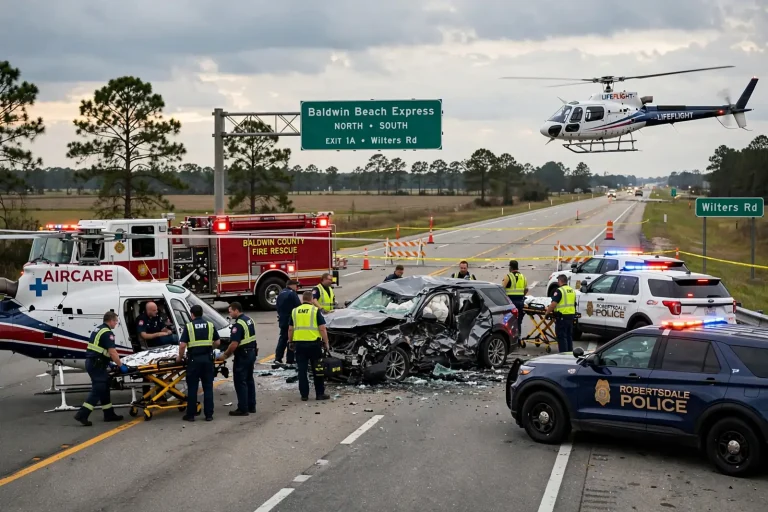
Inside Baldwin County EMA’s Round-the-Clock Push to Recover From Hurricane Sally
Baldwin County EMA Director Zach Hood and his team have worked around the clock from the Robertsdale operations center since before Hurricane Sally made landfall, coordinating debris cleanup, supply distribution and FEMA assistance for storm-weary residents.
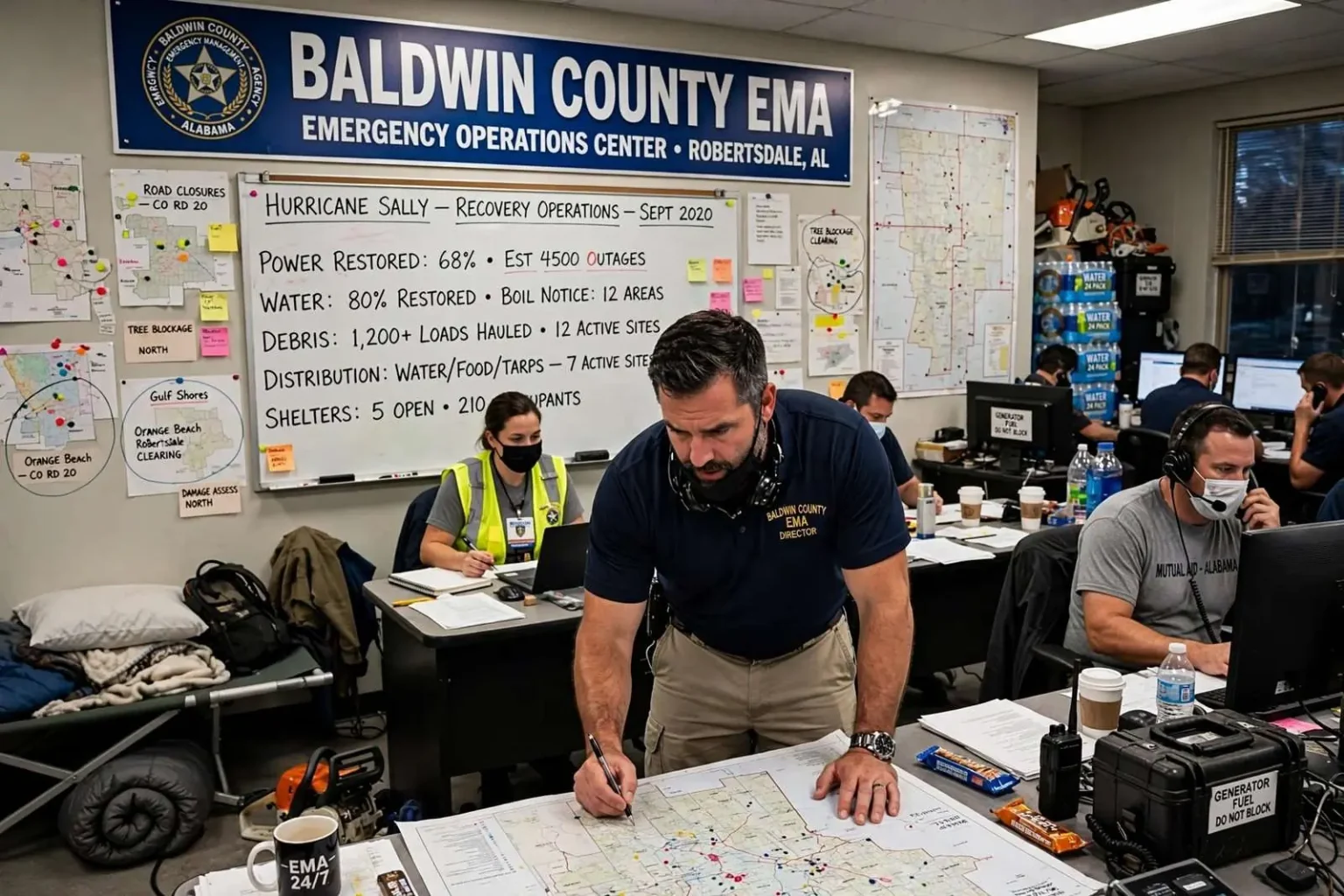
ROBERTSDALE, Ala. — Nearly two weeks after Hurricane Sally roared ashore along the Alabama Gulf Coast, the Baldwin County Emergency Operations Center in Robertsdale is still running at full tilt, coordinating the sprawling, multi-agency effort to get power, water and supplies back to residents across the county.
Emergency Management Agency Director Zach Hood said the pace inside the operations center has not let up since the Sunday before the storm made landfall, when crews began staging equipment and personnel ahead of Sally’s arrival. “We’ve been nonstop, and we will not stop until our mission has ended,” Hood said.
Sally came ashore in the early morning hours of September 16 near Gulf Shores as a strong Category 2 hurricane, and its slow crawl inland proved as damaging as its landfall. The storm’s winds and record rainfall — more than two feet in places — toppled trees across the county’s dense canopies, snapped power lines, flooded roads and cut off neighborhoods for days. Baldwin County, Alabama’s largest by area, felt the storm from the beaches of Gulf Shores and Orange Beach to the agricultural communities along its northern edge, which is why the recovery effort radiating out of Robertsdale has had to cover so much ground.
Staging equipment before landfall is the piece of emergency management the public rarely sees, and it is the piece that decides how fast a county can respond. Fuel, generators, chainsaw crews, search teams and communications gear have to be positioned where they can move the moment winds drop below safe limits — decisions made days ahead on forecasts that could still shift.
The forecast itself was part of the difficulty. Sally’s track wobbled in the final 48 hours before landfall, shifting the expected impact zone along the northern Gulf Coast and forcing emergency managers on both sides of the state line to prepare for several scenarios at once. Baldwin County’s decision to activate fully on the Sunday before landfall bought the lead time that showed up later — in crews already in place, shelters already staffed and mutual-aid partners already rolling when the first damage reports came in.
That mission has required housing mutual-aid crews from across Alabama who came to help with search-and-rescue, debris removal and utility repair, all while trying to keep everyone safe amid the ongoing COVID-19 pandemic. Inside the operations room, staff and visiting responders wore masks as they worked shoulder to shoulder over maps, radios and status boards tracking the recovery in real time. “Incredible challenges, and as you know, we were housing individuals 24/7 and we had to maintain that distance,” Hood said of balancing pandemic protocols with the demands of sheltering out-of-town crews.
Living at the operations center
The toll of round-the-clock operations has fallen heavily on Hood personally. For seven straight days after the storm, he slept in his office rather than go home, and even then he chose the floor over one of the cots set up for responders so that rescue crews would have a more comfortable place to rest.
The arrangement says much about how a modern emergency operations center functions during the acute phase of a disaster. It is at once a command post, a barracks, a dispatch center and a warehouse, and everyone inside it works on a clock that has no shifts. Utility linemen, municipal public works employees, volunteer firefighters and state agency staff filter in and out while the core EMA team holds the center together, coordinating requests for everything from generator fuel to water rescues on a single wall of status boards.
Mutual aid — the system by which agencies across a state lend crews to whatever jurisdiction is hit hardest — is only as good as the logistics behind it, and Baldwin County spent the first two weeks after landfall essentially running a small city for the responders. Feeding, housing and scheduling out-of-town crews while under pandemic distancing rules multiplied the workload of an event that would already have strained the county at full capacity.
The next phase: debris and supply
With search-and-rescue operations winding down, Hood said the emergency management team’s attention has shifted to the next phase of recovery: continued debris cleanup and making sure food, water and other essential supplies reach the residents who still need them most, particularly in areas that saw the heaviest wind and flood damage.
The debris problem in Baldwin County after Sally was staggering in the literal sense — months of work compressed into a single estimate. Downed trees and storm-wrecked material lined county roads and neighborhood streets in volumes that exceeded what local crews could haul on their own, requiring contracted debris haulers, staging sites and a tracking system that satisfies FEMA reimbursement rules. Every load logged correctly is money the county eventually recovers; every load that misses the paperwork is a local cost.
Supply distribution is the more human side of the same phase. Where power is out for weeks, refrigeration and water become daily problems, and distribution points for food, water and tarps become the most visible face of the recovery for residents who cannot drive long distances or afford hotel rooms elsewhere. Keeping those points stocked and staffed — and reaching homebound residents who cannot get to them — has been a central task for the EMA and its partners since the first days after landfall.
Hood credited local volunteer organizations with helping fill gaps that county and state resources alone could not cover in the days after the storm. “And if it weren’t for our volunteer organizations in our community, we definitely would have had an even more difficult time and increased challenges,” he said.
Church groups, civic clubs, volunteer fire departments and nonprofit responders filled roles that no government roster covers at scale: cooking meals, cutting trees out of driveways, checking on elderly neighbors, and staffing distribution sites. Baldwin County’s network of volunteer fire departments in particular covers a county too large for career departments to serve alone, and in a storm of this size those departments were often the first uniformed presence in a damaged neighborhood.
FEMA assistance and the long recovery
Baldwin County EMA is also working closely with the Federal Emergency Management Agency to get FEMA’s individual assistance program up and running for residents who suffered storm damage to their homes. To make that process easier to navigate, the agency has added a new tab to its mobile app that links users directly to the Baldwin County FEMA assistance page, where residents can check eligibility and apply for help with housing and other storm-related losses.
Individual assistance is the program most residents will interact with: grants that can cover temporary housing, essential home repairs and other serious disaster-related needs not met by insurance. Getting a declaration for individual assistance requires damage assessments that document the storm’s toll, and once it is approved the bottleneck becomes applications — which is where the app’s new tab comes in, meeting residents on the phones that are, for many in a power outage, the most reliable screen they have.
EMA staff have urged residents to document damage with photographs, keep receipts for storm-related expenses, and register with FEMA even if they are unsure they will qualify, since registration is the only way to be considered for aid and appeal any initial determination. The lessons of past Gulf storms are written into that advice: residents who waited to register, or who discarded damaged material before it was inspected, consistently fared worse in the assistance process.
County officials have continued to urge residents to be patient as utility crews work through downed lines and blocked roadways, and to report storm damage through official channels so that state and federal aid requests accurately reflect the scope of need across Baldwin County.
The damage reports flowing into the county’s system are not administrative busywork — they are the raw data behind every request Baldwin County and the state send to Washington. A storm’s federal assistance is calibrated to documented damage, and an undercounted county is a shortchanged county. Two weeks in, the operations center in Robertsdale is still collecting that picture one report at a time, and officials say the recovery will be measured in months, not weeks.
For Hood and the staff around him, the transition from rescue to recovery brings its own management challenge: sustaining an operation built for adrenaline through a period that rewards patience. The emergency phase runs on urgency; the recovery phase runs on persistence — debris contracts, damage inspections, assistance applications and utility repairs that proceed street by street. The EMA director who slept on his office floor for a week will now spend the coming months in meetings, paperwork and site visits, coordinating a rebuilding effort that will outlast every headline about the storm itself.