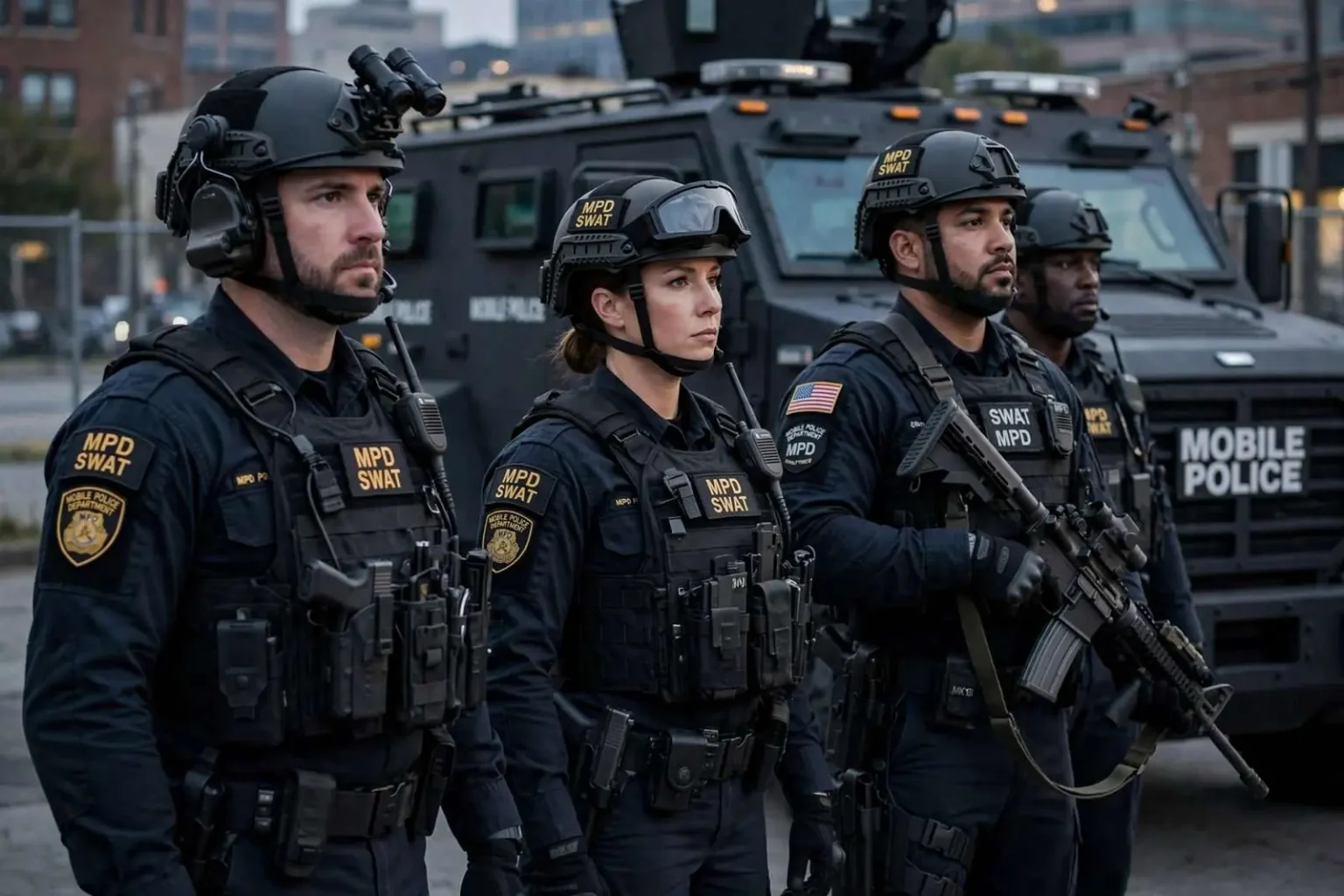
For the officers who make up the Mobile Police Department’s Special Weapons and Tactics team, the job does not end when a shift does. The 13 members of MPD SWAT carry their gear and weapons with them around the clock, ready to be called out to the city’s most dangerous and volatile situations at a moment’s notice, whether that means confronting an armed suspect barricaded inside a home, resolving a hostage standoff or serving a high-risk warrant on a violent offender.
The team’s work is built on repetition. Squads drill the same entry techniques hundreds of times so that when a real call comes in, their movements are automatic. That muscle memory was on full display in January 2018, the night Mobile Police Officer Justin Billa was shot and killed. A SWAT breacher was the first person through the door of the Avondale Court home where the shooter, Robert Hollie, had barricaded himself. The officer said he spotted a shotgun sitting on the edge of a couch, pointed at the door, the moment he turned the corner. Hollie had already taken his own life by the time the team made entry, but the officer said knowing Hollie had just killed a fellow officer made the encounter especially harrowing.
MPD’s SWAT commander, who has led the unit for years and has served on the team since 2002, described the work as unemotional by necessity. Officers have to set aside the natural human response to danger and focus entirely on the task in front of them, he said, because hesitation in a SWAT scenario can cost lives. He prefers the term “show of force” to describe what happens when a team of heavily armed officers arrives at a scene, noting that the mere sight of the unit is often enough to convince a suspect to surrender peacefully.
Each officer’s loadout depends on their assignment and the situation at hand. All SWAT officers carry a standard-issue Glock 17 9mm pistol and an MK18 assault rifle, while snipers and less-lethal specialists carry additional, specialized weapons. The team also has access to body armor, ballistic shields and armored personnel carriers. Despite the team’s imposing arsenal and its resemblance to the SWAT units portrayed in television dramas, the commander said the overwhelming majority of the calls he has handled in his career have ended without a single shot fired.
Of the hundreds of calls the team has responded to, only four have ended in a suspect’s death. One was Corey Hicks, who was shot and killed by SWAT officers in July 2010 after allegedly attacking police with a hatchet at a hotel on the I-65 Service Road; he was believed to have killed his mother in Florida. In 2012, Lawrence Wallace Jr., who fatally stabbed MPD Officer Steven Green while being transported to Mobile Metro Jail, was killed by SWAT officers during a shootout after a manhunt led them to a house on Daytona Drive, where he was hiding underneath the structure.
In an average month, MPD’s SWAT team responds to between eight and 15 calls. During 2018 alone, the team helped execute 84 arrest warrants, most of them tied to high-risk narcotics investigations, and responded to 36 unplanned incidents. Team leadership is emphatic that the unit is not, in the commander’s words, a “kill team” — lethal force is treated as an absolute last resort, deployed only when a suspect poses a direct threat to the public, to bystanders or to officers themselves. More often, he said, the team’s job is to talk suspects down and keep them from harming themselves.
That was the case last June, when 23-year-old Levy Washington triggered a four-hour standoff with the SWAT team, allegedly holding his 4-year-old daughter as a human shield. Washington eventually surrendered without incident, and his daughter was not harmed, but one officer who worked the scene said watching a young child held at gunpoint, both through a robot’s camera and in person, left a lasting impression.
Officers assigned to less-lethal roles carry tools such as tear gas, pepper spray, bean bag rounds and 40mm foam baton rounds, fired at roughly 300 feet per second to incapacitate a suspect without deadly force. One of the team’s less-lethal specialists recalled a call on Fairway Drive that required firing more than 30 gas rounds into a house where a suspect, 20-year-old Brandon Davis, had barricaded himself in 2015. Davis had already shot one man multiple times, taken his girlfriend hostage and fired on responding patrol officers before the woman escaped and SWAT moved in. As the team advanced behind an armored vehicle, Davis could be heard yelling and shooting at officers from inside, and the team used gas to push him toward one area of the house. Davis was among the rare suspects able to keep functioning despite repeated exposure to tear gas, a substance that typically overwhelms most people’s eyes, nose and throat within moments, and he was believed to be under the influence of drugs. After gas rounds had been fired into nearly every window, Davis went silent, and when officers finally entered, they found him dead with no obvious signs of trauma; an autopsy attributed his death to acute methamphetamine toxicity.
Behind the tactical work is a demanding selection and training process. Officers who want to join the team, drawn from the pool of existing MPD patrol officers, must pass tryouts that include obstacle courses, wall climbs, sprints, balance-beam runs and dragging a 225-pound sled meant to simulate carrying a downed officer. Candidates must also shoot a minimum score of 90 on a state qualifications firearms test, complete a combat course and max out pushups, situps, pull-ups, squats and sprints, all while wearing 40 pounds of tactical gear. Anyone who fails a stage is cut immediately, and tryouts are now held only when the team has an opening to fill.
Mobile Police Chief Lawrence Battiste, who commanded the SWAT team earlier in his career, said individual toughness only gets a candidate so far. Cohesion matters just as much, he said, because there is no room on a SWAT operation for officers who are trying to stand out or who cannot trust that the person next to them will do their job without being watched.
Even after making the team, staying on it requires a lifestyle adjustment few outside law enforcement experience. SWAT officers are on call every hour of every day, year-round, and have to structure everyday life, from grocery runs to weekend plans, around the possibility that they could be summoned to a life-or-death situation without warning. Team members say the demands take a toll on relationships, families and childcare arrangements, and that the unit’s officers often spend more waking hours with each other than with their own families. Despite the difficulty of the job, current members say the sense of purpose that comes from stepping in where patrol officers cannot keeps them coming back, call after call.
Origins of SWAT
SWAT units trace their origins to the Los Angeles Police Department, which formed one of the first such teams in the late 1960s under then-Inspector Daryl Gates. Tactical teams have since become standard in police departments of Mobile’s size.