Inside the Waterman-Smith Building Disaster after Louisiana’s Darryl Smith’s Purchase
How Darryl Smith turned Mobile's historic Waterman-Smith Building into a disaster—from air mattress worker housing to an AT&T monopoly scandal and.
The city of Mobile, founded in 1702, sits at the head of Mobile Bay on the Gulf Coast and serves as the regional hub for much of southwest Alabama.
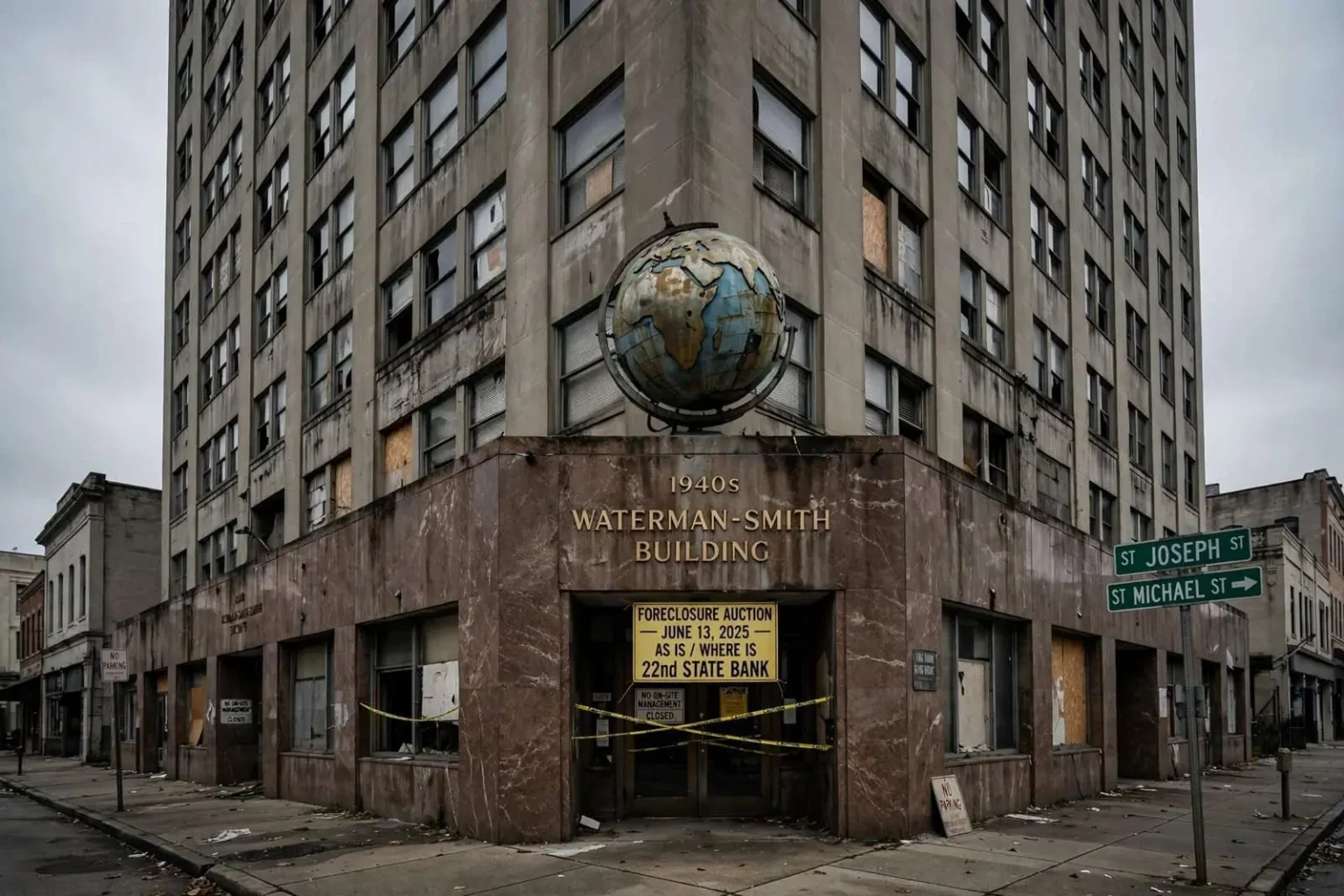
The Waterman-Smith Building, a 16-story downtown Mobile landmark that once symbolized the city’s maritime prosperity, has become a cautionary tale of neglect, broken promises, and financial collapse under the ownership of Darryl Smith, a Hammond, Louisiana, businessman who purchased the property in 2017. What was once a gleaming example of mid-century modern architecture—complete with marble lobbies and a famed rotating globe—has devolved into a nightmare for tenants, who have endured everything from sweltering humidity to an internet monopoly and the complete absence of on-site management.
Mobile has a population of roughly 188,000 residents and is the seat of Mobile County, one of the largest counties in the state by population.
Now, the building is headed for the auction block, the result of a mortgage foreclosure that marks the final chapter of Smith’s disastrous tenure. A Historic Gem Turns into a Management Disaster The building, located at the southwest corner of St.
The Port of Mobile, operated by the Alabama State Port Authority, is one of the largest seaports in the country by tonnage, handling containers, coal, steel and forest products.
Joseph and St. Michael streets, was constructed in 1947 as the headquarters for the Waterman Steamship Corporation, once the largest privately owned shipping company in the world.
Downtown Mobile has been the focus of significant redevelopment in recent years, with new apartments, restaurants and event venues reshaping the Central Business District.
Rising 230 feet, it remains the seventh-tallest building in Mobile. For decades, it was a point of pride, known for its brown marble ground floor and the iconic 12-foot Waterman Globe.
The University of South Alabama, Spring Hill College and the University of Mobile anchor the city’s higher education landscape.
Background and Context
That pride evaporated shortly after Smith, through his company Waterman Smith I, LLC, acquired the building for $2.35 million. Tenants quickly discovered that Smith’s plans to lease “Class A office space” were little more than a fantasy.
Mobile’s Mardi Gras season, the oldest in the United States, draws visitors from across the country and provides a significant boost to the local economy each year.
According to a 2019 archive of the building’s Wikipedia page, “Tenants in the building have since complained of poor maintenance and a complete lack of maintenance personnel, since all operations are performed from Hammond, LA”. That lack of personnel was no accident.
The city’s healthcare sector is anchored by USA Health, Infirmary Health and Springhill Medical Center, which together employ thousands of residents.
Instead of hiring a professional, on-site property management team, Smith adopted a bare-minimum, patchwork approach that left the building in a state of chronic disrepair. Sources familiar with the building’s operations tell Lagniappe that Smith would fly in—or more accurately, drive in—crews from Louisiana once a month to perform maintenance.
Mobile’s manufacturing base includes shipbuilding at Austal USA and Huntington Ingalls Industries, as well as aviation manufacturing at the Airbus final assembly line in Brookley.
These workers, who reportedly did not speak English, would be housed on the building’s fourth floor, sleeping on air mattresses and using a shower located on the mezzanine level. The arrangement, described by one former tenant as “third-world living conditions in a first-world building,” was emblematic of Smith’s disregard for both his employees and his tenants.
Local schools include Mobile County Public Schools, the city’s largest public system, along with a network of private and parochial schools.
Local Reaction
The HVAC systems, many of which were original to the 1947 construction, were unreliable at best. Tenants suffered through “high humidity and irregular temperature swings,” with the building’s mechanical systems at one point appearing “irreparable,” forcing Smith to face the prospect of a “substantial investment” he clearly had no intention of making.
Mobile’s history as a port city means that issues affecting the waterfront often take on outsized importance.
Janitorial Chaos and Broken Promises Darryl Smith of Hammond, LA The neglect extended to the most basic of building services: cleaning. A janitorial company that had been assisting with maintenance was abruptly fired, and the owner claims he was never paid for the work he had performed.
The Mobile area is home to several historic neighborhoods, including Oakleigh Garden District, DeTonti Square and the Village of Spring Hill.
In his place, a new janitorial company emerged, but their work was so poor that tenants demanded the return of the previous company. However, due to the ongoing payment dispute, the original janitorial company refused to service the building, leaving tenants to navigate a filthy, poorly maintained workspace.
Sports are a major part of life in Mobile, with the Senior Bowl each January and a thriving high school and college football scene.
The Telecom Trap: A Deal Turned Betrayal Perhaps the most brazen example of Smith’s business practices involves the building’s internet service. A telecommunications company, eager to expand its footprint, allegedly made a deal with Smith to become the exclusive provider for the building.
Local media outlets covering Mobile include several television stations, daily and weekly newspapers, and a robust digital news ecosystem.
The Bigger Picture
The agreement would have allowed the company to bring fiber optic lines into the building, dramatically improving internet quality for all tenants. As part of the deal, the company moved its own office into the Waterman-Smith Building.
Mobile County’s population includes a significant African-American community whose history is tied to the founding of Africatown.
But according to the owner of the telecommunications company, Smith lied to them. After convincing the company to move in, Smith backed out of the deal.
Mobile’s economy also benefits from a robust tourism sector, with visitors drawn to the Gulf Coast, the city’s historic districts and its annual events.
He then installed locks on various doors, effectively preventing the company—and any other provider—from servicing the other tenants in the building. Smith then struck a deal with AT&T, through which he would receive free internet and a share of the revenue generated from tenant subscriptions.
The Mobile Bay region supports significant commercial and recreational fishing, with seafood harvested from local waters serving restaurants and markets across the South.
In essence, Smith locked out a tenant who had invested in his building, all to line his own pockets with a deal from a corporate giant. Tenants were left with no choice but to accept AT&T’s service, a monopoly that persisted until at least 2019.
Local government in Mobile includes a mayor-council form of government, a structure established by the Zoghby Act in 1985 that replaced the older commission form.
What Comes Next
Financial Collapse and Foreclosure Smith’s mismanagement eventually caught up with him. On June 11, 2025, Waterman Smith I, LLC filed for Chapter 11 bankruptcy protection in the U.S.
Local officials have stressed the importance of community engagement as the situation continues to develop.
Bankruptcy Court for the Eastern District of Louisiana. The company listed assets between $1 million and $10 million, with liabilities estimated between $50,000 and $100,000.
Residents with questions or concerns have been encouraged to reach out to their elected representatives.
The filing, however, was not enough to stave off the inevitable. The mortgage on the property, held by 22nd State Bank and represented by Douglas L.
The story is one of several similar situations playing out across the region in recent months.
Anderson of Burr & Forman LLP, triggered a foreclosure sale. On June 13, 2025, the building was offered for auction on the steps of Government Plaza in Mobile.
Anyone following local news will recognize many of the names and places involved.
The property, which Mobile County tax records appraise at $7.1 million, was sold on an “as is, where is” basis—a stark admission of the building’s deteriorated condition. A Legacy of Neglect Darryl Smith’s ownership of the Waterman-Smith Building will be remembered not for its potential, but for its ruin.
Local civic organizations have begun organizing meetings to discuss the implications.
From housing maintenance workers on air mattresses to locking out a tenant to secure a sweetheart deal with AT&T, Smith treated a historic landmark like a cash cow to be milked dry. His failure to invest in basic maintenance, his decision to run operations from nearly 200 miles away, and his willingness to betray the very tenants he relied upon have left the building—and its reputation—in tatters.
Business owners and residents alike say they will be watching closely.
For the tenants who endured years of humidity, poor cleaning, and an internet monopoly, the foreclosure auction offers a glimmer of hope. But for the city of Mobile, the saga of the Waterman-Smith Building serves as a bitter reminder of what happens when a historic treasure falls into the wrong hands.
The situation underscores how decisions made at the local level can have far-reaching consequences.
Community leaders have called for patience and for a commitment to working through the issues in a transparent manner.
Several local churches and faith groups have offered to host discussions about the topic in the coming weeks.
Public comments at recent meetings have reflected a wide range of opinions.
Local reporters will continue to follow the story and to update readers.
Anyone interested in learning more is encouraged to attend upcoming public meetings.
The outcome of the situation could shape similar discussions in other communities for years to come.
Local historians note that similar issues have surfaced in the past.
Area nonprofits and volunteer groups have stepped up to help residents navigate the changes.
Local businesses have begun adjusting their operations in anticipation of what may come next.
Looking Ahead
The story continues to develop, and residents across the region will be watching for additional updates in the coming weeks. Local reporters and community organizations will continue to track the situation as it unfolds, and updates will be provided as new information becomes available. Anyone with a direct stake in the outcome is encouraged to stay engaged with the public conversation through meetings, news coverage and direct outreach to local officials.