Interview: Caleb Caudle on Country, Americana and Callaghan’s Irish Social Club
An interview with Caleb Caudle on country, Americana and his show at Callaghan's Irish Social Club in Mobile.
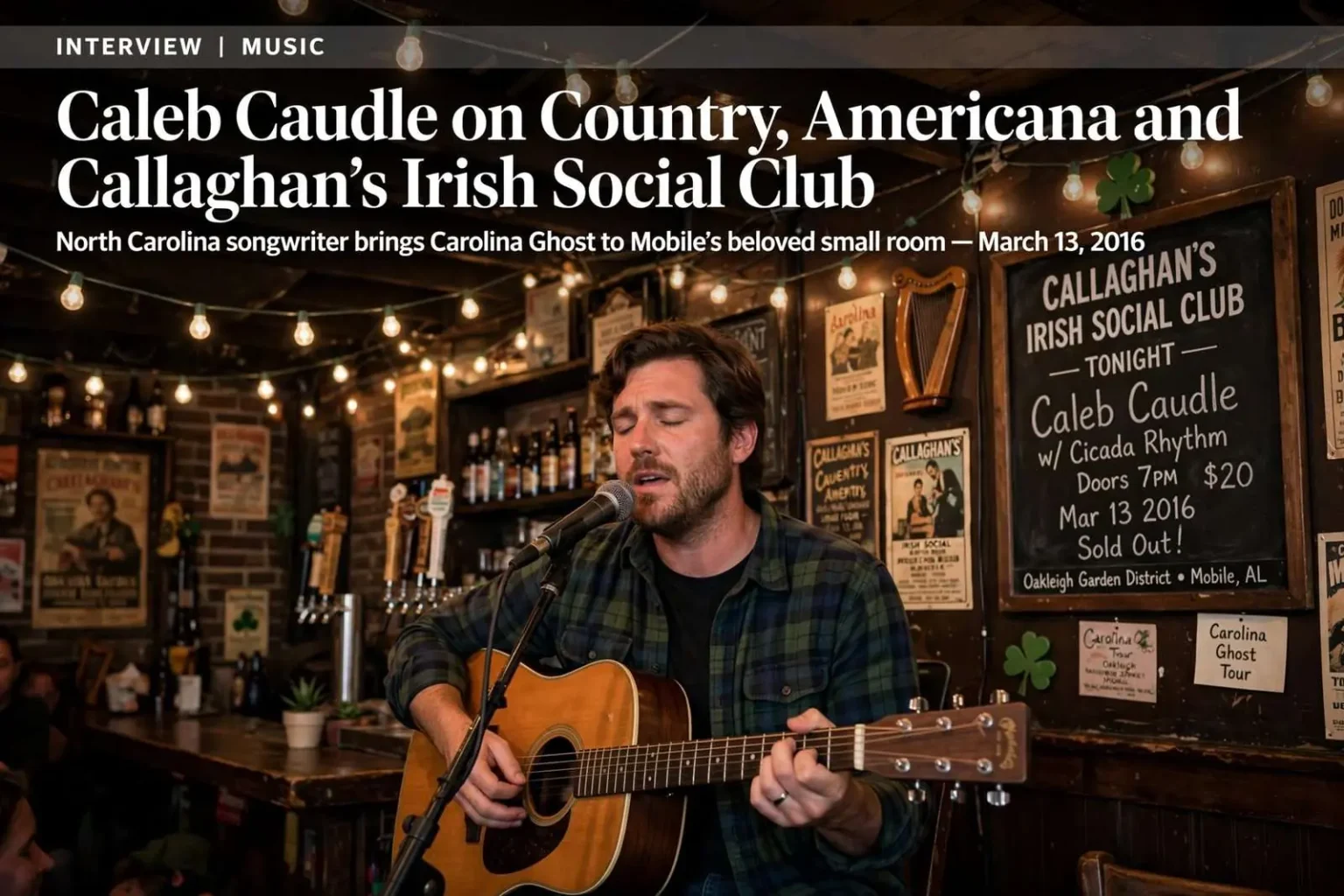
Musician Caleb Caudle draws old-school country influence from greats like Gram Parsons, Merle Haggard and George Strait. Fresh off his album Carolina Ghost, Caudle performed at Callaghan’s Irish Social Club on March 13, 2016, with regional act Cicada Rhythm opening at 7 p.m. and limited $20 tickets.
The stop brought the North Carolina songwriter back through one of the Gulf Coast’s most beloved small rooms. Callaghan’s, tucked into Mobile’s Oakleigh Garden District, has built a national reputation out of proportion to its size, the kind of neighborhood bar where touring singer-songwriters play inches from the audience and the kitchen’s burgers draw almost as much attention as the music. For artists working the independent circuit, a night at Callaghan’s is a fixture of a southeastern tour rather than an afterthought between bigger cities.
Carolina Ghost, the album Caudle carried into the show, continued a run of records that established him as one of the quieter success stories of the Americana underground. The album’s songs trade in the imagery of his home state, distance, memory and the open road, delivered in a voice that owes as much to Parsons’ celestial country as to Haggard’s Bakersfield directness and Strait’s neotraditional restraint.
Why Independent Venues Matter
When touring and building an audience, Caudle said, “It is important to have folks who want to help you build your audience.” Clubs like Callaghan’s take a chance on new acts and help grow the market. For a working songwriter, that help is concrete: a guaranteed room, a stage with good sound, a local promoter who puts the show in front of the right people and staff who treat a Tuesday-night act like a headliner.
“I feel extremely fortunate to have a network of small dedicated venues,” he said. The network Caudle describes spans the Southeast, a chain of listening rooms and bars from the Carolina piedmont through Atlanta, across Alabama and down to the coast, that keeps independent artists on the road without requiring radio play, label money or festival slots. Each venue feeds the next, and the artists who work the circuit year after year build followings one market at a time.
Small rooms also shape how audiences hear new music. In a club the size of Callaghan’s there is no barrier to hide behind: songs land or they do not, and the artist learns immediately which verses move people. That feedback loop is how songwriters sharpen records, and it is why many established acts still schedule club dates long after they could fill larger halls.
Country, Americana and Crossover
Caudle calls himself a country singer but is fine being labeled Americana. The distinction sounds academic until it shapes careers: country radio playlists and the Nashville machinery define one path, while Americana radio, festivals and independent charts define another. Artists like Caudle often live between the two, too traditional for the pop-country mainstream and too contemporary for pure revivalism.
“I have had people tell me that they are not huge country music fans but that they really dig what I do,” he said, hoping to be a gateway for listeners to discover the genre. That gateway role is a real phenomenon on the Americana circuit, where audiences who came of age on rock and indie music find their way back to country through songwriters whose lyrics lead the way rather than the production.
The influences Caudle names map neatly onto that middle territory. Gram Parsons invented the idea of “cosmic American music,” blending country sincerity with rock-and-roll scope. Merle Haggard wrote plainspoken story songs that became the blueprint for three generations of country writers. George Strait proved that traditional arrangements could dominate for decades without ever chasing trends. A songwriter who absorbs all three arrives at a sound that honors the form while speaking plainly to modern audiences.
The Mindset Behind the Music
A line from Glossary’s “Blood On The Knobs” guides his approach: “walk on that stage and play it like it’s the last time, ’cause it might be.” The sentiment sounds dramatic, but for a touring songwriter it is practical wisdom. Independent artists play hundreds of rooms where nothing is guaranteed, no contract protects the next booking and the only thing within their control is the quality of the performance in front of them.
That philosophy has a particular weight in rooms like Callaghan’s, where the distance between performer and audience collapses. A artist playing to a packed club at capacity cannot coast on volume or production; every lyric is delivered face to face. Veterans of the circuit say those rooms are where they do their best work, precisely because nothing separates the song from the listener.
On Getting Noticed
He does not think being a Southern musician is harder than anywhere else. “You really just gotta have great songs. All the other stuff falls into place with enough hard work and dedication,” Caudle said. It is a deliberately unfashionable answer in an era of streaming algorithms and social media strategy, but it reflects how the independent folk and country world actually operates.
Great songs, in this economy, are the durable asset. They get covered by other artists, they survive lineup changes and label shifts, and they keep earning long after a tour ends. The songwriters who last, from Haggard to the present circuit, are the ones who treat writing as a daily discipline rather than a lightning strike.
Hard work, in Caudle’s version of the business, means relentless touring, one market at a time. A spring date at Callaghan’s with Cicada Rhythm opening is one night in that arithmetic, but the cumulative effect is what turns a regional act into a national one. Cicada Rhythm, the Georgia-based duo opening the show, occupies a similar spot on the circuit, building an audience through the same accumulation of small rooms and loyal crowds.
The Show
The March 13, 2016, date followed the pattern that has made Callaghan’s a destination for songwriters: an early 7 p.m. start, a $20 ticket limited by the size of the room and a pairing of a national touring act with a regional opener worth arriving early for. Shows of this kind regularly sell out, another reason the venue remains on the map for artists routing tours between New Orleans, Atlanta and the Florida panhandle.
For Mobile audiences, the night offered a chance to hear Carolina Ghost material in the setting where it works best, up close, loud enough to feel and quiet enough to hear every word. For Caudle, it was another stop in the long work of building an audience the old way: great songs, played like they might be the last time.
Carolina Ghost and the Road Behind It
Carolina Ghost arrived as a milestone in a career built steadily rather than suddenly. Caudle began releasing records as a teenager in North Carolina, fronting bands before striking out as a solo songwriter, and each release broadened the geography of his audience. By the time of the Mobile show, his records were reaching listeners far beyond the Southeast through Americana radio and the word-of-mouth economy of touring songwriters.
The album’s title reflects the pull that home state exerts on his writing. Songs rooted in specific places, Carolina roads, small towns, family history, resonate with listeners everywhere precisely because they are not generic. That specificity is a hallmark of the writers Caudle admires, from Haggard’s California farmworker towns to Parsons’ undefined somewhere out west, and it is what separates songwriters who endure from those who chase whatever sound is currently selling.
Touring behind a record like Carolina Ghost through venues like Callaghan’s completes the circle the album began. A record collects a fan base in cities the artist may never have visited; the tour converts those listeners into ticket buyers; the shows feed the next record. It is a slow engine, but for independent artists it has proven more durable than any shortcut.
Callaghan’s and Mobile’s Music Culture
Callaghan’s Irish Social Club occupies a specific place in Mobile’s cultural landscape. Opened as a neighborhood bar in the Oakleigh Garden District, it evolved into one of the Southeast’s respected small venues by programming national touring songwriters alongside local acts, pairing the music with a kitchen that earned its own following. The room’s reputation now draws artists who could play larger venues, because the audience that fills it listens.
Venues like it anchor the regional circuit that makes a touring life possible in the Southeast. Between New Orleans, Birmingham, Atlanta, Nashville and the coast, a working songwriter can route a two-week tour entirely through rooms of a few hundred capacity or less, each with owners who know their audience and bookers who take chances on new names. That infrastructure is invisible to the mainstream industry but essential to it, since nearly every act that graduates to bigger halls was built somewhere like this first.
The $20 ticket price reflects the economics of such rooms. With limited capacity, no ticketing giants and a bar supporting the bottom line, venues like Callaghan’s can keep shows affordable while paying artists fairly. The model has been replicated across the country, but the Southeast’s density of quality small rooms is a genuine competitive advantage for the region’s music scene.
For the audience, nights like this one are the reason local music culture matters. A chance to hear a songwriter of Caudle’s caliber within arm’s reach, with an opener like Cicada Rhythm on the way up, is the kind of experience that keeps listeners coming back to independent venues long after the big tours have left town. On March 13, 2016, Mobile got one of those nights, and the songsmith from North Carolina got another roomful of people learning his songs for the first time.