Interview: Jamell Richardson, the ‘Gulf Coast Blues Boy,’ Returns to Soul Kitchen
The 'Gulf Coast Blues Boy' Jamell Richardson discusses winning Reach for the Beach and his Soul Kitchen show in this Mobile interview.
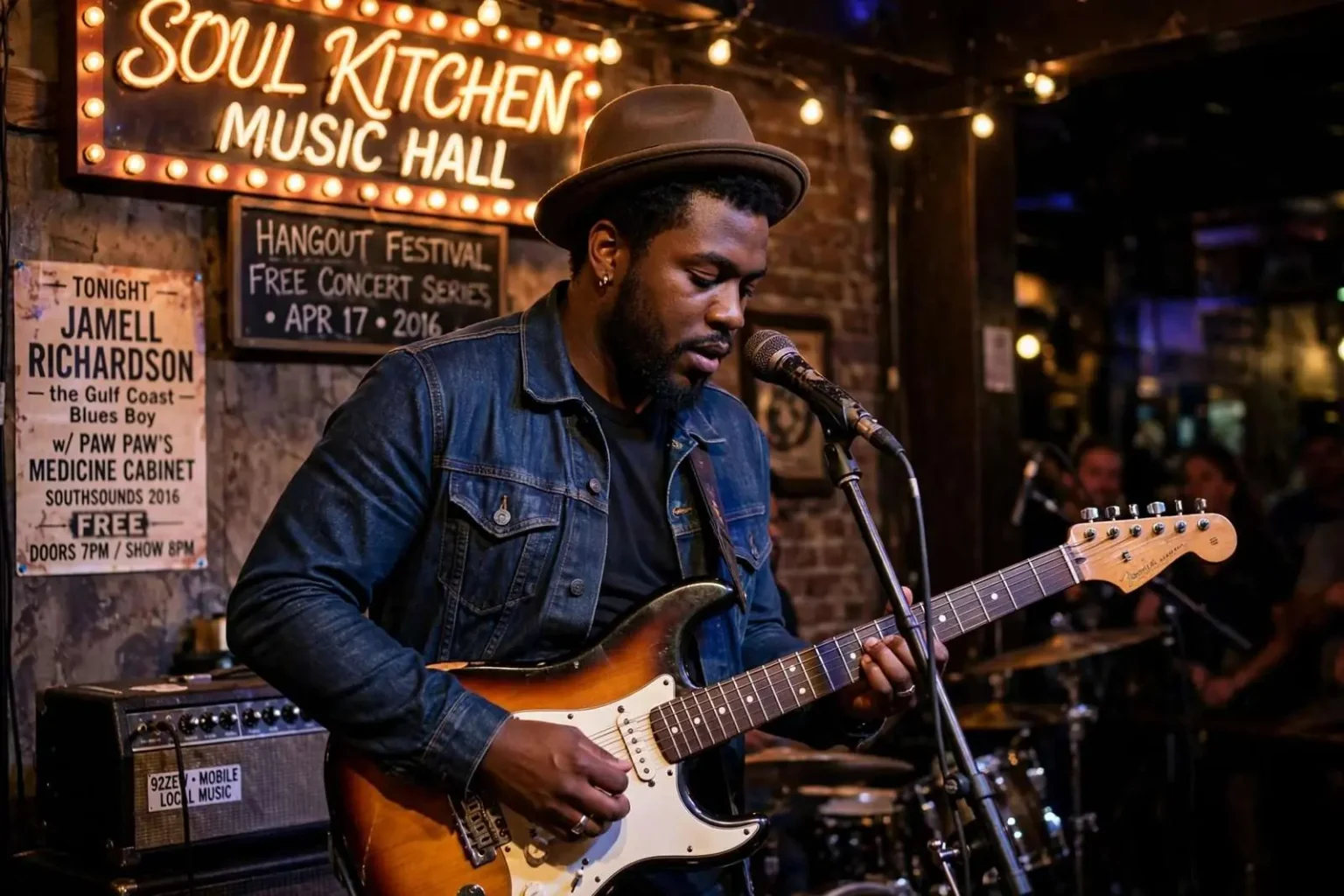
SouthSounds 2016 artist Jamell Richardson, known as the “Gulf Coast Blues Boy,” performed downtown Mobile again on Sunday, April 17, 2016, at the Hangout Festival Free Concert Series at Soul Kitchen Music Hall. For Richardson, the date was a return on two fronts: a homecoming to the city that had already booked him once this year, and another rung on a ladder he had climbed fast — from regional blues circuit to festival stages in barely a season.
Those who missed him during SouthSounds got a second chance, with fellow SouthSounds act Paw Paw’s Medicine Cabinet also on the bill. The pairing gave the Sunday audience a double helping of the Gulf Coast’s emerging talent, in the venue that has become Mobile’s stage for exactly this kind of booking — acts with momentum, playing rooms small enough for the audience to feel it.
A Contest That Changed Everything
Richardson won the Hangout Festival’s Reach for the Beach contest in 2015, and new bands competed for the honor again in 2016. The competition — which sends an up-and-coming act onto the bill of one of the country’s most popular beach festivals — has become a fixture of the Gulf Coast music calendar, and Richardson’s 2015 victory made him the contest’s most recent proof that it can alter a career’s trajectory overnight.
“Winning Reach For The Beach has done more for my career than anyone could imagine,” he said, praising 92ZEW and The Hangout for treating every contestant fairly. The endorsement carried weight coming from a working bluesman: radio stations and festival operators field hundreds of submissions from bands hoping for a break, and Richardson’s point was that the contest’s organizers ran it straight — that the act with the best show, not the best connections, got the slot.
The Hangout Festival itself deserves its reputation in that story. Staged on the white sand of Gulf Shores each May, the event has grown into one of the Southeast’s flagship music festivals, drawing tens of thousands of fans and a national lineup to a stretch of coast better known for vacation rentals than guitar heroes. For a Gulf Coast artist, a slot on that bill means performing where the region’s music community — and a national audience — is watching at the same time.
92ZEW’s role in the contest matters too. The Mobile independent station has spent decades championing local and regional acts on its airwaves, and its involvement gives Reach for the Beach both its platform and its credibility. Richardson’s public thanks reflected the symbiosis: a station that needs local music to stay vital, and a musician whose break came through the station’s machinery.
Playing in the Rain
He remembered playing in the rain to a handful of people the prior year and deciding then to play for himself. The memory is the kind every working musician carries — the gig where the audience doesn’t show, the weather doesn’t cooperate, and the only reason to keep playing is the music itself. Richardson’s account of that night framed it as a turning point rather than a low point: the moment he stopped performing for approval and started performing for the work.
That reset, in his telling, preceded the contest win that changed his trajectory. The lesson embedded in the sequence is one the Gulf Coast blues community has always known: the circuit between Pensacola, Mobile and New Orleans doesn’t hand out shortcuts, and the artists who last are the ones who can play as hard for six people in a downpour as for a festival field.
The Gulf Coast Blues Tradition
Richardson’s nickname — the “Gulf Coast Blues Boy” — places him deliberately in a lineage. The central Gulf Coast has its own blues identity, distinct from the Delta and the Piedmont: a tradition shaped by the port cities, the juke joints of rural Mississippi and Alabama, and the beachside bars where blues, soul and Gulf Coast “swamp” R&B have mingled for generations. Artists who work this circuit learn early to play across those styles, because a Saturday night crowd in Mobile will ask for them all.
The region’s blues infrastructure, while less celebrated than Memphis’s or Chicago’s, is real and active. Rooms from Biloxi to Pensacola book blues acts weekly, festivals across South Alabama and the Mississippi Gulf Coast program them, and radio along the corridor still gives the genre airtime. Richardson’s rise through that infrastructure — culminating in a Hangout Festival slot and SouthSounds billing — followed the classic path: rooms, then radio, then festivals.
Blues also carries the region’s history in a way few genres do. The music that grew up around the Gulf Coast’s ports and mill towns carries the cadence of the people who built them, and contemporary artists like Richardson inherit both the repertoire and the responsibility of keeping it alive for new audiences. A Sunday evening set at Soul Kitchen, in front of a crowd that spans generations, is part of that transmission.
SouthSounds and the Spring Calendar
Richardson’s inclusion among the SouthSounds 2016 artists placed him in Mobile’s most important showcase for emerging acts. The festival, staged across downtown venues each spring, exists precisely to surface artists from the Gulf Coast and beyond at the moment they’re ready for bigger rooms — and its alumni network has become a who’s-who of the region’s independent scene.
The April 17 date fell in the thick of that season. With SouthSounds artists rotating through town and the Hangout Festival’s own machinery ramping up toward its May dates in Gulf Shores, Mobile in April becomes a proving ground: acts that connect with local audiences in the spring carry that momentum to the beach the following month. Richardson’s Sunday set sat exactly at that junction.
The free concert series format extended the reach. By putting festival-caliber acts on a downtown stage without a ticket, the series converts casual passersby into fans — an audience-building tool that benefits the artists as much as the crowds. For a bluesman whose reputation rests on live performance, a free show with a potentially large walk-up audience is not a charity gig; it is the most efficient marketing available.
Two Acts, One Bill
With Paw Paw’s Medicine Cabinet also on the bill, the Sunday show doubled as a survey of the region’s rising talent. The fellow SouthSounds act brought its own following, and the pairing of a bluesman with a band of a different stripe is standard Gulf Coast bill-making: book acts that share an audience’s curiosity rather than its genre loyalties, and both leave with new fans.
For Richardson, sharing the stage with another SouthSounds artist reinforced the network effect the festival aims to build. Emerging acts that tour and bill together — cross-referencing each other’s audiences, sharing gear, splitting drives — survive the circuit’s economics far better than acts that treat every gig as a solo mission. The April 17 show was a working example of that cooperation.
Advice for Up-and-Comers
For aspiring bands and local musicians, Richardson offered simple guidance: “Do not worry about the crowd, just go and do the best that you can do. Dress well, sound good, be professional on and off stage and most of all enjoy the experience.”
Broken down, the advice is a career manual in four lines. “Do not worry about the crowd” echoes the lesson of his rain-soaked gig — play for the work, not the headcount. “Dress well, sound good” is the Gulf Coast working musician’s code: the region’s audiences, raised on show bands and juke-joint bluesmen alike, respect an act that arrives looking like the gig matters. “Be professional on and off stage” is the part most young bands skip — showing up on time, treating promoters and sound engineers as partners, and understanding that a reputation travels faster than a set list.
“And most of all enjoy the experience” sounds like the softest of the four, but it may be the most practical. Regional music careers burn out on resentment — the small crowds, the unpaid doors, the clubs that close. Artists who can still enjoy the experience after the rain-gig nights are the ones still standing when a contest win or festival slot finally arrives, as it did for Richardson in 2015.
The Reach for the Beach Model
The 2016 edition of the contest, with new bands competing for the same slot Richardson won a year earlier, showed the machinery working as designed. Contest formats sometimes draw cynicism — the suspicion that winners are pre-selected or that the prize means little — which is why Richardson’s explicit praise for fair treatment matters. His testimony, from the contest’s most recent champion, functions as the program’s best advertisement: the prize is real, and it does what it claims.
Reach for the Beach also fills a genuine gap in the regional scene. Gulf Coast bands have always had venues, but the distance between the club circuit and a major festival stage is enormous, and few mechanisms cross it. A contest that hands that bridge to one act a year — selected on merit, promoted on radio — gives the whole scene a visible ladder, and every entrant knows the ladder reaches somewhere.
Richardson’s own arc validated the model within a single year: contest win in 2015, festival stage, then a spring 2016 that included SouthSounds billing in Mobile and a return engagement at Soul Kitchen. That is a faster ascent than most regional acts manage in a decade, and it was built on the combination he described — the break, and the work ethic to make the break count.
Return to Soul Kitchen
The venue itself completed the circle. Soul Kitchen Music Hall, in the heart of downtown Mobile’s entertainment district, has become the city’s default stage for national touring acts and regional risers alike, and its free-concert-series dates serve as a bridge between the club’s ticketed shows and the street-level audience Dauphin Street delivers on weekend nights. A Sunday slot keeps the room busy without competing with its headline bookings, and gives local fans a no-cover chance to see acts they’d otherwise pay to catch.
For Richardson, the return engagement said something about how Mobile had received him. Venues rebook artists they trust to draw and deliver, and a second downtown date within the same spring — bookended by festival appearances on either side of his calendar — marked him as an artist the city’s bookers wanted attached to their spring season.
The April 17, 2016 date, with Paw Paw’s Medicine Cabinet sharing the bill, thus closed a loop that opened with a contest victory on the beach: the Gulf Coast Blues Boy, back in the room, with a festival slot behind him, a season of SouthSounds momentum around him, and a set of advice for the next act still playing to six people in the rain.
What Comes After the Break
The honest question hanging over any contest-win story is what happens next — whether the festival slot becomes a platform or a peak. Richardson’s trajectory through 2016 offered the encouraging version: rather than coasting on the Hangout appearance, he kept working the regional circuit, accepted showcase slots like SouthSounds, and treated free shows in rooms like Soul Kitchen as part of the job. The artists who convert a break into a career are the ones who never stop playing the small rooms, and his spring schedule showed exactly that discipline.
The Sunday, April 17, 2016 show — the Gulf Coast Blues Boy at Soul Kitchen Music Hall, free to anyone walking Dauphin Street, with Paw Paw’s Medicine Cabinet opening — was, in that light, more than a gig. It was the region’s music economy working as intended: a contest that kept its word, a festival that opened its stage, a station that kept its airwaves open, and an artist who remembered the rain and played every date like it mattered. His advice to the acts still climbing read as the distilled version of everything that got him to that Sunday, and in spring 2016, Jamell Richardson was the Gulf Coast’s most recent working proof of the formula.