Interview: Mobile’s Black Titan and Touring Act King Buffalo at the Blind Mule
Two underground rock acts converged at the Blind Mule Restaurant and Bar's Attic stage on June 21 at 9 p.m.: Mobile's own Black Titan and Rochester, New.
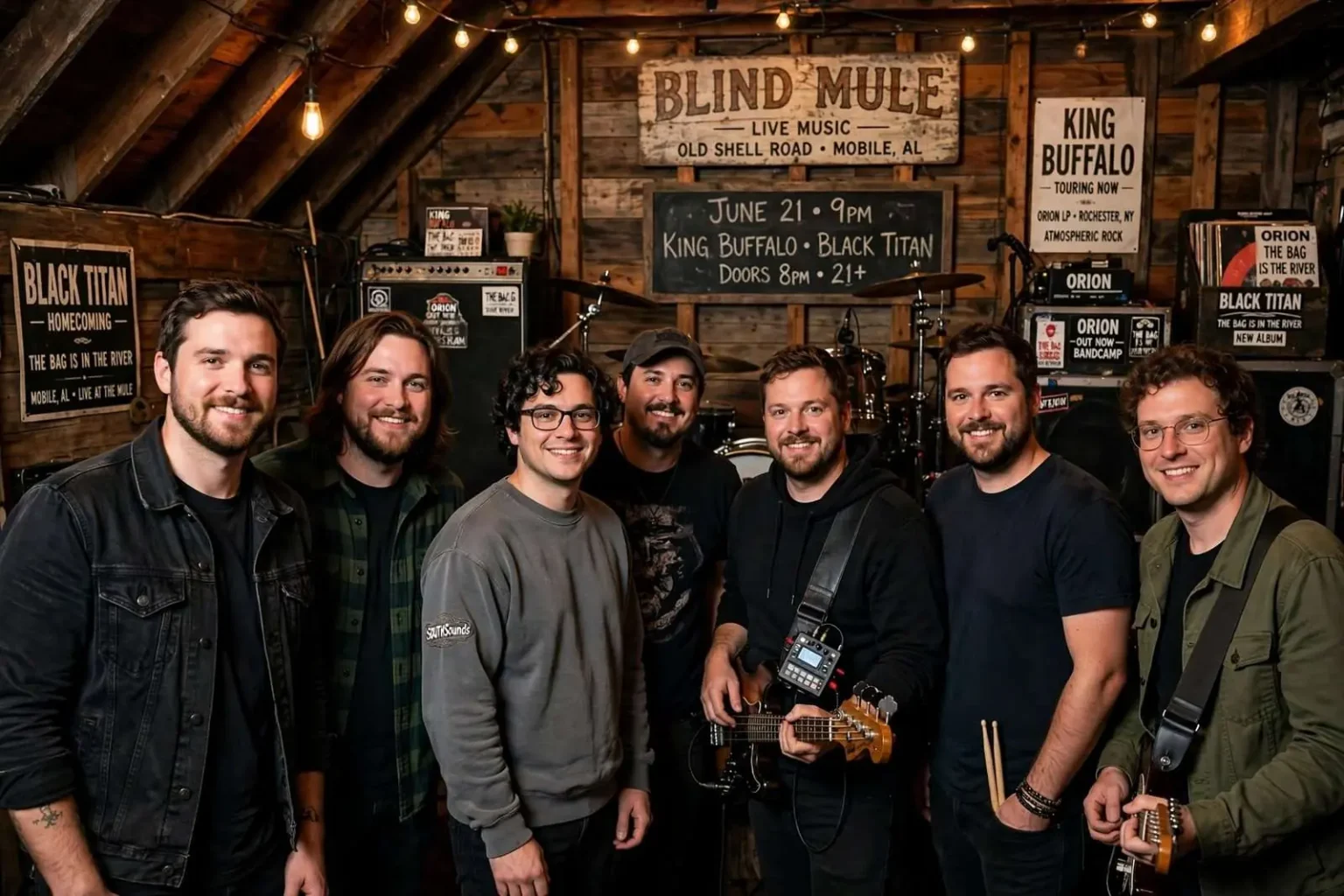
Two underground rock acts converged at the Blind Mule Restaurant and Bar’s Attic stage on June 21 at 9 p.m.: Mobile’s own Black Titan and Rochester, New York’s King Buffalo. Both bands sat for interviews ahead of the show, and the conversations revealed two groups at different points on the same road, one sharpening new material at home, the other carrying it across the country night after night.
The Blind Mule has long occupied a particular place in Mobile’s music landscape. The restaurant and bar on Old Shell Road draws dinner crowds in its downstairs dining room while the Attic above it hosts the heavier, louder side of the city’s calendar, making it one of the few venues where a listener can eat a full meal and still catch a national touring act before last call. For bands routing between New Orleans and the Florida Panhandle, the Mule’s stage has become a reliable stop, and for local acts it functions as both home field and proving ground.
King Buffalo’s atmospheric rock
King Buffalo, featuring Dan Reynolds on bass and lights, Scott Donaldson on drums and vocals, and Sean McVay on guitar and lead vocals, was touring behind its full-length “Orion,” available on Bandcamp. The trio described its music as guitar-forward songs woven with atmospheric soundscapes, a sound that has earned the band a following well beyond its western New York base.
The band’s configuration is unusual and telling: Reynolds handles the light show from the stage while playing bass, making the visual side of the performance inseparable from the music. For a trio working without a dedicated lighting operator, that integration lets the band deliver a full-scale production in rooms the size of the Attic. It is an approach built for exactly the kind of club circuit the band was traveling, where atmosphere and volume do the work that big budgets do for larger acts.
Touring behind an independent release through clubs and small rooms is the traditional path for bands at King Buffalo’s level, and Bandcamp remains a lifeline for that model, letting listeners buy directly from artists without a label in between. The trio’s decision to keep its catalog there reflects a wider practice among underground rock bands, for whom direct sales on the road and online often sustain the next leg of touring more than streaming ever could.
The members said independent venues are “immensely” important, calling them the reason bands like theirs can tour at all. The observation doubles as a description of the economics of underground rock: without rooms like the Attic, a three-piece from Rochester would have nowhere to play between major markets, and the circuit of small stages, back bars and upstairs rooms that keeps touring acts moving would collapse. King Buffalo’s route through Mobile put that network into practice, one small stage at a time.
Rochester sits far from the Gulf Coast, and a tour that reaches Mobile represents a serious commitment of time and money for an independent band. Fuel, lodging and merchandise inventory all come off the top before anyone is paid, and bands manage that math night by night. Playing a market like Mobile, where the Mule has built a listening audience over years, is part of how touring acts convert unfamiliar cities into regular stops, and return visits depend on how the first one lands.
Black Titan’s homecoming
Black Titan, made up of Clayton H. Bates, Jimmy Lee, Allin Kilpatrick, and Ian D. Taylor, had become a SouthSounds fixture, debuting across multiple stages in 2015 and headlining the Blind Mule in 2016. That trajectory, from festival newcomer to headliner in a single year, marked the band as one of the fastest-rising acts in Mobile’s rock scene.
Bates said fans were responding strongly to the new album “The Bag Is In The River,” and credited the Mule, where he has worked since the band formed, and owner Ed Walker as central to the group’s growth. The connection between a working musician and the room that employs him is a Mobile story as much as a music-industry one: barbacks and sound engineers who play in bands are a fixture of the local scene, and the relationships built on shift work translate directly into stage time and opening slots.
The homecoming framing was more than convenience. Playing new material for a hometown audience that has watched a band develop gives players immediate, honest feedback, and the Attic’s size means the reaction is unfiltered. For Black Titan, a night at the Mule served as both celebration and tuning session, a chance to tighten songs that would carry the band into future bookings, surrounded by the crowd that had followed it from the first SouthSounds stage appearances.
SouthSounds itself deserves mention as the engine behind that rise. The festival, built around showcasing emerging artists across downtown Mobile venues, has functioned as a launchpad for regional bands since its founding, giving acts a concentrated audience of fans, bookers and fellow musicians over a single weekend. A band that performs well across multiple stages during the festival, as Black Titan did in 2015, walks away with the kind of visibility that local scenes rarely offer otherwise.
The pairing of the two bands made musical sense as well. King Buffalo’s atmospheric, riff-driven rock and Black Titan’s heavier local sound share enough common ground to draw one crowd, while giving listeners a contrast in approach: a touring trio that has refined its production on the road, and a hometown band pushing its new record in the room that helped build it. Double bills of that kind are a staple of club-level booking, where complementary lineups fill rooms that a single act alone might not.
For Mobile listeners, the show offered a chance to see a beloved local act tighten new material alongside a respected touring band, all in a room small enough that the music lands directly. It also illustrated the layered health of the city’s scene: a festival that develops acts, a venue that employs and stages them, and a touring circuit that brings national-caliber underground bands through town on a weeknight in June.
Nights like this one tend to pass without much fanfare, then matter in retrospect. The bands that fill festival lineups five years from now are on stages like the Attic this summer, playing to the crowds that show up on a Friday or a Tuesday. Mobile’s scene has learned that lesson through SouthSounds and rooms like the Blind Mule, and the June 21 double bill was the latest working example of how a local scene grows: one homecoming, one road band, and one full room underneath them both.
Album releases anchor everything else a touring band does. A record like “Orion” gives a band a reason to book a route, a product to sell at the merch table and a set of new songs to build sets around, and the months after a release are when bands work hardest on the road. The same is true locally for Black Titan and “The Bag Is In The River,” with the homecoming show serving as the album’s proper Mobile introduction. In both cases the recording functions less as a destination than as fuel for the live shows where underground bands actually earn their living.
The Attic’s role in that economy is easy to underestimate. Rooms that size pay touring acts modest guarantees but offer something scarce: an attentive audience in a city between larger markets, and a sound engineer who knows the stage. Sound quality can make or break a trio built on texture and volume, and bands remember rooms where the mix allowed their music to be heard as designed. Word travels among touring musicians about which venues are worth the drive, and reputations like the Mule’s are built over years of consistent shows.
The Mule’s owner has been part of that consistency. Walker’s support for local music, as Bates acknowledged, extends beyond booking to the kind of day-to-day accommodation that keeps bands functioning, from rehearsal logistics to employees who play in bands and need schedule flexibility around tours. Independent venue owners up and down the Gulf Coast play a similar role, absorbing the risks of slow weeknights so that the scene has stages available when they are needed.
Local scenes survive on that reciprocity. A band that gets its start on a hometown stage eventually brings touring partners back to that stage, drawing new listeners who discover the local opener on the way to the headliner. Each show builds the audience pool that every act in town shares, which is why scenes with healthy venues tend to produce more working bands than cities with bigger populations but weaker club infrastructure.
The June 21 show closed with both bands’ futures open: King Buffalo continuing its tour beyond the Gulf Coast, and Black Titan carrying its new album into the rest of the summer’s bookings. For the crowd at the Attic, the night was a reminder that the underground circuit runs straight through Mobile, and that supporting it, at the door and at the merch table, is what keeps it coming back.