IRS Grants Tax Filing Extension to Hurricane Sally Victims in Alabama
The IRS extended tax filing and payment deadlines to Jan. 15, 2021, for Hurricane Sally victims in Baldwin, Escambia and Mobile counties in Alabama.
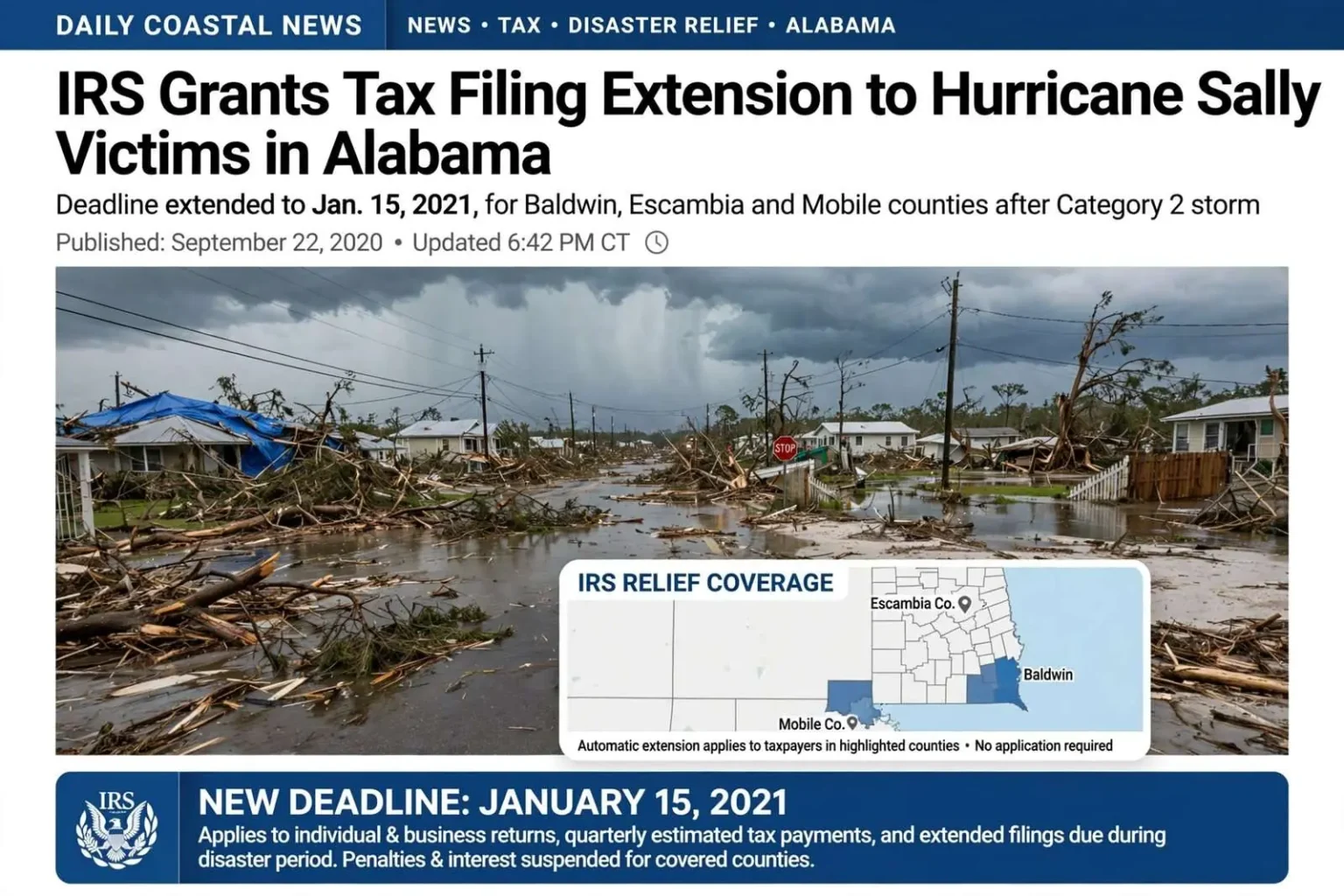
The Internal Revenue Service has extended the deadline to file and pay individual and business tax returns until Jan. 15, 2021, for Alabama residents and businesses affected by Hurricane Sally. The relief applies to taxpayers in Baldwin, Escambia and Mobile counties, according to the IRS, covering the Alabama counties the federal disaster declaration captured after the Category 2 hurricane came ashore near Gulf Shores on Sept. 16, 2020. The postponement applies both to returns that were due during the disaster window and to payments that would otherwise have accrued penalties and interest during that period.
The extension covers the full range of returns individuals and businesses commonly file in the late-summer and fall window, including quarterly estimated tax payments and extended business filings. Under IRS disaster relief practice, taxpayers in a designated disaster area receive the postponement automatically, without needing to apply for it or call the agency to request special treatment. That automatic design matters in the weeks after a hurricane, when residents are dealing with power outages, insurance claims and property repairs and may have no capacity to navigate an application process.
The IRS also noted that localities added to the federal disaster area later will automatically receive the same filing and payment relief. Disaster declarations frequently expand after the initial assessment, as damage surveys document losses in additional jurisdictions, and the agency’s procedure ensures that taxpayers in newly added areas do not lose relief time while the paperwork catches up to reality on the ground.
How the disaster declaration reached Alabama’s coastal counties
Hurricane Sally made landfall in the early hours of Sept. 16, 2020, near Gulf Shores, moving slowly enough to drop extreme rainfall across the central Gulf Coast and push a damaging storm surge through coastal communities. Baldwin County took the brunt of the initial landfall, with communities from Gulf Shores and Orange Beach to Foley, Fairhope and Bay Minette reporting downed trees, damaged roofs, flooded streets and weeks of power outages. Mobile and Escambia counties saw widespread wind damage and flooding as the storm’s slow track sprawled its impacts across the region.
The federal disaster declaration that followed opened the door to assistance from the Federal Emergency Management Agency for affected residents and, critically for taxpayers, triggered the IRS’s authority to postpone filing and payment deadlines. Baldwin, Escambia and Mobile counties were identified as the covered jurisdictions for the tax relief, aligning the IRS benefit with the disaster-assistance geography. Taxpayers in those counties did not need to demonstrate individual storm damage to claim the extension; residence or business location in a covered county was sufficient.
For businesses in coastal Alabama, the postponement covered filings that were imminent when the storm struck. The fall quarter is a busy stretch for tax deadlines, and a hurricane that shut down offices, destroyed records and knocked out internet service across two counties created exactly the circumstances the relief was designed to address.
What the Jan. 15, 2021 deadline means for taxpayers
The practical effect of the extension is that any individual or business return originally due during the postponement period, and any payment attached to those returns, is not due until Jan. 15, 2021, for taxpayers in the covered counties. Filers who had already requested extensions for their 2019 returns received the postponement as well, pushing those deadlines back alongside the storm-affected obligations. Interest and late-payment penalties that would otherwise accrue during the postponement window are suspended for covered taxpayers.
The relief applies broadly rather than selectively. Individuals who pay quarterly estimated taxes, partnerships and S corporations on extended fall deadlines, and businesses filing employment or excise returns during the window all fall under the same postponement. The IRS structures hurricane relief this way to avoid forcing storm-affected taxpayers to sort out which of their obligations qualify; the calendar itself defines the coverage.
Taxpayers should be aware that the postponement covers filing and payment deadlines, not every tax obligation. Trusts and estates with specific due dates, payroll deposits on their own schedule and other narrowly defined obligations can carry different treatment, and taxpayers with unusual filing calendars benefit from confirming their specific deadlines. For the overwhelming majority of individual filers and small businesses in Baldwin, Escambia and Mobile counties, however, the operative date became Jan. 15, 2021.
Handling a penalty notice that arrives anyway
The IRS advised that affected taxpayers who receive a late-filing or late-payment penalty notice with an original or extended due date that falls within the postponement period should call the number on the notice to have the penalty abated. Mismatched notices are a common byproduct of large-scale disaster relief: the agency’s automated systems issue reminders and penalty notices on their regular schedule, and a notice can arrive before the taxpayer’s account reflects the disaster postponement.
The remedy in those cases is straightforward and does not require the taxpayer to argue the merits. Calling the number printed on the notice, identifying the address as being in a designated disaster county and citing the Hurricane Sally postponement is generally enough for the agency’s representatives to abate the penalty. Taxpayers should keep the notice in hand when they call, along with documentation of their county of residence or business location if the address on file differs from the covered county.
Relief of this kind also interacts with insurance and FEMA claims in ways taxpayers should track. Disaster-related losses can carry their own tax treatment, and records assembled for insurance claims — receipts, repair estimates, photographs of damage — often serve double duty when tax questions about casualty losses arise. Coastal Alabama taxpayers navigating the aftermath of Sally were advised to keep those files organized through the extended filing season.
A familiar pattern of Gulf Coast relief
The Sally extension followed a pattern the central Gulf Coast knows well. Hurricanes Ivan, Katrina, Dennis and Zeta all produced IRS deadline postponements for Alabama or Florida panhandle counties in their turns, and the mechanics have stayed consistent: a federal disaster declaration, a list of covered counties, an automatic postponement to a stated date and a phone-based abatement process for stray penalty notices. Residents and tax professionals along the coast have learned to calendar those dates carefully, because obligations postponed but not forgotten still arrive.
For Baldwin, Escambia and Mobile county taxpayers in the fall of 2020, the extension to Jan. 15, 2021, bought roughly four additional months for the returns and payments caught in the storm’s path. The IRS noted the automatic relief for localities added to the disaster area later and directed taxpayers who received penalty notices within the postponement period to call the number on the notice for abatement, completing the practical outline of the relief package.
Preparing records in a storm’s aftermath
Taxpayers working through the extended deadline had practical reasons to use the extra months deliberately rather than simply delaying. Storm recovery generates paperwork at every turn: insurance settlement letters, contractor invoices, FEMA correspondence, receipts for temporary lodging and generator purchases. Much of that documentation feeds into decisions about casualty-loss treatment and disaster-related deductions, and taxpayers who assembled it methodically during the postponement window entered the tax season with claims their preparers could substantiate. The IRS has long advised disaster victims to photograph damage before cleanup begins where possible and to retain every receipt tied to repair and recovery, since the same file that supports an insurance claim supports the tax return built afterward.
Businesses in the covered counties faced additional record-keeping challenges. Storm damage to inventory, equipment and premises can produce losses that appear on business returns, and damaged or destroyed records complicate the process of reconstructing figures. The IRS offers reconstruction guidance for taxpayers whose books were lost, allowing reasonable estimates supported by available documentation. For the many small businesses along the Highway 98 and Highway 90 corridors that spent October and November rebuilding, the postponement to Jan. 15, 2021, provided time to rebuild the records as well as the storefronts.
Tax preparers across Baldwin, Escambia and Mobile counties absorbed a compressed schedule as a result of the extension. Returns that would normally have been finished by their original October deadlines moved into December and January, stacking on top of the regular season that begins at the end of January. Preparers advised clients not to wait for the final date, noting that storm-affected returns took longer to assemble precisely because of the documentation they carried.
Who qualified and how the coverage was determined
Qualification for the postponement turned on geography rather than individual circumstances. A taxpayer whose primary residence, principal place of business or, in some cases, tax preparer or records location sat within Baldwin, Escambia or Mobile county fell within the relief automatically. The IRS ties disaster postponements to the counties listed in the FEMA disaster declaration, which is why the agency emphasized that localities added to the federal disaster area later would automatically receive the same filing and payment relief. Residents of Washington, Clarke, Monroe and Conecuh counties, which saw outages and damage from Sally’s broad footprint but were not part of the covered declaration for tax purposes at the time of the announcement, did not receive the postponement unless their localities were added.
That county-line structure occasionally creates hard cases along the edges of a disaster footprint, and the IRS addresses them through its disaster relief hotline and through abatement requests. A taxpayer outside the covered counties who suffered documented storm losses could still seek case-by-case relief, though the automatic postponement was reserved for the designated area. Taxpayers with questions about whether their address qualified were directed to the IRS’s disaster relief page, which lists current covered jurisdictions by disaster and by date.
The Sally relief also coordinated with other deadlines moving through the fall of 2020. The pandemic had already shifted the ordinary tax calendar that year, extending the usual April season to July, and the hurricane postponement layered a further adjustment onto a year in which Alabama’s coastal taxpayers dealt with successive disruptions. The Jan. 15, 2021, date the IRS set brought the storm-affected returns close enough to the regular season that preparers could fold them into early-season filing, completing the recovery of the tax calendar alongside the physical recovery of the coast.