It’s Time for Mobile to Honor Its Own Jimmy Buffett
Mobile native Jimmy Buffett has never been formally honored in his hometown. Advocates are pushing for a statue, a renamed Causeway, or a Mobile Music Hall.
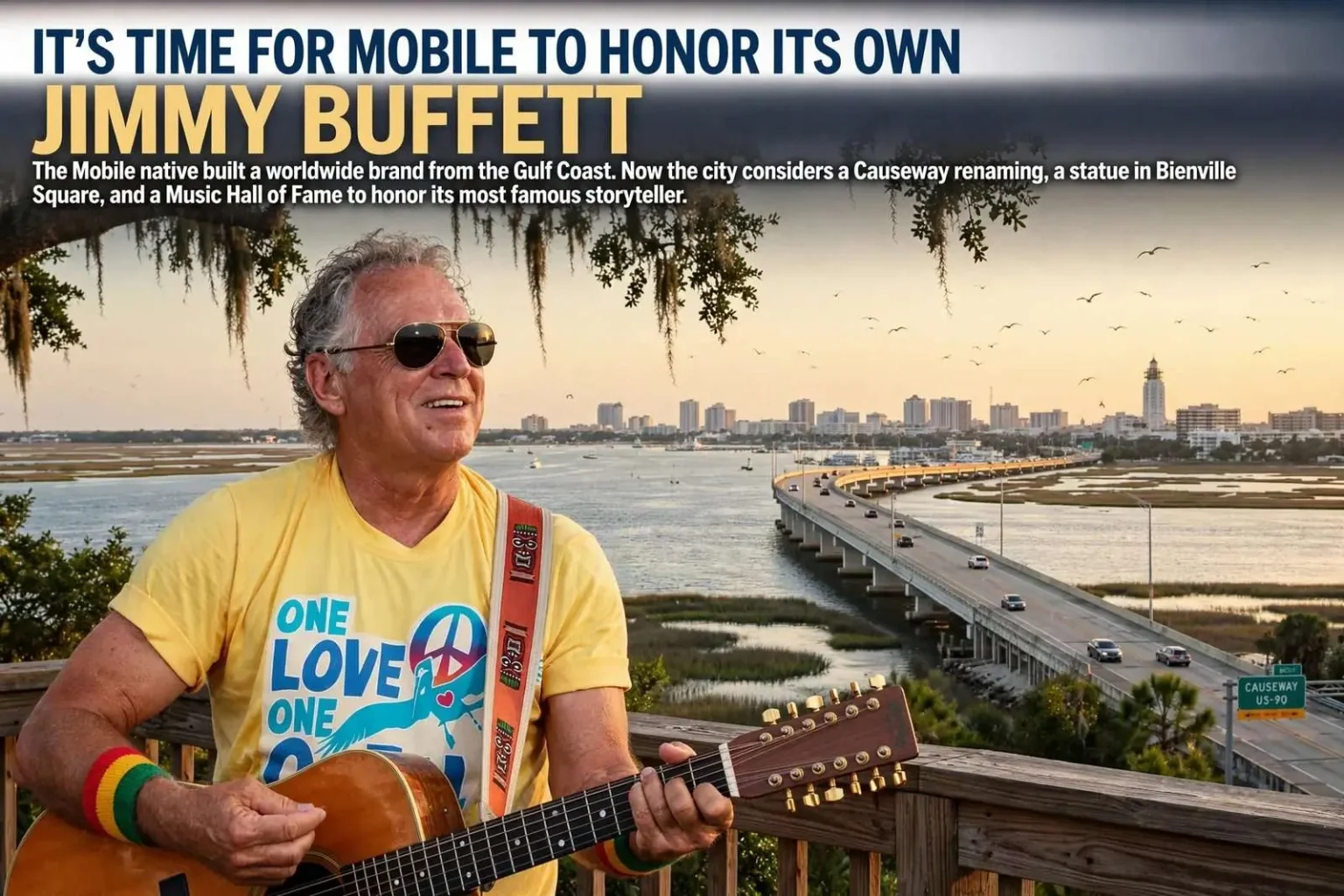
Watching Jimmy Buffett trade stories with David Letterman on national television is a reminder of something Mobile has been slow to act on: the city has yet to formally honor one of the most successful entertainers it has ever produced. Buffett, a Mobile native, has built a career that spans music, writing, business and theater, turning a laid-back, coastal-inspired sound into one of the most recognizable brands in American entertainment. Few performers from anywhere, let alone the Gulf Coast, can claim that kind of multi-decade reach across so many different fields. Yet Mobile, the city where his story began, has no lasting public tribute to show for it. That is worth changing.
The contrast between Buffett’s reach and Mobile’s silence grows sharper with each passing year. His songs have soundtracked decades of American summers, his books have spent weeks on national bestseller lists, his Margaritaville business ventures have grown into a worldwide brand of restaurants, resorts and licensed products, and his theatrical projects have carried his coastal storytelling to Broadway audiences. Audiences fill arenas and amphitheaters across the country generations after his first records, and the fans who follow him from show to show have become a cultural phenomenon of their own. For a city of Mobile’s size, the accomplishment is extraordinary — and it went unmarked in the entertainer’s hometown for far too long.
A Renamed Causeway
One straightforward idea already circulating among fans and civic-minded residents is renaming the Causeway after Buffett, giving one of the region’s most heavily traveled routes a name tied to a hometown success story instead of leaving it as a purely functional stretch of road. The Causeway — the low bridge and Parkway corridor that carries U.S. 90 across the upper end of Mobile Bay to the Eastern Shore — is driven by hundreds of thousands of commuters, tourists and cargo haulers every month, connecting downtown Mobile directly to Baldwin County’s beaches and neighborhoods.
Other cities have not hesitated to attach the names of local notables to prominent public infrastructure, and Mobile already has plenty of examples of streets, buildings and landmarks named for politicians and civic figures. A musician whose career has done as much as anyone’s to put Mobile’s name in front of a national audience seems like a reasonable candidate for the same treatment. Renaming a road costs almost nothing compared with building a monument, and the daily visibility of the name would do more to keep Buffett’s story part of the city’s conversation than any plaque tucked away in a museum case.
There is a certain poetry to the Causeway, too. It hugs the water, crossing open bay with the skyline behind and the shore ahead — the kind of landscape that runs through Buffett’s songwriting from the beginning. Drivers crossing the bay with the windows down already get an earful of gulls, salt air and boat traffic; a Buffett name on that route would simply match the scenery to the soundtrack.
A Statue in Bienville Square
A statue is another natural option. Bienville Square, long a gathering point in the heart of downtown Mobile, would be a fitting location for a public tribute to Buffett, giving residents and visitors alike a physical landmark tied to the city’s musical history. The park sits blocks from Dauphin Street’s nightlife, the convention district and the theaters that anchor downtown’s cultural life, and it already serves as the setting for festivals, lunch crowds and public gatherings.
A statue, unlike a road name, gives a city a place — a spot for photographs, a stop on a walking tour, a landmark that out-of-town fans can seek out. Cities across the country have found that tributes to musical figures become genuine draws, and Mobile’s historic downtown, with its oak-shaded squares and walkable blocks, is ideally suited to that kind of landmark. Buffett’s following is famously devoted; a tribute statue in his hometown would quickly find its way onto the itineraries of parrotheads passing through the region.
Why Stop at One Tribute? A Music Hall of Fame
Beyond a single statue or a renamed road, there is a broader case for Mobile to establish its own Music Hall of Fame. The city has a deep and often under-appreciated musical history, and a hall of fame would not need to start with an expensive building or dedicated headquarters. It could begin modestly, recognizing local musicians and the city’s contributions to American music, and grow from there.
Mobile’s musical roots run through gospel, blues, jazz, rhythm and blues, country and rock — traditions that grew up along the Gulf Coast and in the city’s churches, clubs and school bands. The city’s Mardi Gras celebrations, the oldest organized Carnival tradition in the United States, have always been inseparable from music, marching bands and the brass traditions that carried through the Gulf region. Generations of Mobile musicians have carried those sounds to New Orleans, Nashville, Muscle Shoals and beyond, even if the city itself has rarely claimed credit.
A hall of fame could honor that legacy in stages: a first class of inductees chosen by a local committee, plaques or exhibits hosted in existing downtown spaces, an annual induction ceremony timed to a festival weekend, and school programs that introduce students to the city’s musical past. Cities far smaller than Mobile have used exactly that model to build institutions that eventually earned permanent homes. The point is not architecture; it is recognition, and recognition can start with a committee and a ceremony.
Mobile already maintains a sports hall of fame to celebrate its athletic history; a parallel institution for music seems just as justified. The city has produced Hall of Fame athletes whose names are celebrated around the region, and its contributions to American sport are part of the civic pride residents learn early. Music has shaped the city’s identity just as deeply, yet no comparable institution exists to collect, preserve and celebrate it.
The Case Comes Down to Acknowledgment
None of this requires fans to agree on every note of Buffett’s catalog. What it does require is a basic acknowledgment that a hometown figure who has found this level of national success in music, writing, business and theater deserves more than passing recognition. The same acknowledgment extends to the wider history of Mobile music, which has influenced American culture far out of proportion to the attention it receives at home.
Civic recognition also carries practical benefits. Heritage tourism is a growth business, and travelers increasingly build trips around the homes, haunts and honors of cultural figures. A city that can point visitors to a Buffett landmark downtown adds a stop to the itinerary of every fan crossing the Gulf Coast, alongside the attractions the city already markets. Local businesses gain, the visitor bureaus gain a story to tell, and the artists who come after Buffett gain proof that Mobile celebrates its own.
How It Could Happen
Residents interested in seeing something come of these ideas would do well to raise them with local elected officials, who ultimately control what gets named, built or funded in Mobile’s public spaces. Renaming a public right-of-way requires action by city government, a statue on public land requires approval and, in many cases, private fundraising, and a hall of fame would need civic sponsors willing to organize it. None of those hurdles is unusual; they are the same steps every city has taken to honor the figures it values.
Private partners could carry much of the load. Local musicians, venue owners, restaurateurs and fans groups have both the motivation and the means to fund a statue or endow a hall of fame’s first exhibits. What such efforts have lacked so far is a starting signal — a civic body or community leader willing to convene the first meeting and put a proposal in front of the council.
Mobile has never been shy about claiming its native sons and daughters when they succeed elsewhere. It is past time the city put something permanent behind that pride. A road name, a statue in the square, a hall of fame that begins with a handful of plaques — any one of them would tell the world, and remind the city itself, that the Gulf Coast’s most famous storyteller learned to tell his stories here.
The timing argument also grows stronger with every year. Honors are best given while the honoree can see them, and Buffett remains active in every one of his fields — touring, writing and expanding the business empire that grew out of a Gulf Coast upbringing. Cities that wait for a legend’s passing to erect their tributes miss the chance to host the homecoming such recognition makes possible. A ceremony on the Causeway or in Bienville Square with the man himself on hand would be the kind of event Mobile does best: public, festive and by the water.
Until then, the disconnect remains an odd one for a city that markets its coastal culture to the world. The songs that made Buffett famous were written out of the same landscape Mobile calls home — bays, beaches, barroom stages and the endless summer of the Gulf. Honoring him would cost the city little and remind everyone, locals and visitors alike, that the biggest island-influenced act in American history started its journey on Mobile Bay.